
Local SEO for Architects: Dominate Your Area's Search Results
Whether you're a solo practitioner or running a multi-office firm, local search is where most of your potential clients start their journey. In 2025, when someone searches for an architect in their area, they expect to find relevant, credible professionals quickly. If you're not visible in those local results, you're losing work to competitors who are.
78%
of clients shortlist architects found online
44%
of local search clicks go to the 3-pack
88%
of local mobile searches lead to contact within 24 hours
500%+
growth in "near me" searches over 5 years
Key Takeaway
Local SEO for architects is not just about appearing in Google Maps. It's about building authority, trust, and visibility in your specific geographic market through optimised business profiles, genuine reviews, local citations, and strategic content. The architects with the strongest local presence—those who master Google Business Profile optimisation, accumulate authentic reviews, and maintain consistent NAP across directories—consistently attract more qualified leads and win more projects.
Why Local SEO Matters for Architects
Architects operate in a uniquely local business. Unlike many services that can be delivered remotely, architecture is geographically constrained. Clients need to meet you, understand your local market knowledge, and feel confident that you understand their region's planning regulations, building standards, and neighbourhood character.
The search behaviour backs this up. When potential clients search for architects, they almost always include a location modifier: "architects in Manchester," "London-based architectural firm," or simply "architects near me." The RIBA Find an Architect directory attracts 50,000+ users monthly—but that's just one channel. Google Local Search dominates, and if you're not optimised there, you're invisible to the majority of online searches.
Consider the scale of competition: the ARB registers 38,981 architects across the UK, but competition varies massively by location. In central London, you might face hundreds of ranked competitors. In smaller towns, you might be one of just three or four. Either way, local SEO gives you the edge to rank above generalist competitors and rank above architects who haven't optimised their online presence.
The stakes are high. 88% of local mobile searches result in a call or visit within 24 hours. This means that dominating local search isn't just about awareness—it's about immediate, conversion-ready traffic. Architects who appear in the Local 3-Pack (the three business results shown at the top of local search) capture 44% of all clicks on local SERPs. That's disproportionate authority concentrated in just three spots.
Google Business Profile Optimisation
Your Google Business Profile (GBP) is the single most important asset for local SEO. Google Business Profile is the #1 local ranking factor—more important than citations, reviews, or any other signal. A well-optimised profile can be the difference between appearing in the 3-Pack or disappearing into page two.
Claim and Complete Your Profile
If you haven't already claimed your business profile, start there. Navigate to Google Business, search for your business, and claim it. If your business is already listed (perhaps by a client or directory), claim it immediately to take control.
Completeness is a ranking signal. Fill in every field:
- Business name: Your registered business name (or trading name if more recognisable)
- Category: Choose "Architect" as your primary category, and secondary categories like "Building designer" or "Interior designer" if relevant
- Description: 750 characters of compelling, keyword-rich copy about your practice
- Service areas: Define the postcodes or suburbs you serve
- Phone and email: Direct contact numbers (not shared receptionists)
- Website: Link to your main architectural practice website
- Opening hours: Accurate, up-to-date hours
- Address: Street address (avoid PO boxes for architects)
- Attributes: Toggle relevant attributes like "Free consultations," "Accepts clients online," etc.
Photos and Visual Content
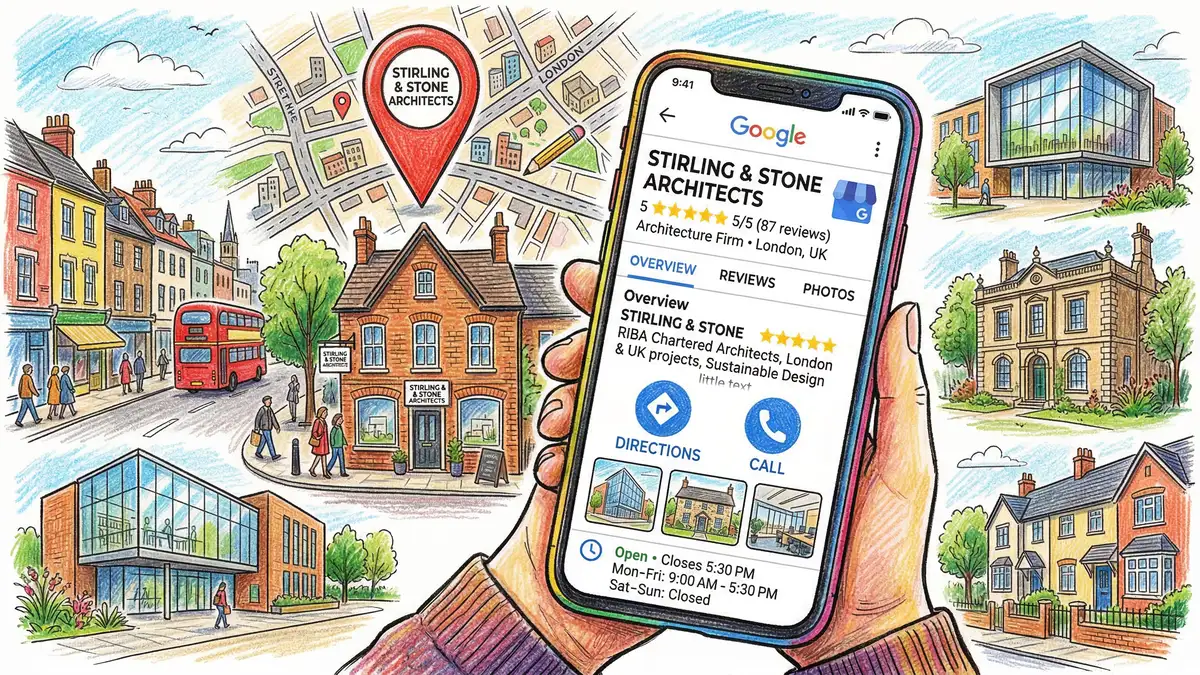
Photos are the second-most important element of your GBP after completeness. Google prioritises profiles with high-quality photos. Upload:
- 5–10 professional portfolio photos (your best completed projects)
- 2–3 office photos (interior and exterior)
- Team photos (humanises your practice)
- Process photos (design workshops, site visits, etc.)
Google favours businesses with consistent, regular photo uploads. Aim to add new photos monthly—especially project shots.
Google Business Profile Posts
Posts are a vastly underused local SEO tool. You can post directly to your GBP, and these appear in search results and maps. Post regularly about:
- New project completions
- Local planning updates or regulations
- Design trends relevant to your region
- Seasonal offers or promotions
- Team updates or new hires
Aim for at least one post per week. Each post should have a clear CTA (link to your website, book consultation, view portfolio, etc.).
Q&A Section
Monitor your GBP's Q&A section daily. Answer questions promptly and thoroughly. Common questions from potential clients might include "Do you offer 3D renders?", "What's your typical project timeline?", or "Do you handle planning applications?" Use these to highlight your unique value propositions.
Building Local Citations
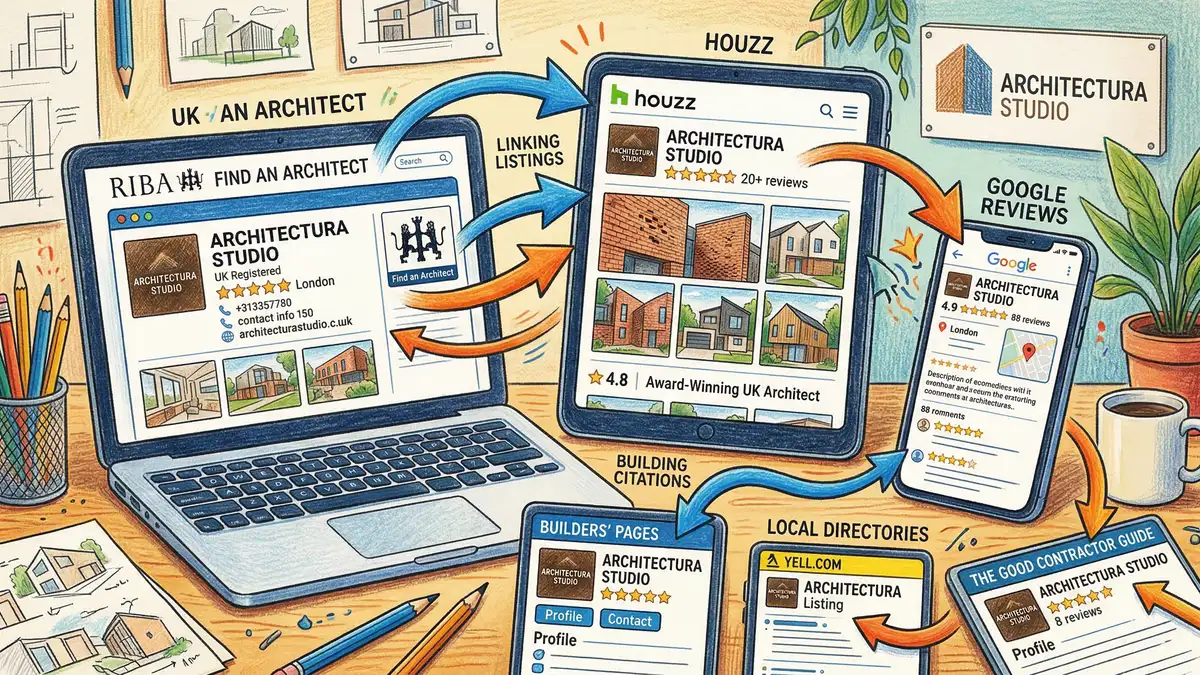
A citation is any online mention of your business name, address, and phone number (NAP). Citations tell Google that your business is real, established, and trusted. NAP consistency across 20+ directories is critical for local rankings.
UK-specific directories for architects are your priority. Getting listed in the right places not only helps SEO but also drives direct traffic and leads.
| Directory | Authority Level | Priority |
|---|---|---|
| RIBA Find an Architect | Very High | Critical |
| ARB Register (ARB) | Very High | Critical |
| Yell | High | High |
| Google Maps | Very High | Critical |
| Local Chamber of Commerce / Business Directory | Medium-High | High |
| BrightLocal / Local Citation Network | Medium | Medium |
| Local Planning Authority Website | Medium | Medium |
| Architectural Association / Professional Bodies | Medium-High | High |
RIBA and ARB are non-negotiable. If you're not listed in the RIBA Find an Architect directory or the ARB Register, you're leaving serious authority on the table. Both are high-authority, architecture-specific directories that Google trusts implicitly.
Consistency is critical. Ensure your NAP (Name, Address, Phone) is identical across all directories. Even small variations (e.g., "Ltd" vs. "Limited," "020 7123 4567" vs. "+44 20 7123 4567") can confuse Google and dilute your local authority. Use a citation audit tool to check consistency.
Want to dominate local search for your architecture practice? See our SEO for Architects service.
View SEO for ArchitectsReview Generation Strategy
Reviews are the #2 local ranking factor—and architects have a serious disadvantage here. The average architecture practice has 3–5 reviews on Google. Tradespersons have 20+. This gap costs you rankings and client confidence.
Reviews do two things:
- Rank you higher: Google explicitly favours businesses with more reviews and higher average ratings
- Convert prospects: 88% of consumers trust online reviews as much as personal recommendations. No reviews = no trust
How to Ask for Reviews
Architects rarely ask for reviews. That's your opportunity. After project completion or successful consultation, send a follow-up email with a direct link to your Google review request. Here's a template:
"Hi [Client], Thank you for choosing us for your [project type]. We loved working on [project name]. If we delivered the design and service you expected, would you mind leaving a quick review on Google? Your feedback helps other homeowners find us, and it only takes a minute. [GOOGLE REVIEW LINK]. Cheers, [Your name]"
Timing matters. Ask for reviews within 2–4 weeks of project completion, when the client is happiest. Don't ask immediately (they haven't experienced your service yet); don't wait too long (they'll have moved on mentally).
Review Platforms for Architects
Google Reviews
The most important platform. Directly impacts local rankings and appears in search results. Non-negotiable.
Houzz
Architecture-specific platform with high authority. Strong for residential/interior architects. Ranks for design-specific searches.
Trustpilot
Growing trust platform. Reviews appear in SERP snippets. Good for credibility.
RIBA Reviews
Architecture-specific but lower traffic. Still valuable for specialised authority.
Automate the process without being pushy. Integrate review requests into your project closeout workflow. CRM tools like HubSpot or Pipedrive can automate gentle reminder emails at optimal times.
Local Content Strategy
Local SEO isn't just about your Google Business Profile—it's also about creating content that proves your local expertise. This is where architecture firms have a massive competitive advantage: you have real, locally-relevant projects to showcase.
Location Pages
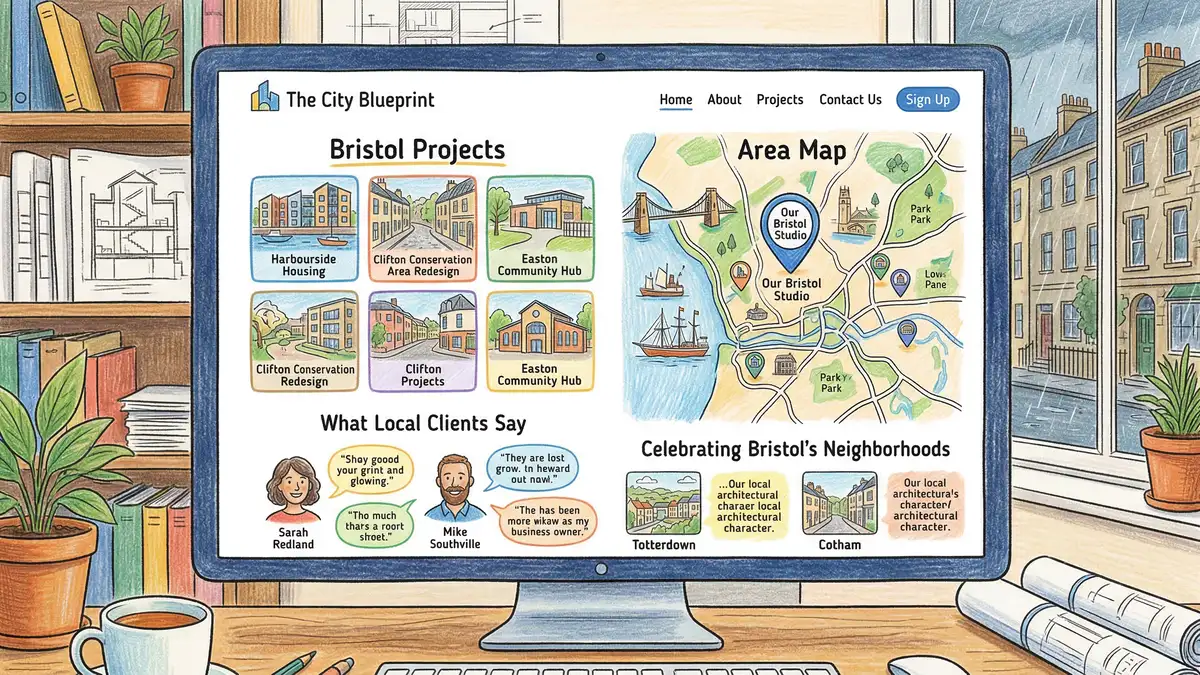
If you operate in multiple towns or cities, create a dedicated location page for each one. A location page should include:
- Local keyword phrases (e.g., "architect in Bristol," "architectural services in Bath")
- Brief description of the local area and what makes it unique
- Portfolio projects completed in that area
- Local planning information or building regulations specific to that area
- Embedded Google Map of the location
- Local contact info and office hours
- Links to local resources and building authorities
Location pages serve dual purposes: they rank for local searches AND they help Google understand the geographic scope of your practice. Multi-office firms should have one location page per office.
Project Case Studies with Local Data
Project case studies are content assets that rank for design-specific searches, but they're also local SEO assets. Structure case studies to include:
- Project location (with town/postcode in title)
- Local planning challenges overcome
- Local design context (heritage area considerations, planning policy, etc.)
- Before/after imagery
- Client testimonial or quote
- Timeline and budget (often searched by potential clients)
Publish case studies to your main site, but also to design-specific directories like Houzz. Each is a potential entry point for local + design searches.
Planning Data as Unique Local Content
Here's an untapped opportunity: planning application data. Your local authority publishes all planning applications and decisions publicly. You can repurpose this data into content that:
- Ranks for local planning searches ("planning decisions in [area]")
- Demonstrates local planning expertise
- Drives traffic from developers, property investors, and future clients
Create content like "2024 Planning Decisions in Chelsea: Trends and Lessons," or "Heritage Listing Impact on Planning: Case Studies from [Area]." Reference the government planning portal and local authority planning databases.
Local Link Building
Links from local websites boost your local authority. While national links still matter, Google gives extra weight to local links—particularly from high-authority local sources.
Local Press and Business Coverage
Pitch your completed projects to local news outlets, architecture blogs, and design media. Coverage usually results in a link and massive credibility boost. Angles might include:
- Award-winning project or design innovation
- Sustainable/green building story
- Heritage renovation or conservation project
- Local economic impact ("local architect creates jobs," etc.)
Community Partnerships
Partner with local community organisations, educational institutions, or non-profits. Sponsor a local event or provide free design consultation to a community project. The resulting press coverage and website links boost your local authority.
Chamber of Commerce and Business Networks
Join your local Chamber of Commerce or business association. Many publish member directories and feature member stories on their website. These links carry local weight.
Schema Markup for Local Architects
Schema markup helps Google understand your business structure, services, and local relevance. Implement the following schema types on your website:
LocalBusiness Schema
This tells Google you're a local business with specific attributes:
| Schema Field | What to Include |
|---|---|
| businessName | Your registered business name |
| address | Full street address, city, postcode |
| telephone | Direct phone number |
| url | Homepage URL |
| serviceArea | Postcodes or regions you serve |
| priceRange | £, ££, or £££ (optional but helpful) |
| image | Logo or professional photo of your practice |
| sameAs | Links to your social profiles and RIBA/ARB listings |
ProfessionalService Schema
Architects are professional service providers. Add ProfessionalService schema to signal your expertise and credibility.
AggregateOffer Schema
If you offer tiered services (hourly consultation, fixed-fee design, full project management), structure these with AggregateOffer schema so Google understands your service tiers.
Implement schema using JSON-LD, which is the easiest method and is Google's preferred format. Most modern website builders and CMS platforms include schema implementation tools.
Multi-Location SEO for Architecture Firms
If you operate multiple offices or serve multiple cities, multi-location SEO strategy is essential. Without it, you'll get cross-office ranking conflicts and cannibalistic SERPs.
Strategy for Multi-Office Firms
- One Google Business Profile per location: Create separate, independent GBP listings for each office. Do not try to manage multiple locations from one profile.
- Location-specific landing pages: Each location gets its own dedicated page on your main website, optimised for that location's keywords and services.
- Separate service area boundaries: In your GBP, clearly define the postcode areas each office serves. Avoid overlap.
- Local contact info: Each office should have its own phone number and email where possible. This helps Google differentiate them.
- Consistent branding, consistent NAP: While each location is separate, your business name, address format, and phone number format must be identical across all directories. Only the office identifier changes.
Prevent Ranking Cannibalism
Without careful structure, multiple locations can rank for each other's keywords, leading to poor user experience and lost rankings. Solution:
- Use internal linking to direct searchers to the correct location (e.g., "Our Manchester office" → Manchester location page)
- Implement hreflang tags if you have regional versions of your website (e.g., .co.uk/manchester vs. .co.uk/london)
- Make service area boundaries explicit in schema markup
Local SEO Audit Checklist
Use this step-by-step checklist to audit your current local SEO performance. Address gaps systematically.
Claim GBP
Claim your Google Business Profile and verify ownership. Ensure no duplicate listings exist.
Complete Profile
Fill every field in your GBP: description, categories, hours, attributes, and service areas. Add 5+ photos.
NAP Consistency
Audit your business name, address, and phone across 20+ directories. Correct any inconsistencies.
RIBA/ARB Listed
Ensure you're listed in both RIBA Find an Architect and the ARB Register. Update profiles if necessary.
Review Generation
Set up systematic review request emails. Aim for 3 new Google reviews per month minimum.
Schema Markup
Implement LocalBusiness and ProfessionalService schema on your homepage and location pages.
FAQ
Ready to Dominate Local Search for Architecture?
We help architecture firms build local search visibility that drives qualified project enquiries from your target areas.
Architect Marketing Hub
Clwyd Probert
Managing Director, Whitehat SEO
Clwyd has over 15 years of experience in digital marketing and SEO, helping professional services firms achieve sustainable organic growth through evidence-based strategies.
Sources: RIBA Find an Architect, ARB Register, Google Search Central, Statista local search studies, Professional Services Marketing Institute.