
Architect Marketing Costs & ROI: What to Budget in 2026
A data-driven guide to marketing budgets, channel breakdown, and expected returns for UK architecture firms of all sizes.
6%
Avg marketing spend as % of revenue (2026)
56%
Budget allocation to digital channels
5:1
Expected ROI from digital marketing
£50–£150
Cost per high-value lead
Key Takeaway
Architecture firms have increased marketing spend from 1.5% of revenue in 2020 to 6% in 2026. Digital channels now command 56% of budgets, with local SEO accounting for 30% of total marketing investment. A properly executed digital strategy delivers a 5:1 ROI, making strategic investment essential for growth.
How Much Should Architects Spend on Marketing?
The answer depends on your firm's stage and ambitions. Industry benchmarking data from RIBA shows that architecture firms typically allocate 4–6% of annual revenue to business development and marketing activities—a significant increase from the 1.5% average in 2020.
For context, if your practice generates £500,000 in annual fee income, you should budget £20,000–£30,000 per year for marketing (6% of £500k). Larger practices with £5 million in revenue might allocate £250,000–£300,000 annually.
The investment pays dividends: firms with well-structured digital marketing strategies report 5:1 ROI within 12–18 months. This means every £1 spent on marketing should generate approximately £5 in new project fees.
Marketing Cost Breakdown by Channel
Not all marketing channels deliver the same value. Here's how architecture firms typically allocate their budgets across channels, with realistic cost ranges for 2026:
| Channel | Monthly Cost Range | Annual Investment | Best For |
|---|---|---|---|
| Local SEO | £500–£1,500 | £6,000–£18,000 | Long-term organic visibility, local client acquisition |
| SEO Retainer | £500–£2,500 | £6,000–£30,000 | Technical SEO, content optimisation, monthly reporting |
| Content Marketing | £500–£2,000 | £6,000–£24,000 | Thought leadership, organic traffic, lead nurturing |
| Google Ads (PPC) | £500–£5,000 | £6,000–£60,000 | Quick visibility, commercial intent keywords, lead generation |
| Social Media Management | £300–£1,500 | £3,600–£18,000 | Brand awareness, portfolio showcase, community engagement |
| Professional Photography | £500–£2,000 | £2,500–£10,000 per project | Project documentation, portfolio quality, client credibility |
| Email Marketing | £100–£300 | £1,200–£3,600 | Client retention, nurture sequences, project updates |
| Paid Social (LinkedIn, Instagram) | £300–£1,000 | £3,600–£12,000 | Portfolio reach, B2B outreach, client testimonials |
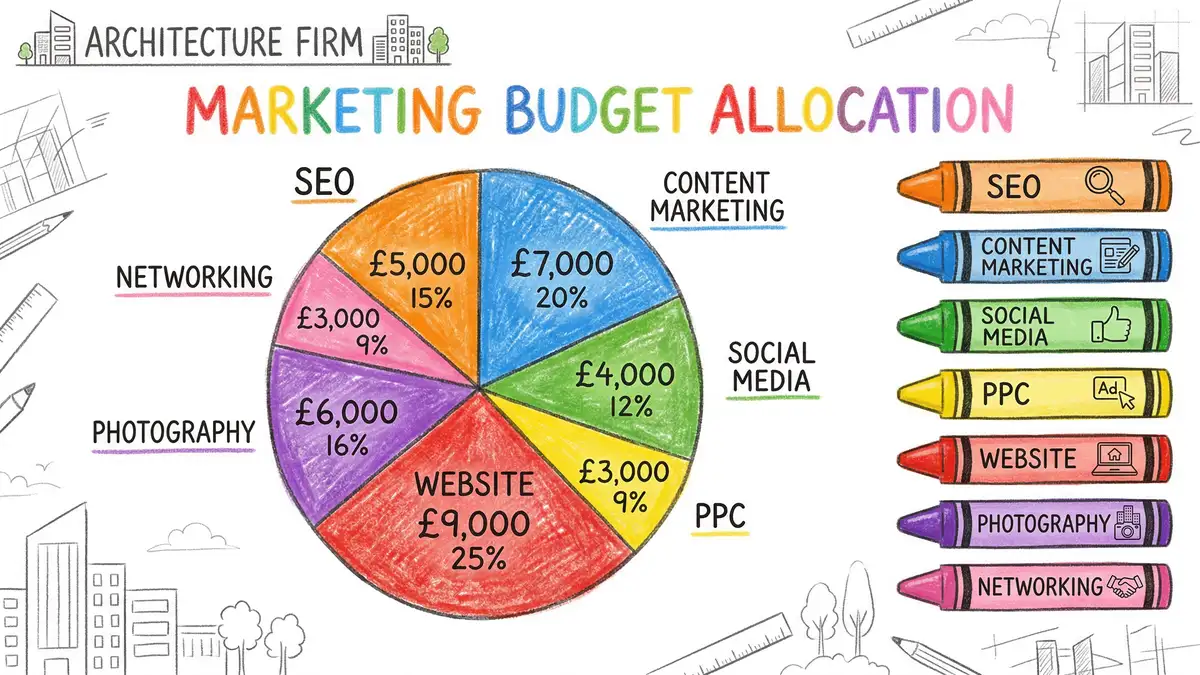
SEO & Content Marketing Costs
Search engine optimisation is the single highest-ROI channel for architecture firms. Local SEO commands 30% of total marketing investment because it directly targets prospects actively searching for "architects near me" or "architecture services in [city]."
SEO Retainer Costs (2026)
- Small practice (1–5 staff): £500–£1,200/month for technical SEO, keyword research, and content optimisation
- Mid-size practice (6–20 staff): £1,200–£2,500/month for comprehensive SEO, link building, and monthly reporting
- Large practice (20+ staff): £2,500–£5,000/month for enterprise SEO, multiple locations, and dedicated account management
Content Marketing
Regular blog content (1–2 posts/month) costs £500–£2,000 monthly depending on research depth and editorial polish. This supports SEO efforts and establishes thought leadership. A portfolio of 30–50 pieces of optimised content can generate 60–80% of your inbound leads within 12 months.
Want to understand the true ROI of marketing for your architecture practice? See our SEO for Architects service.
View SEO for ArchitectsWebsite Design & Development Costs
Your website is the foundation of digital marketing. Budget varies significantly by scope and complexity:
- Website redesign/refresh (small practice): £3,000–£15,000 — Modernising an existing site, improving UX, adding portfolio features
- Full website build (small–mid practice): £10,000–£30,000 — Custom design, portfolio functionality, client case study integration
- Enterprise website (large practice): £25,000–£50,000+ — Multi-office support, advanced filtering, 3D visualisation, project management integration
- Annual maintenance & hosting: £500–£3,000 — Security updates, backups, performance monitoring, content updates
Key investment areas: mobile responsiveness (essential—70% of architecture prospects browse on mobile), fast load times, and intuitive portfolio navigation. A site redesign should improve conversion rates by 20–30% within 6 months when paired with SEO and paid traffic.
Paid Advertising Budgets

Google Ads (Search)
Architecture firms typically spend £500–£5,000 per month on Google Ads, targeting high-intent keywords like "architect near [city]," "commercial architect," or "residential design services." Cost per click averages £1.50–£8.00 depending on competition and locality.
Minimum recommended budget: £500/month to generate meaningful lead volume. Expect 3–5 qualified leads per month at this spend level. Larger campaigns (£2,000–£5,000/month) attract 15–30 leads monthly, with cost per lead in the £50–£150 range for high-value B2B prospects.
LinkedIn Ads
Ideal for B2B outreach to corporate and institutional clients. Budgets typically range £300–£2,000/month. LinkedIn's targeting is premium (cost per click: £3–£10), but conversion quality is high for larger projects.
Instagram & Facebook Ads
Best for brand awareness and portfolio showcase. Budget £300–£1,000/month to reach design-conscious audiences. Lower cost per click (£0.50–£3), but conversion to leads requires strong portfolio presentation.
Agency vs In-House Marketing: Cost Comparison
Many architecture firms face a critical decision: hire an in-house marketing manager or outsource to an agency. Here's a realistic cost breakdown:
| Approach | Annual Cost | Staffing Cost (% of revenue) | Best For |
|---|---|---|---|
| In-House Marketing Manager | £35k–£55k salary | 3.5–5.5% of revenue | Practices with 50k–100k fee income; continuous brand management |
| In-House Senior Specialist | £50k–£75k salary | 5–7.5% of revenue | Larger firms wanting strategic control; multi-channel expertise |
| Marketing Agency (Full Service) | £1,500–£5,000/month | 2–6% of revenue | Smaller firms, scalability, specialist expertise, flexibility |
| Freelance Specialist | £300–£1,500/month | 0.5–1.8% of revenue | Single-channel focus (SEO, content, ads); limited scope |
| DIY / In-House Tools Only | £100–£500/month tools | Partner time investment (unquantified) | Very small practices, limited marketing ambitions |
Hidden in-house costs: Staffing typically consumes 61–64% of architecture firm revenue. Adding a marketing hire increases overhead significantly. You'll also need to budget for ongoing education, tools (HubSpot, Google Analytics, design software: £50–£300/month), and scale challenges as your marketer may lack specialist expertise in paid ads or technical SEO.
Agency advantage: Access to specialist teams (SEO, paid media, design, copywriting), economies of scale across clients, and flexibility to scale spend up/down. Most reputable agencies provide transparent monthly reporting tied to lead generation or website traffic KPIs.
Calculating Marketing ROI

ROI calculation is straightforward: (Revenue from marketing – Marketing cost) / Marketing cost × 100
Example: If you spend £20,000 on digital marketing and generate £100,000 in new project fees, your ROI is (£100k – £20k) / £20k × 100 = 400%.
Setting ROI Expectations by Channel
- SEO (6–12 month horizon): 4:1 to 8:1 ROI — Slow burn, but compounding returns as your content library grows
- Google Ads: 2:1 to 4:1 ROI — Immediate but dependent on campaign optimisation
- Content Marketing: 3:1 to 6:1 ROI — Medium-term, requires 12+ months to mature
- Social Media: 1:1 to 3:1 ROI — Highly variable; best for brand awareness than direct conversion
- Website Redesign: 2:1 to 5:1 ROI over 24 months — Conversion lift of 20–30% typical
Tracking Tools
Use Google Analytics 4, Google Search Console, and UTM parameters to track which channels generate leads and revenue. Most agencies provide monthly dashboards showing cost per lead, lead quality, and pipeline impact. Moore Kingston Smith's architecture sector benchmarking offers additional ROI context for UK practices.
Budget Allocation by Firm Size
Marketing budgets should scale with firm revenue and growth stage. Here are realistic 2026 allocations:
Sole Practitioner / 1–2 Staff
- Annual revenue: £50,000–£150,000
- Marketing budget: £2,500–£9,000 (5–6% of revenue)
- Recommended allocation: Website (£1,000), Local SEO retainer (£500–£800/month), LinkedIn/portfolio (DIY or £200–£300/month)
- ROI focus: SEO and referral marketing; minimal paid ad spend
Small Practice (3–10 Staff)
- Annual revenue: £150,000–£500,000
- Marketing budget: £9,000–£30,000 (6% of revenue)
- Recommended allocation: SEO retainer (£1,000–£1,500/month), Content (£500–£1,000/month), Google Ads (£300–£800/month), Social (£200–£500/month), Portfolio photography (£1,500–£3,000/year)
- ROI focus: Multi-channel approach; begin paid ads testing
Mid-Size Practice (11–30 Staff)
- Annual revenue: £500,000–£2,000,000
- Marketing budget: £30,000–£120,000 (6% of revenue)
- Recommended allocation: In-house marketing manager (£35k–£50k) OR agency retainer (£2,000–£4,000/month); content team (£1,000–£2,000/month); Google Ads (£800–£2,000/month); photography/video (£3,000–£10,000/year)
- ROI focus: Integrated campaigns; brand positioning; multi-location SEO
Large Practice (30+ Staff)
- Annual revenue: £2,000,000+
- Marketing budget: £120,000+ (6% of revenue, often higher)
- Recommended allocation: In-house team (£60k–£100k for manager + specialist roles); full-service agency partnership (£3,000–£8,000/month); content & thought leadership (£2,000–£5,000/month); advanced paid media (£2,000–£8,000/month); brand/rebranding projects (£5,000–£25,000 one-time)
- ROI focus: Integrated brand strategy; sector/service line specialisation; institutional relationships
12-Month Budget Planning Framework
Use this step-by-step approach to build your 2026 marketing budget:
Calculate Total Available Budget
Multiply your projected annual fee income by 6% (industry standard). Example: £600k revenue × 6% = £36k annual budget or £3,000/month.
Allocate Staffing First (If In-House)
If hiring an in-house marketer, deduct salary (£35k–£55k) before channel allocation. Remaining budget covers tools and paid media.
Prioritise SEO & Content
Allocate 40–50% to SEO retainer + content marketing. This is your long-term growth engine with highest ROI (4–8:1 over 12 months).
Budget for Paid Media
Allocate 20–30% to Google Ads and LinkedIn Ads. Start conservative (£500–£1,000/month) and scale based on cost-per-lead performance.
Set Aside Tools & Infrastructure
Budget 5–10% for software (HubSpot, Google Analytics, SEO tools: £100–£300/month), website hosting, and email platforms.
Contingency & Testing (10–15%)
Reserve funds for portfolio photography, video content, A/B testing, rebranding, or mid-year pivots based on performance data.
Monitor & Adjust Quarterly
Review ROI monthly. If a channel underperforms (cost per lead exceeds your target by 25%+), reallocate budget to higher-performing channels by Q2/Q3.
Plan for Growth Investment
Year 1 focuses on foundation (SEO, website, organic reach). Year 2+ allows for scaling proven channels (higher Google Ads budgets, expanded content, video).
Hidden Costs & Common Mistakes
Don't Let These Cost Overruns Derail Your Budget
- Scope creep: Website redesigns often exceed budgets by 25–50%. Lock scope early and avoid "nice-to-have" features (3D tours, custom animations) that delay launch and inflate costs.
- Inefficient ad spending: Poorly configured Google Ads campaigns burn budget fast. A £1,000/month campaign with bad targeting wastes £500+. Hire certified Google Ads specialists or agencies.
- Underestimating content production: High-quality blog articles (2,000+ words, optimised for SEO) cost £200–£600 each. Most content plans need 12–20 pieces annually (£2,400–£12,000).
- Tools & software bloat: Don't subscribe to every marketing tool. Stick to 3–5 essentials: analytics platform (Google Analytics, free), email (Mailchimp, free–£150/month), SEO tools (Ahrefs/Semrush, £80–£200/month), CRM (HubSpot Free–£500/month).
- Ignoring analytics setup: Poor GA4 configuration or missing UTM tags means you can't track which channels generate leads. Budget £500–£2,000 for proper analytics infrastructure at launch.
- Photography and video underbudgeting: One project photoshoot (4–8 hours) costs £500–£2,000. Firms need 3–5 shoots/year for fresh portfolio content. Video production (3–5 min case study): £2,000–£8,000.
- Rebranding surprises: A partial rebrand (logo, website update) costs £5,000–£15,000; full rebrand (identity system, collateral, messaging, website): £15,000–£50,000. Budget this separately from annual marketing spend.
Frequently Asked Questions
Ready to Invest Wisely in Your Architecture Firm's Marketing?
We help architects build marketing strategies that deliver measurable ROI and sustainable growth.
Related Resources for Architect Marketing
Complete guide to ranking higher in search results.
Multi-channel strategies for architecture firms.
Building websites that rank and convert.
Proven strategies to attract qualified prospects.
Dominate your geographic market.
Portfolio showcase and client engagement on social platforms.
Thought leadership and organic visibility through content.
Paid search strategies for immediate lead generation.
Central hub for all architect SEO resources and services.
Clwyd Probert
Managing Director, Whitehat SEO
Clwyd has over 15 years of experience in digital marketing and SEO, helping professional services firms achieve sustainable organic growth through evidence-based strategies.
Disclaimer: This article provides general marketing cost estimates and ROI guidance based on 2026 UK market data and industry benchmarks. Actual costs vary significantly by location, firm specialisation, market competitiveness, and specific scope of work. Figures referenced from RIBA business development guidelines, Moore Kingston Smith sector analysis, and DataForSEO research. This content is for informational purposes and should not be construed as financial or legal advice. Consult with a qualified marketing professional or accountant for costs specific to your practice. Whitehat SEO does not guarantee specific ROI results; outcomes depend on implementation quality, market conditions, and sustained effort over time.