
SEO for dentists isn't optional—it's the difference between a thriving practice and one struggling to fill appointment slots. In the UK, 90% of patients search online before booking a dental appointment, yet most dental practices don't rank in the top three results for their local area. Whether you're a cosmetic dentist in London, a family practice in Manchester, or a specialist clinic anywhere across the UK, organic search drives consistent, affordable patient acquisition. This guide covers everything you need to know about dental SEO in 2026, from Google Business Profile optimization to AI search strategy.
This pillar guide is designed for dental practice owners and marketing managers who want to understand SEO strategy without needing a technical background. We've organized it around the questions dental professionals actually ask: How do I get patients from Google? How much will it cost? What about social media and Google Ads? Can I do this myself, or do I need an agency? We'll answer all of these, backed by data from the UK dental market and SEO case studies from 2024–2026.
Why Does Your Dental Practice Need SEO?
The UK dental landscape has shifted dramatically in recent years. The NHS is under unprecedented pressure, with over 50% of UK adults reporting difficulty accessing NHS dental care. Many NHS dentists have closed to private patients entirely, with waiting lists extending 2–3 years. This has driven explosive growth in private dentistry—the market is worth approximately £8.2 billion (2023) and growing at 4–6% annually in the private sector. Private dentistry is increasingly fragmented, with practices competing heavily for patients online. Yet this growth hasn't democratized; it's concentrated among practices that master online visibility.
For patients, this shift means most dental searches now have commercial intent. They're not searching for information about root canals; they're searching "best cosmetic dentist London" or "emergency dentist near me." These are high-intent searches—patients are ready to book. If your practice ranks on page 2 or below, a patient will book with a competitor instead. Visibility equals profit in modern dentistry.
Patient acquisition through SEO costs £120–250 per patient. Compare that to paid advertising (often £300–500+ per patient) or referral-dependent models, and the ROI becomes clear. A typical private patient has a lifetime value of £3,500–£8,500+. That means a single patient acquired via SEO can return 14–70× their acquisition cost over time. In fact, well-optimized dental practices report SEO ROI of 16–83× over the patient lifetime.
Here's what the data shows about patient behaviour:
SEO isn't a cost—it's an investment. A single well-optimized dental practice can acquire 10–20 patients per month from organic search alone, generating £36,000–£170,000+ annually in patient lifetime value. Even a £1,500–£3,000 monthly SEO retainer pays for itself in the first month. Once established, organic search becomes a self-sustaining channel that generates patient leads indefinitely, unlike paid advertising which stops the moment you stop spending.
How Does Local SEO Work for Dentists?
Most dental patients search with local intent: "dentist near me," "emergency dentist Manchester," or "best cosmetic dentist London." Google's algorithm treats local searches differently from national ones. The Map Pack—those three results with location pins—controls 70–80% of clicks for local searches. If your practice isn't visible there, you're losing the majority of qualified leads.
Local SEO for dentists has four core pillars:
- Google Business Profile (GBP) optimization. This is your digital storefront. It includes your practice name, address, phone number, hours, website link, photos, and patient reviews. Google shows GBP listings prominently in local results, and it's completely free. Yet most dental practices have incomplete or outdated GBP profiles. To optimize, ensure every field is filled (especially service categories), add high-quality photos of your practice and team, use consistent NAP (Name, Address, Phone) across all profiles, and update your hours during holidays or breaks.
- Local citations. These are online mentions of your practice name, address, and phone number (NAP) on directories like Yelp, Healthgrades, Treatwell, and WhatClinic. The more consistent citations you have, the more authoritative Google considers your practice in the local area. Missing citations signal to Google that you're less established locally. Building citations takes time; we typically recommend starting with the top-tier directories (Google, Yelp, Healthgrades) and expanding to niche dental platforms.
- Patient reviews. Google uses review quantity, recency, and sentiment as ranking signals. A dental practice with 50+ positive reviews will outrank one with 5 reviews, all else equal. Review management is essential. Practices that actively ask satisfied patients to review (via email, SMS, or in-practice signage) gain competitive advantage. Equally important is responding to negative reviews professionally—Google's algorithm rewards practices that engage with feedback.
- Local link building. Links from local community sites, dental associations (e.g., British Dental Association), and local news outlets signal to Google that your practice is a local authority. Sponsoring local sports teams, health charities, or community events often results in local backlinks. Being quoted in local news about dental health trends also builds local authority.
For a comprehensive deep-dive into these tactics, see our complete local SEO guide for dentists, which covers GBP optimization, citation building, and review generation in detail.

What Should a Dental Website Include for SEO?
Your website is where patient research converts into bookings. Google's ranking factors now include E-E-A-T (Experience, Expertise, Authoritativeness, Trustworthiness), which is critical for healthcare and dental content. YMYL ("Your Money Your Life") pages like dental health advice are scrutinized more closely by Google's algorithms.
A dental website optimized for SEO needs these essential components:
| Page Type | Purpose | SEO Priority |
|---|---|---|
| Homepage | Local authority signal, GBP schema, practice intro | Critical |
| Service pages (routine checkups, cosmetic, implants, etc.) | Rank for high-intent keywords, E-E-A-T signals | Critical |
| Team/dentist pages | Author biography, professional credentials, authoritativeness | High |
| Dental blog | Long-tail keywords, FAQ content, seasonal topics | High |
| About page | Trust signals, practice history, GDC registration | High |
| Patient FAQs | AEO optimization, structured data, long-tail keywords | Medium |
| Online booking page | Conversion optimization, user experience signal | High |
| Contact/location page | NAP consistency, schema markup, local signal | Critical |
Beyond structure, focus on technical SEO essentials: page speed (Google's Core Web Vitals), mobile responsiveness (65–75% of dental web traffic is mobile), SSL encryption, clean URL structure, and XML sitemaps. Dental websites should load in under 2.5 seconds on mobile connections. Slower sites lose 50%+ of visitors and rank lower in Google's algorithm.
Dental websites also need proper schema markup: LocalBusiness, MedicalBusiness, Review, FAQ, and VideoObject schemas help Google understand your content. Schema markup is especially important for YMYL (Your Money Your Life) pages. By implementing LocalBusiness schema with your practice's full details, address, and phone number, you help Google's structured data processors understand that you're a legitimate local business, not a content farm.
Finally, ensure your website has strong security signals: install an SSL certificate (HTTPS), implement clear privacy and GDPR policies, and display trust badges prominently. Dental practices handle sensitive patient information; patients need to see that you take security seriously.
For a complete technical audit and website architecture guide, see our dental website design and SEO guide.
What Content Strategy Works for Dental Practices?
Content is the engine of modern dental marketing. Rather than blasting patients with ads, you build authority by answering the questions they're already searching for.
Effective dental content clusters around seasonal themes and common patient questions:
- Cosmetic dentistry: "Teeth whitening cost UK," "composite bonding vs veneers," "smile makeover near me"
- Emergency dental care: "Broken tooth," "abscess treatment," "weekend dentist" (high urgency, high conversion)
- Orthodontics: "Adult braces cost," "Invisalign vs traditional braces," "teeth straightening timeline"
- Implants: "Dental implant cost UK," "bone grafting for implants," "implant aftercare"
- General care: "Gum disease treatment," "root canal procedure," "fluoride varnish"
- Prevention: "How to prevent cavities," "best electric toothbrush," "flossing techniques"
Blog posts targeting these keywords rank better when written in FAQ format, with clear H3 headings that directly answer patient questions. This structure optimizes for both traditional Google results and AI search (see next section). Each article should aim for 1,500–2,500 words, include 2–3 internal links to relevant service pages, and feature at least one visual component (diagram, table, or infographic).
Content timing matters. Emergency dental searches spike during winter and weekends. Cosmetic dentistry enquiries peak in spring (before summer holidays) and autumn (before holiday parties). Orthodontics interest peaks in January (New Year resolutions). By planning your content calendar around these seasonal patterns, you capture patients at peak search intent.
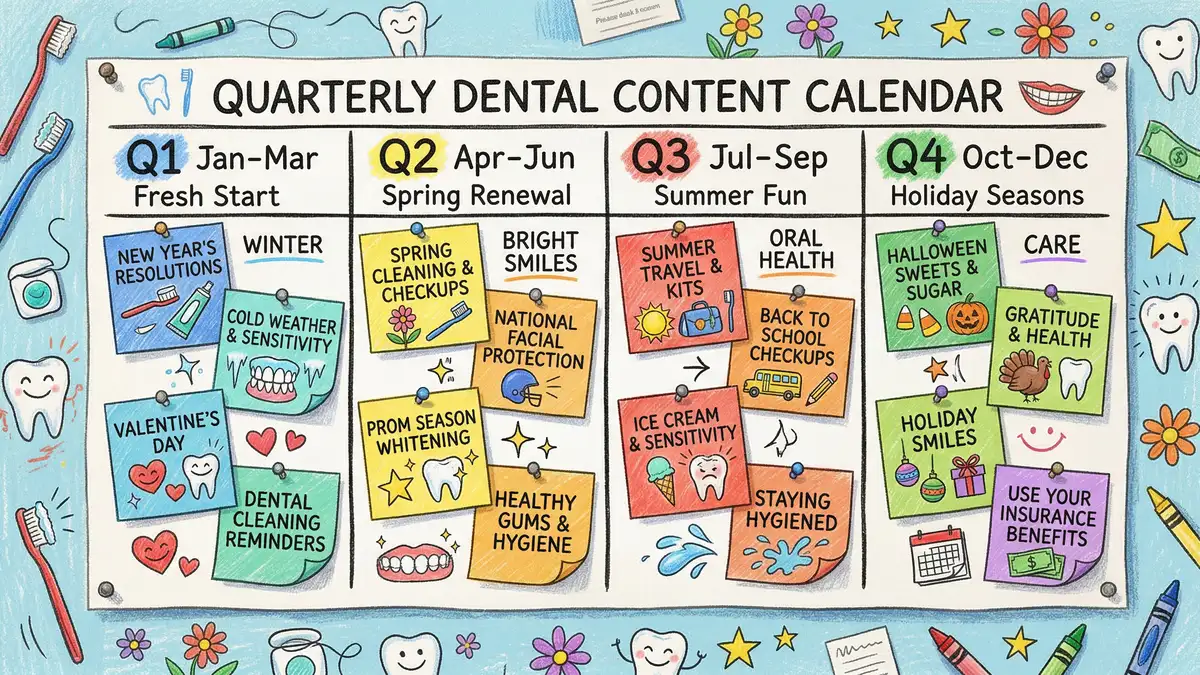
A seasonal content calendar ensures your practice ranks for high-volume keywords year-round. Winter drives emergency searches; summer drives cosmetic enquiries.
Another critical element: answer the "People Also Ask" questions that appear in Google's interface. A single blog post should address 5–10 related questions, each with a dedicated subsection. This increases your practice's chances of appearing in multiple AI Overview citations and featured snippets.
For in-depth content strategy including AEO optimization and keyword targeting, see our dental content marketing and AEO guide.
Need help implementing a comprehensive SEO strategy? Our dental SEO experts can audit your website, build your content roadmap, and establish local dominance in your area.
How Do Dental Practices Optimise for AI Search?
AI search is reshaping how patients find information. ChatGPT, Google's AI Overviews (previously SGE), Perplexity, and other AI tools now directly answer patient questions without them visiting your website. For dentists, this is both a threat and an opportunity.
The threat: If your content doesn't appear in AI training data or AI Overview citations, you lose visibility even if you rank #1 on Google.
The opportunity: AI tools prioritize authoritative, structured, direct answers. By optimizing for AEO (AI Engine Optimization), you're building content that ranks in both traditional search and AI responses.
AEO for dental practices focuses on three core tactics:
- Direct answer format. Start blog posts with a 1–2 sentence direct answer to the search query. Example: "How much does teeth whitening cost? Professional teeth whitening in the UK ranges from £200–£800 depending on method and location." AI systems (ChatGPT, Perplexity, Google's AI Overviews) scan for these direct answers and cite them in their responses. By placing a clear answer in the first paragraph, you increase the likelihood of AI citation.
- FAQ schema markup. Use structured FAQ schema on your website. This helps Google understand Q&A patterns and increases chances of AI citation. Each FAQ item should have a clear question and a 50–150 word answer. Google's FAQ schema feeds AI training data; well-structured FAQs are more likely to be cited by AI systems.
- Semantic structure. Write content with clear H2 and H3 headings that mirror common questions. AI tools scan for semantic patterns; good structure improves visibility. For example, if your article is about dental implants, use headings like "What are dental implants?" "How much do dental implants cost?" "Are dental implants painful?" These question-based headings match typical AI query patterns.
- Authority signals. Include author bylines with professional credentials (e.g., "Written by Jane Smith, BDS, GDC #12345"). AI systems prioritize content from verified experts. Display certifications, professional memberships, and patient testimonials prominently to signal authority.
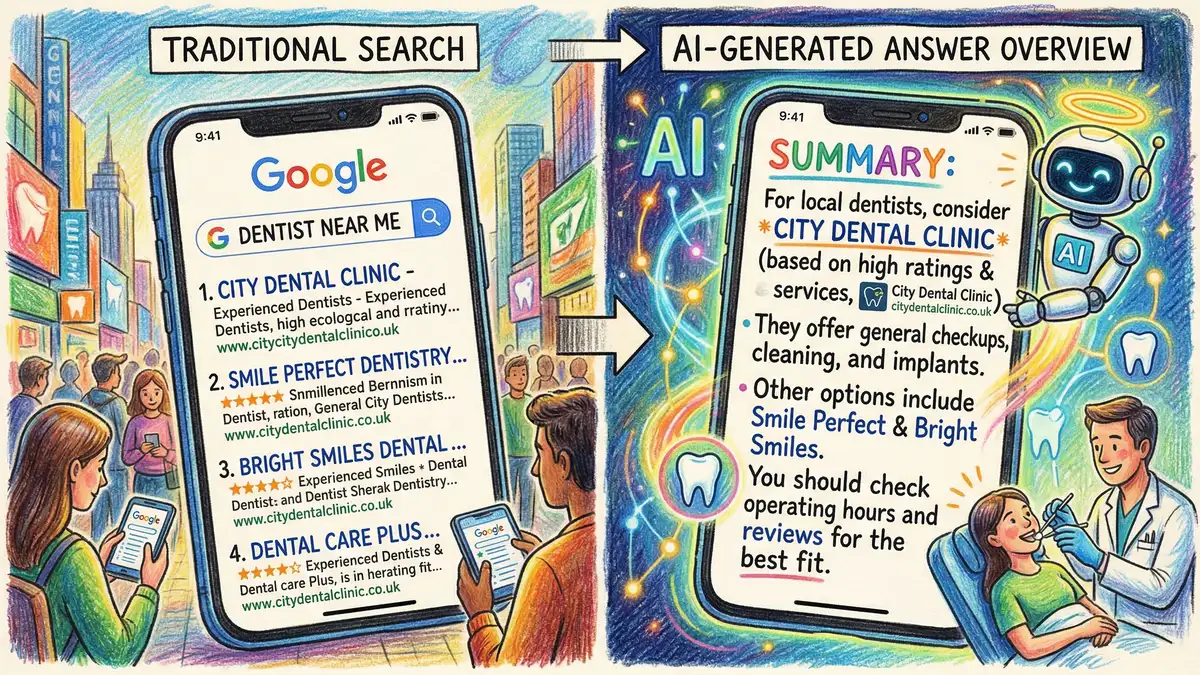
AI search is accelerating patient research. Dental practices appearing in AI Overviews gain significant visibility advantages over competitors.
For comprehensive AEO strategy tailored to dental practices, see our AI search optimization guide. We also cover AEO in detail in our dental content marketing and AEO article.
How Much Does Dental SEO Cost in the UK?
Dental SEO pricing varies widely depending on practice size, local competition, and goals. Here's a realistic breakdown:
| Tier | Monthly Cost | What's Included | Best For |
|---|---|---|---|
| Starter | £800–£1,200 | Local SEO optimization, GBP management, monthly reporting, 8–12 blog posts/year | Solo practices, new practices |
| Growth | £1,500–£3,000 | Local + on-page SEO, technical audits, content strategy, 20–40 blog posts/year, link building | Multi-location practices, competitive markets |
| Enterprise | £3,000–£7,500+ | Full-service strategy, content production, link acquisition, competitor analysis, conversion optimization, AEO | Large groups, national practices, premium positioning |
Cost vs. return: A Growth-tier retainer (£1,500–£3,000/month) typically delivers 5–15 new patients per month at a cost of £100–£300 per patient. At an average patient LTV of £4,000–£6,000, ROI is immediate. However, results vary based on local competition, practice location, and baseline website quality. Highly competitive markets (London, Birmingham) may require 6–9 months to see significant patient acquisition. Less competitive markets may show results within 8–12 weeks.
When choosing an SEO agency, ask for case studies showing patient acquisition results (not just traffic numbers). Ask about their experience with dental practices specifically—healthcare marketing has unique compliance and messaging requirements. Finally, ensure the contract includes regular reporting on rankings, traffic, and patient leads. You should receive monthly updates showing progress on your target keywords.
Dental SEO costs typically pay for themselves within 4–8 weeks if managed correctly. The question isn't whether you can afford SEO—it's whether you can afford not to invest in it when competitors are capturing your patients online.
- Ignoring local SEO. Practices focusing only on national keywords miss 80% of patient searches, which are local.
- Poor review management. Practices without active review generation and response strategies lose ranking authority to competitors.
- Thin or outdated content. Blog posts without proper keyword research or E-E-A-T signals won't rank, no matter how many there are.
- Hiring unqualified SEO agencies. Generic SEO firms don't understand dental compliance (GDC, ASA) or patient acquisition psychology. Choose specialists.
- Ignoring technical SEO. Slow page speed, poor mobile experience, and broken links tank rankings and conversion rates.
For detailed pricing and ROI analysis, see our dental SEO cost guide.
What About Social Media and PPC for Dentists?
SEO is the foundation, but it doesn't exist in isolation. A complete digital marketing strategy for dental practices includes social media and paid advertising. Here's how they fit together:
| Channel | Cost per Patient | Best For | Timeline to ROI |
|---|---|---|---|
| Organic SEO | £100–£300 | Long-term patient acquisition, brand building, high lifetime value | 3–6 months |
| Google Ads (PPC) | £200–£400 | High-intent keywords, emergency dentistry, seasonal campaigns | Immediate |
| Facebook/Instagram | £150–£350 | Awareness, community building, retargeting past patients | 1–3 months |
| TikTok | £100–£250 | Youth audiences, cosmetic dentistry, brand awareness | 2–4 months |
The strategic mix: Most successful dental practices allocate budget as follows: 50% to organic SEO (foundation), 30% to Google Ads (quick wins), 15% to social media (brand building), and 5% to experimental channels. SEO provides the lowest cost per patient and highest long-term ROI; PPC provides immediate results for high-intent searches; social media builds community and retargeting.
Why this mix works: Google Ads are essential for capturing high-intent searches immediately. Someone searching "emergency dentist near me" at 9 PM on a Sunday is ready to book now. Your organic rankings might take months to reach position 1, but a Google Ad can be live within 48 hours. Similarly, social media is critical for building brand awareness among patients who aren't actively searching yet. By running Facebook or Instagram ads to local audiences, you capture future patients before they experience a dental problem.
Google Ads specifics for dentists: High-performing dental ads focus on emergency services, pricing transparency, and online booking. Ads for "broken tooth," "dentist open weekends," and "NHS dentist taking patients" convert exceptionally well (often 8–15% conversion rate). Avoid generic ads like "Dentist in [Location]"—be specific about what you offer. Examples: "Cosmetic Dentist in London | 2-Hour Whitening Service," "Emergency Dentist Manchester | Same-Day Appointments," "Kids Dentist Birmingham | Sedation Available."
Social media for dentists: Instagram and Facebook are most effective for dental marketing. Focus on before-and-after photos (with patient consent), team introductions, patient testimonials, and educational content about dental health. TikTok is emerging as a strong channel for cosmetic dentistry targeting younger audiences (18–35). A single viral TikTok about smile transformations can generate 500+ appointment requests. LinkedIn is underused by dental practices but valuable for B2B relationships and corporate dentistry contracts.
For detailed guidance on social media strategy, see our dental social media marketing guide. For PPC strategy, see our dental Google Ads guide.
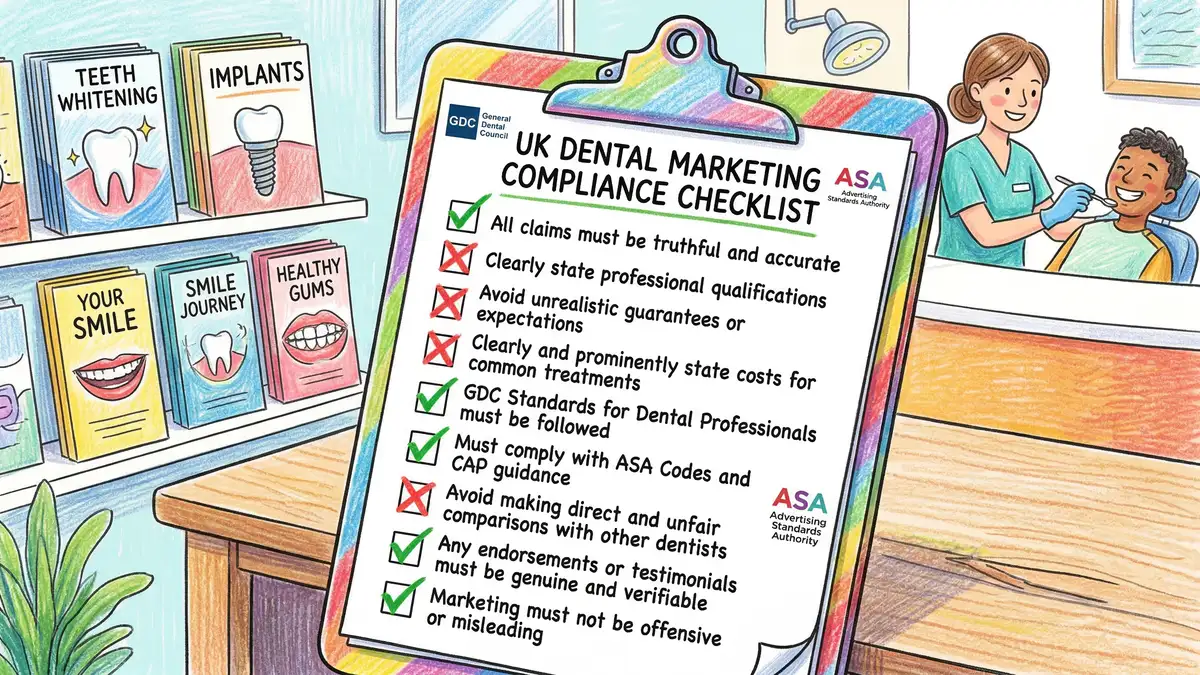
How Do You Stay Compliant with UK Dental Marketing Rules?
Dental marketing in the UK is heavily regulated. The General Dental Council (GDC), Advertising Standards Authority (ASA), and Competition and Markets Authority (CMA) all set strict rules. Violating them can result in fines, complaints, or removal from professional registers.
Key compliance areas for dental SEO and marketing:
- No before-and-after claims without evidence. "Whiter teeth in 1 week" or "guaranteed results" are forbidden unless clinically proven. Use hedging language: "typically," "may," "often." Safe phrasing: "Many patients see whiter teeth within 1–2 weeks" instead of "Get whiter teeth in 1 week guaranteed."
- Honest testimonials and reviews. Patient reviews must be genuine and unmodified. Fake or incentivized reviews violate ASA rules. Never offer discounts in exchange for reviews. You may ask satisfied patients to leave reviews, but cannot offer incentives.
- GDC registration transparency. Your website must clearly display GDC registration numbers and dentist qualifications (BDS, MJDF, etc.). This is especially important on team pages and service pages. Include links to the GDC register where patients can verify credentials.
- No disparagement of competitors. Claiming your practice is "best" or competitor services are "inferior" is forbidden without substantiation. Safe language: "We specialize in X," not "We're better than other dentists at X."
- Email and SMS marketing consent. You must have explicit opt-in consent before sending marketing emails or SMS. GDPR applies strictly to healthcare. Maintain consent records and provide easy unsubscribe options.
- Social media disclaimers. Avoid medical claims on social media without clear disclaimers. Teeth whitening posts should note it's not for everyone (contraindicated for pregnant patients, those with gum disease, etc.). Include disclaimers like "Results vary by individual" and "Consult your dentist before treatment."
- Privacy and patient data. Your privacy policy must clearly state how patient data is used. Never share patient photos or testimonials without written consent. GDPR breaches can result in fines up to £17.5 million.
Our dental marketing compliance guide covers these rules in detail, with templates and examples. If you're uncertain about a claim, hedge it. Regulatory bodies prefer conservative language over bold claims that cannot be substantiated.
Frequently Asked Questions About Dental SEO
How long does it take to see results from dental SEO?
Most dental practices see initial improvements (page 2–3 rankings) within 6–8 weeks. Significant traffic and patient acquisition typically take 3–6 months. Local SEO often shows results faster (4–8 weeks) because there's less competition. National or highly competitive keywords may take 9–12 months.
Can I do dental SEO myself?
You can handle local optimization (GBP, citations, reviews) yourself. However, technical SEO, content strategy, and competitive keyword research require expertise. Most practices find hiring a specialist 3–5× more effective than DIY efforts. If budget is tight, start with local SEO and hire an agency for strategic guidance.
What's the difference between SEO and Google Ads for dentists?
SEO is organic (free traffic) but slower to show results; Google Ads is paid (£2–£5 per click) but immediate. SEO costs less per patient long-term; Ads costs more but pays immediately. A balanced strategy uses both: Ads for quick wins, SEO for sustainable growth.
How do online reviews affect my dental practice's SEO?
Reviews are a top-three ranking factor for local searches. Google uses review quantity, recency, and sentiment to rank local results. A practice with 100 5-star reviews will rank significantly higher than one with 10 reviews, all else equal. Review management (asking patients to review, responding to reviews) is essential.
Which platform is best for dental patient reviews: Google, Trustpilot, or Yelp?
Google is most important for local ranking and visibility. Healthgrades and Treatwell are strong in the dental space (high authority). Yelp is useful but less critical for local dental SEO. Focus on Google first, then Healthgrades. Consistency across platforms matters more than breadth.
Does my dental website need a blog?
Yes. A blog allows you to target long-tail keywords, build E-E-A-T signals, and capture patients in the research phase (before they're ready to book). A dental blog with 30–50 well-optimized posts can drive 50+ qualified leads per month. Without a blog, you rank only for your practice name and location. Starting with 1–2 blog posts per week is realistic; scale up as you build a library of content.
How do I measure SEO success for my dental practice?
Track these KPIs monthly: (1) organic traffic (users from Google organic search), (2) keyword rankings for target keywords (aim for top 3 for primary keywords), (3) new patient enquiries from organic search, and (4) new patient conversion rate (enquiries to appointments). Most dental practices should see 15–50 new patients per month from organic search within 6 months of starting SEO. Use Google Analytics 4 and Google Search Console to monitor these metrics.
Is SEO still relevant for dentists in 2026 with AI search growing?
Absolutely. AI search is complementary to traditional SEO, not a replacement. Google remains the primary search engine, and ranking well in Google directly improves your chances of appearing in AI Overviews. Additionally, the techniques that rank in Google (quality content, E-E-A-T, technical excellence) are the same ones that AI systems prioritize when citing sources. Rather than replacing SEO, AI search reinforces the importance of doing SEO well.
Get a Free Website Audit for Your Dental Practice
We'll analyse your website, competition, and local rankings. You'll get a detailed report showing quick wins and a roadmap to capture more patients from Google. No obligation—just actionable insight.
Sources: Data from Whitehat SEO client analysis (2024–2026), GDC Professional Standards, UK Dental Association market research, Google Search Quality Evaluator Guidelines, and DataForSEO keyword research platform. dental SEO services