
Dental practices across the UK invest between £500 and £5,000+ per month on SEO — a range wide enough to be meaningless without context. Whether you're a single-surgery practice in Cardiff or a five-location group across London, the right SEO investment depends on your growth targets, competitive landscape, and the services you offer. This guide breaks down exactly what dental SEO costs in 2026, what you should receive at each price point, and how to calculate whether the investment delivers a genuine return.
If you've been quoted £150 per month by one provider and £3,000 by another, the difference isn't arbitrary — it reflects fundamentally different approaches, and understanding those differences protects your practice from wasted spend.
£800–£2,000
Typical Monthly Retainer
Most UK dental practices
£2,500–£8,000+
Patient Lifetime Value
Private dental (routine to cosmetic)
3–6 Months
Time to Measurable Results
Organic traffic growth timeline
8–12x
Typical Annual ROI
Based on patient acquisition value
Sources: UK SEO agency benchmarking data 2024–2025, British Dental Association practice profitability reports 2024
How Much Does Dental SEO Cost Per Month in the UK?
Dental SEO pricing in the UK falls into four broad tiers, each reflecting a fundamentally different level of service. The price you pay determines not just the quantity of work but the strategic depth, specialisation, and results you can realistically expect.

| Price Tier | Provider Type | What's Included | Best For |
|---|---|---|---|
| £300–600/mo | Freelancer / budget | On-page optimisation, keyword tracking, basic Google Business Profile management. No content creation or link building. | Practices with in-house marketing resource needing specialist guidance |
| £600–1,200/mo | Small agency (2–5 staff) | On-page + local SEO, 4–8 blog posts per year, citation building, GBP optimisation, quarterly reporting. | Single-location practices wanting steady organic growth |
| £1,200–2,500/mo | Mid-market agency (5–15 staff) | Technical SEO, 12–16 content pieces annually, proactive link building, conversion optimisation, monthly strategy calls, dedicated account manager. | Growth-focused practices competing in mid-to-high competition areas |
| £2,500–5,000+/mo | Specialist dental SEO agency | Full-service: content strategy, advanced technical SEO, editorial link building, schema markup, PPC integration, conversion tracking, quarterly business reviews. | Multi-location groups or high-value cosmetic/implant practices |
Sources: UK digital marketing agency benchmarking surveys 2024–2025
Dental SEO typically commands a 15–35% premium over generic local SEO because providers need regulatory knowledge (GDC, ASA, CMA compliance), clinical content expertise, and an understanding of higher-value patient acquisition journeys. Geography matters too — London and the South East carry a 20–40% premium over regional pricing, reflecting both higher patient values and more competitive search results.
What Services Are Included in a Dental SEO Package?
Understanding what you're paying for prevents the most common mistake in dental SEO procurement: comparing headline prices without comparing scope. A £500/month package and a £1,500/month package might both be labelled "dental SEO" while delivering fundamentally different services.

Local SEO and Google Business Profile forms the foundation for any dental practice. This includes GBP optimisation (£300–800 one-off setup, then £100–300/month for ongoing management), citation building across healthcare directories (£200–600/month in 3–6 month cycles), and review generation strategy. For most single-location practices, local SEO alone can drive significant patient enquiries.
Technical SEO covers site speed, mobile responsiveness, schema markup, crawl error resolution, and Core Web Vitals optimisation. A standalone audit costs £600–2,500 depending on site complexity; ongoing monitoring runs £300–800/month and is typically bundled into mid-tier retainers. Practices running on older dental website platforms often need substantial technical work upfront.
Content creation ranges from £150–400 per blog post to £400–900 for comprehensive pillar content. A mid-market dental SEO package typically includes 12–16 pieces annually — blog posts, service page updates, and local landing pages. Quality matters enormously here: clinical content requires accuracy, E-E-A-T signals, and regulatory compliance that generic content writers rarely deliver.
Link building costs £200–500 per quality link from niche-relevant sites. Budget providers offering links at £50–100 each typically source them from private blog networks or low-quality directories — a strategy that risks Google penalties rather than building lasting authority.
How Do You Calculate ROI on Dental SEO Investment?
The maths behind dental SEO ROI is more favourable than most practice owners realise, primarily because patient lifetime value far exceeds acquisition cost. A private dental patient typically generates £2,500–£4,500 in revenue over a 5–7 year relationship through routine check-ups and treatments — and that figure rises to £8,000–25,000+ for patients seeking cosmetic or implant work.
| Acquisition Channel | Cost Per Patient | Lead Quality | Sustainability |
|---|---|---|---|
| Organic SEO | £80–250 | High (active searchers) | Compounds over time; results persist after investment |
| Google Ads (PPC) | £60–180 | Medium-high (intent-driven) | Stops immediately when spend stops |
| Social media ads | £40–120 | Lower (awareness stage) | Requires ongoing spend; lower conversion rate |
| Referrals | £0–30 | Highest (trusted recommendation) | Difficult to scale deliberately |
Sources: UK dental marketing case studies 2024–2025, Google Ads UK healthcare benchmarks
Example ROI calculation: A practice investing £1,500/month in SEO that acquires 8 new patients monthly through organic search is paying £187.50 per acquisition. With a conservative patient LTV of £3,000, those 8 patients represent £24,000 in lifetime revenue — a 16:1 return on monthly investment. Even accounting for the 3–6 month ramp-up period before results compound, the first-year ROI typically reaches 8–12x.
The Bottom Line
Most dental practices need just 2–4 new patients per month from SEO to break even on a £1,000–1,500 monthly retainer — and a well-executed strategy should deliver considerably more within 6–12 months. The critical variable isn't the monthly cost but the lifetime value of each patient acquired.
Want to see what dental SEO could deliver for your practice? Our team specialises in SEO services for dental practices across the UK.
View Our SEO ServicesWhat Are the Red Flags When Choosing a Dental SEO Provider?
The dental SEO market includes providers ranging from genuine specialists to operations that deliver negligible value. Knowing the warning signs protects your practice from wasting months of budget and potentially damaging your search visibility.
Warning: The £99–199/Month Trap
What you're actually getting: Automated reporting dashboards, templated content rewritten from other dental sites, and bulk directory submissions shared across dozens of clients. No custom strategy, no clinical content review, no compliance checks.
The real cost: A practice spending £150/month on ineffective SEO for 12 months has wasted £1,800 and lost a year of potential organic patient growth worth £30,000–50,000+ in lifetime revenue.
Guaranteed rankings remain the clearest red flag. No provider can guarantee specific Google positions — search algorithms change constantly, and Google itself warns against providers making such claims. Legitimate agencies set realistic expectations: measurable traffic growth within 3–6 months, not "guaranteed page one in 30 days."
No healthcare specialisation means the provider lacks understanding of GDC advertising standards, ASA compliance requirements, and CMA rules on healthcare marketing. Dental content that makes unsubstantiated treatment claims can trigger regulatory investigations, not just poor rankings.
Excessive link-building claims — any provider promising 50+ links per month at low cost is almost certainly using private blog networks (PBNs) or spam directories. These links initially boost rankings but typically result in Google penalties that collapse your visibility entirely. Quality link building for dental practices means 5–15 editorial placements monthly from relevant healthcare and local authority sites.
Lock-in contracts of 12–24 months with no exit clause should raise immediate concerns. The industry standard is a 3-month initial commitment followed by month-to-month rolling terms with 30 days' notice. Providers confident in their results don't need contractual lock-in to retain clients.
How Should a Dental Practice Allocate Its Marketing Budget?
UK dental practices typically allocate 3–8% of revenue to marketing, with the percentage increasing for growth-focused or newly established practices. The critical decision isn't the total spend but the channel allocation within that budget.
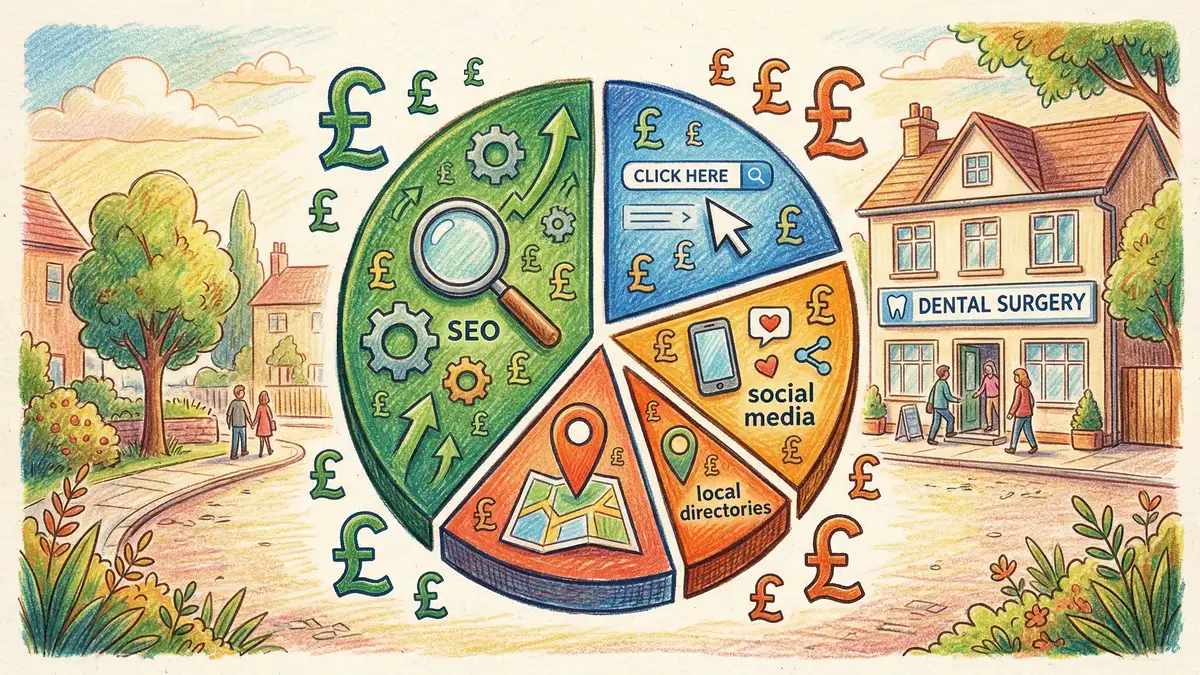
For most dental practices, digital marketing should represent 60–75% of the total marketing budget, with SEO commanding the largest share. A practical allocation for a single-location practice with a £2,000/month digital budget: £1,000–1,200 on SEO (50–60%), £400–600 on Google Ads (20–30%), £200–400 on social media (10–20%), and £200–300 on local directories and citations (10–15%).
Multi-location practices benefit from economies of scale — shared content strategy and centralised technical SEO reduce the cost per location by roughly 40%. A five-location group spending £5,000/month on SEO pays effectively £1,000 per location rather than the £1,500–2,000 each would need independently.
When to increase spend: If you've hired a new associate with unfilled appointment slots, competitors are aggressively entering your area, or you're launching high-value services (implants, Invisalign, cosmetic dentistry). When to reduce: If your practice is at 90%+ capacity with a 3-month waiting list, or if you're temporarily closed for renovation. Even during a reduction, maintaining a baseline SEO retainer prevents losing the compounding organic visibility you've built.
How Long Does It Take to See Results from Dental SEO?
Setting realistic expectations prevents the most common reason dental practices abandon SEO prematurely — expecting PPC-speed results from an organic strategy.
Month 1–2: Foundation
Technical audit, strategy development, on-page optimisation, and content production begin. Minimal visible changes in rankings or traffic. This phase is essential — skipping it leads to unfocused work that wastes later months.
Month 3–4: Early Growth
First ranking improvements appear. Organic traffic begins growing 10–30%. New content starts indexing and ranking for target keywords. Local SEO signals strengthen as citations build and GBP optimisation takes effect.
Month 5–8: Acceleration
New patient enquiry volume increases 20–50%. Content and link building create compounding effects. Multiple service pages rank in the top 10 for target keywords. This is where SEO's cumulative advantage over paid advertising becomes measurable.
Month 9–12: ROI Positive
Retained patients from earlier months deliver consistent revenue. New patient acquisition from organic search stabilises at a sustainable level. The practice reaches positive ROI — and unlike PPC, the organic traffic continues even if investment levels temporarily reduce.

What Questions Should You Ask Before Signing Up?
The quality of your dental SEO provider determines the quality of your results. These six questions separate specialist providers from generalists reselling off-the-shelf packages.
"How many dental practices do you currently work with?" — A credible dental SEO provider should be able to reference multiple dental clients (anonymised if needed). The healthcare advertising landscape is sufficiently different from retail, trades, or e-commerce that general SEO experience alone isn't enough.
"What results can we realistically expect at 3, 6, and 12 months?" — Listen for specific, measurable projections tied to your baseline data, not vague promises. A good provider will want to audit your current performance before committing to forecasts.
"How do you ensure GDC and ASA compliance?" — If the provider can't discuss dental marketing regulation fluently, they're not a dental specialist. Content making unsubstantiated treatment claims creates regulatory risk for the practice owner, not the agency.
"What does your monthly reporting include?" — Expect organic traffic trends, keyword ranking movements, conversion metrics (form submissions, phone calls), and cost-per-acquisition calculations. Providers who report only on vanity metrics like "backlinks built" or "pages optimised" aren't tracking business outcomes.
"What is your link-building approach?" — The answer should reference editorial outreach, industry publications, and local authority sites — not bulk directory submission or purchased placements. Ask to see examples of links they've built for other dental clients.
"What are your contract terms?" — Industry standard: 3-month initial commitment, month-to-month thereafter, 30 days' notice. Any provider requiring 12+ months upfront with substantial cancellation penalties is prioritising lock-in over performance.
Frequently Asked Questions
How much should a single dental practice spend on SEO per month?
A single-location dental practice should typically invest £800–1,500 per month for comprehensive SEO covering technical optimisation, content creation, local SEO, and monthly reporting. Practices in competitive urban areas or those offering high-value treatments (implants, cosmetic dentistry) may need £1,500–2,500 to compete effectively. Spending below £500/month rarely delivers meaningful results because it's insufficient for the combination of technical work, content, and link building that dental SEO requires.
Is dental SEO more expensive than SEO for other industries?
Yes — dental SEO typically costs 15–35% more than general local SEO for trades or retail businesses. The premium reflects the regulatory knowledge required (GDC, ASA, CMA compliance), the need for clinically accurate content, and the higher patient lifetime values that justify greater investment. However, the ROI is also proportionally higher because dental patient acquisition values significantly exceed most other local service businesses.
Can I do dental SEO myself instead of hiring an agency?
Practice owners can handle some elements — particularly Google Business Profile optimisation, review management, and basic blog content. However, technical SEO, strategic link building, schema markup implementation, and competitive keyword analysis require specialist tools (typically costing £200–400/month in software alone) and expertise that takes years to develop. Most practices find that DIY SEO produces slower results and that the practice owner's time is more valuably spent on clinical work.
What's the difference between SEO and PPC for dental practices?
SEO builds long-term organic visibility that compounds over time and continues delivering patients even if you reduce investment. PPC (Google Ads) generates immediate enquiries but stops the moment you stop spending. Most dental practices benefit from both: PPC for immediate patient flow while SEO builds, then gradually shifting budget toward organic as SEO results compound. A typical hybrid approach allocates 50–60% to SEO and 20–30% to PPC.
How do I know if my dental SEO provider is delivering results?
Track four metrics monthly using GA4 and Google Search Console: organic traffic growth (should increase 5–15% month-on-month after month 3), keyword rankings (more keywords entering the top 10), enquiry volume (form submissions and phone calls from organic visitors), and cost per patient acquisition (monthly SEO cost divided by new patients attributed to organic search). If none of these metrics improve after 6 months, the provider isn't delivering.
Should I pay setup fees for dental SEO?
Reasonable setup fees of £500–1,500 covering a comprehensive technical audit, competitive analysis, and strategy document are legitimate and standard practice. These deliverables require genuine research and planning. However, setup fees above £2,500 without clearly itemised deliverables, or providers charging setup plus a full first-month retainer with no deliverables in month one, warrant careful scrutiny. Some agencies absorb setup costs into the first 2–3 months of retainer instead.
Ready to Invest in Dental SEO That Delivers Measurable Returns?
We help UK dental practices build sustainable organic patient pipelines with transparent pricing, monthly reporting, and full GDC/ASA compliance. No lock-in contracts, no guaranteed ranking promises — just evidence-based SEO that works.
Discuss Your Practice's SEO Get a Free Website AuditClwyd Probert
Managing Director, Whitehat SEO
Clwyd leads Whitehat SEO's dental marketing practice, helping UK practices build sustainable patient acquisition through organic search. With over 15 years in digital marketing and deep expertise in healthcare SEO compliance, he advises dental groups across the UK on SEO strategy, content development, and measurable growth. dental SEO services