
What Makes a Great Law Firm Website in 2025?
A great law firm website is one that converts visitors into clients—and that starts with design built around how people actually search for legal services. In the UK, 96% of prospective clients begin their search for a solicitor using a search engine, and mobile devices drive 7× more traffic than desktop in the legal sector. Yet only 74% of UK law firms have mobile-friendly websites, and the average law firm website converts just 2.07% of visitors into enquiries.
The gap between average and high-performing law firm websites is stark. Firms with optimised designs—fast loading, clear calls-to-action, strong trust signals, and proper SEO foundations—achieve conversion PPC landing page optimisation for solicitors converting website visitors into client enquiries rates of 5–7%, a 200% improvement that translates directly into more clients from the same traffic. Whether you're planning a full redesign or optimising your existing site, understanding what actually moves the needle is essential.
This guide covers everything UK law firms need to know about website design that works for both search engines and prospective clients, from technical SEO requirements and SRA compliance to the design elements that drive enquiries. For broader context on how your website fits into your overall digital strategy, see our law firm digital marketing guide.
Key Takeaway
The average UK law firm website converts just 2.07% of visitors into enquiries. High-performing sites with optimised design achieve 5–7%—a difference that means 3× more clients from identical traffic. Mobile speed, clear CTAs, and SRA-compliant trust signals are the three biggest conversion drivers.
How Much Does a Law Firm Website Cost in the UK?
Website design costs for UK law firms vary dramatically based on complexity, specialisation, and whether you choose a general agency or one with legal sector expertise. The distinction matters more than most firms realise—a Texas law firm paid £12,000 for an agency-designed site but saw low organic traffic because the agency lacked legal SEO knowledge, while a personal injury firm investing £15,000 with a legal-specialist agency saw a 40% increase in leads within six months.
| Website Type | Cost Range | Annual Running | Best For |
|---|---|---|---|
| Template / DIY | £2,000–£5,000 | £400–£1,200 | Solo practitioners needing a professional online presence quickly |
| General Agency | £10,000–£15,000 | £1,200–£3,000 | Small firms wanting custom design but not legal-specific SEO |
| Legal Specialist | £15,000–£30,000 | £3,000–£6,000 | Mid-sized firms wanting SEO-driven lead generation |
| Enterprise / Bespoke | £30,000–£80,000+ | £6,000–£15,000 | Large firms with multi-office, multi-practice requirements |
Sources: UK Business Digital Index 2025, Legal Marketing Association benchmarks
Annual running costs include hosting (£140–£500), domain registration (£15–£50), SSL certificate (often included), CMS licensing fees, and ongoing maintenance and security updates. Firms using managed CMS platforms like HubSpot or WordPress with managed hosting typically pay £200–£500 per month for combined hosting, support, and updates.
96%
Start With Search
Of clients begin on a search engine
7×
Mobile vs Desktop
Mobile drives 7× more legal traffic
69%
Abandon Slow Sites
Mobile visitors leave slow law firm sites
2.07%
Avg Conversion
Average law firm website conversion rate
What Technical SEO Requirements Should a Law Firm Website Meet?
Technical SEO determines whether search engines can properly crawl, index, and rank your website. For law firms, the essential technical foundations are fast page load speeds, mobile responsiveness, correct schema markup, HTTPS security, clean URL structures, and a valid XML sitemap. Getting these right is non-negotiable—without them, even the best content won't rank.
Core Web Vitals: The Speed Benchmarks That Matter
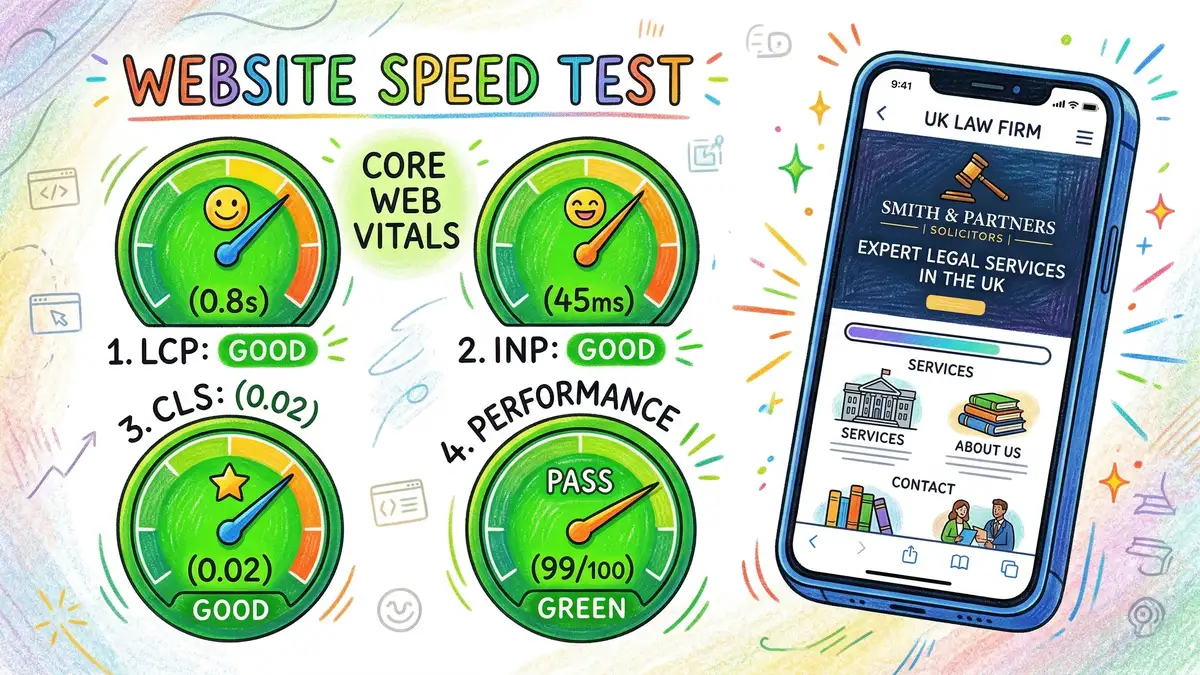
Google's Core Web Vitals are now a primary ranking factor. Three metrics determine whether your site passes: Largest Contentful Paint (LCP) measures how quickly the main content loads—target ≤2.5 seconds. Interaction to Next Paint (INP) measures responsiveness when users click or tap—target ≤200 milliseconds. Cumulative Layout Shift (CLS) measures visual stability—target ≤0.1.
The business impact is measurable. Google's study of millions of page impressions found that sites meeting all Core Web Vitals thresholds see users 24% less likely to abandon pages. Economic Times reduced its INP from 1,000ms to 257ms and saw a 50% decrease in bounce rate with a 43% increase in pageviews. For law firms, where 69% of mobile visitors abandon slow-loading sites, speed isn't a nice-to-have—it directly determines how many potential clients you lose before they even see your services.
| Metric | Good | Needs Work | What It Measures |
|---|---|---|---|
| LCP | ≤ 2.5s | > 4.0s | Time for the largest visible content to load (hero image, main heading block) |
| INP | ≤ 200ms | > 500ms | Responsiveness to user interactions (clicks, taps, keyboard input) |
| CLS | ≤ 0.1 | > 0.25 | Visual stability—how much content shifts unexpectedly during loading |
Schema Markup for Legal Websites
Structured data markup makes your website machine-readable for both Google and AI systems like ChatGPT and Perplexity. For law firms, the most valuable schema types are LegalService (specifies practice areas and services—note that Attorney schema is now deprecated), LocalBusiness (displays contact information and location in search), Review schema (shows star ratings in search results), and FAQPage (enables FAQ rich results). Schema markup adoption remains minimal among UK law firms, representing a significant competitive advantage for those who implement it correctly.
URL Structure and Site Architecture
A well-structured URL hierarchy helps both users and search engines understand your site. For multi-practice law firms, the recommended pattern uses a hub-and-spoke architecture: broad practice area pages (hubs) link to detailed sub-topic pages (spokes). For example, /personal-injury/ links to /personal-injury/road-traffic-accidents/, /personal-injury/workplace-injuries/, and so on. Each practice area should have its own dedicated page targeting specific keywords reflecting how clients actually search. For a comprehensive SEO strategy framework, see our SEO for solicitors guide.
Which Design Elements Actually Convert Visitors Into Clients?
Design elements fall into three categories: trust signals that build confidence, conversion elements that capture enquiries, and content structures that demonstrate expertise. The most effective law firm websites layer all three throughout the user journey.
Calls-to-Action That Work
High-performing law firm websites position clear, prominent calls-to-action above the fold on every page. Action-forward language drives higher engagement—phrases like "Book Your Free Consultation," "Speak With a Solicitor Today," or "Get Expert Legal Advice" outperform generic text like "Contact Us" or "Submit." CTA button colour also matters: analysis of over 2,500 A/B tests found blue buttons achieved the highest conversion rate at 31%, followed by green at 22% and red at 16%—though contrast against the page background matters more than absolute colour.
Contact forms require particular optimisation for mobile. Forms should request only essential information—name, phone number, and a brief description of the issue. Every additional field reduces submission rates. Structured lead capture forms generate 3× higher conversion rates compared to pages without them.
Trust Signals That Matter for Legal Websites
For solicitors, trust signals carry more weight than in almost any other sector. The essential elements include the SRA digital badge and authorisation number, professional headshots of all solicitors (profiles with professional photos receive significantly more engagement), genuine client reviews on Google, ReviewSolicitors, and Trustpilot, accreditations such as Lexcel, Law Society panels, or specialist quality marks, and case study results or notable outcomes where client confidentiality allows.
Response speed is a critical but often overlooked trust signal. Research shows that responding to enquiries within 5 minutes increases conversion probability by 400%. Yet most law firms take hours or even days to respond to website enquiries, losing clients to faster competitors.

What Are the SRA Website Compliance Requirements?
The Solicitors Regulation Authority requires all authorised law firms to display specific regulatory and pricing information on their websites. The SRA conducts proactive web sweeps checking for compliance and issues fixed penalties of £750 for first offences and £1,500 for subsequent breaches.
Mandatory Information for All Law Firm Websites
Every SRA-authorised firm must display its SRA digital badge (clickable, linking to the SRA register), the firm's SRA authorisation number with the words "authorised and regulated by the Solicitors Regulation Authority," and comprehensive complaints handling procedures including details of how and when a complaint can be made to the Legal Ombudsman and the SRA.
Price Transparency Rules
Firms offering designated services must display detailed pricing information in a prominent, easily accessible location. For individuals, this covers residential conveyancing, uncontested probate, summary motoring offences, employment tribunal claims, and immigration (excluding asylum). For businesses, it covers debt recovery up to £100,000, employment tribunal defence, and licensing applications. Required details include the pricing structure including VAT and disbursements, what's included and excluded, qualifications and experience of the team, and typical timescales and key stages.
SRA Compliance Checklist
Non-negotiable: SRA clickable badge, authorisation number, complaints procedure, Legal Ombudsman details. Missing any of these risks a £750 fine on first inspection.
If offering designated services: Full pricing with VAT, disbursements, inclusions/exclusions, team qualifications, and timescales. The SRA updated guidance in September 2024 reinforcing these requirements.
Need a website that's SEO-optimised and SRA-compliant? See how Whitehat's SEO services help law firms build websites that rank and convert.
View Our SEO Services
Which CMS Platform Should a Law Firm Choose?
Your content management system determines how easily you can update content, maintain technical SEO, and scale as your firm grows. Cloud-based CMS solutions now hold 81% of the market, with SaaS models bundling hosting, SSL, CDN, and updates into a single subscription. The three main options for UK law firms each have distinct advantages.
WordPress powers over 60% of content sites worldwide and offers maximum flexibility through its extensive plugin ecosystem. It's the most cost-effective option for firms that want full control, but requires active security management and technical oversight. Plugin complexity can impact site performance if not carefully managed. Typical cost: £5,000–£15,000 for design and build, plus £100–£300/month for managed hosting and maintenance.
HubSpot CMS integrates website, CRM, and marketing automation into a single platform. This makes it particularly strong for law firms focused on lead generation and client relationship management. Built-in analytics, A/B testing, and smart content features reduce reliance on third-party tools. The trade-off is higher monthly costs and less design flexibility than WordPress. Typical cost: £10,000–£25,000 for design and build, plus £300–£800/month for the platform.
Bespoke / Headless CMS solutions decouple the front-end design from the back-end content management, offering maximum performance and flexibility. This approach suits large firms with complex multi-location requirements or those needing integration with practice management systems. Typical cost: £25,000–£80,000+ for design and build, plus £500–£1,500/month for hosting and maintenance.
How Should You Optimise Your Law Firm Website for AI Search?
AI visibility is no longer optional. ChatGPT alone accounts for 87.4% of all AI referral traffic, and AI platforms generated over 1.13 billion referral visits in June 2025—up 357% year-on-year. Zero-click searches have risen from 56% to 69% of all Google queries, and when AI Overviews appear, users click through to websites only 8% of the time compared to 15% without an AI summary.
The practical implication is that if an AI system recommends your firm, you get the call. If it doesn't mention you, that potential client is gone before you had a chance. To optimise for AI citation, lead with clear, direct answers to common legal questions structured so AI tools can quote them. FAQ sections, step-by-step guides, and well-organised explainer pages perform particularly well. Implement FAQPage, LegalService, and Article schema to help AI systems parse your content accurately.
Four factors determine whether AI systems cite your content: topical depth (covering a practice area comprehensively across multiple pages), content quality and currency (regularly updated, expert-attributed content), E-E-A-T signals (demonstrated experience, expertise, authority, and trustworthiness), and external citations (presence on authoritative legal directories and publications). Learn more about optimising for AI search in our SEO for solicitors pillar guide.
What Does a High-Converting Law Firm Website Redesign Look Like?
A website redesign that delivers measurable results follows a structured three-month approach, moving from audit through implementation to optimisation.
Month 1: Audit and Strategy
Run a full technical SEO audit covering Core Web Vitals, mobile usability, schema markup, and crawlability. Audit SRA compliance against the current transparency requirements. Benchmark current conversion rates by page type and traffic source. Map your practice areas to a hub-and-spoke URL architecture. Define target keywords for every page.
Month 2: Design, Build, and Content
Design mobile-first templates with prominent CTAs, trust signals, and minimal-friction contact forms. Build practice area pages using the hub-and-spoke architecture. Implement schema markup (LegalService, LocalBusiness, FAQPage). Create or refresh content for every practice area page with client-focused language and clear value propositions.
Month 3: Launch, Monitor, and Optimise
Launch with proper 301 redirects preserving existing URL equity. Set up Google Analytics 4 and Search Console tracking. Monitor Core Web Vitals, conversion rates, and organic visibility weekly. A/B test CTA placement, button colours, and form designs. Respond to all website enquiries within 5 minutes to maximise the 400% conversion uplift from fast response.
FAQ: Frequently Asked Questions About Law Firm Website Design
How much should a small law firm spend on a website?
A small UK law firm (6–25 solicitors) should expect to invest £10,000–£20,000 for a professionally designed, SEO-optimised website, with annual running costs of £1,200–£3,000 for hosting, maintenance, and security. Solo practitioners can start with template-based solutions for £2,000–£5,000. The critical factor is choosing a provider with legal sector experience—generic agencies often miss practice-area SEO, SRA compliance, and conversion optimisation for legal services.
What are the most important pages on a law firm website?
The highest-converting pages are practice area pages (targeting specific legal services with clear calls-to-action), your homepage (which should immediately communicate what you do and where), and location-specific pages for multi-office firms. Each practice area should have its own dedicated page targeting the keywords your clients actually search for. Blog content supports these pages by building topical authority and capturing informational queries.
How long does a law firm website redesign take?
A typical law firm website redesign takes 8–16 weeks from strategy through launch, depending on the number of practice areas, pages, and level of custom functionality. Template-based builds can launch in 4–6 weeks. Enterprise sites with custom integrations, client portals, or multi-language support can take 16–24 weeks. The most common cause of delays is content—start writing practice area content and gathering testimonials early in the process.
Should a law firm use WordPress or HubSpot?
WordPress offers more design flexibility and lower monthly costs, making it ideal for firms that have (or can hire) technical support for ongoing maintenance and security. HubSpot integrates CRM, marketing, and analytics into a single platform, which suits firms prioritising lead generation and client nurture workflows. Both platforms can deliver excellent SEO performance when properly configured.
What accessibility standards must a law firm website meet?
UK law firm websites should comply with WCAG 2.1 Level AA standards covering contrast ratios, heading structure, image alt text, form labels, and keyboard navigation. Currently, 94.8% of websites fail basic accessibility standards, and accessibility lawsuits are increasing globally. Common failures include low-contrast text (79.1% of sites), missing alt text (55.5%), and unlabelled form inputs (48.2%). Accessibility isn't just legal compliance—it also improves SEO and serves clients with disabilities.
Ready for a website that ranks and converts?
Whitehat builds SEO-optimised, SRA-compliant websites for UK law firms. From technical foundations to conversion design, we deliver sites that generate measurable client enquiries.
Clwyd Probert
Managing Director, Whitehat SEO
Clwyd has led Whitehat since 2011, delivering SEO and content strategy for B2B and professional services clients across the UK. A HubSpot Diamond Partner, he specialises in building sustainable organic visibility through data-driven content and technical SEO. Whitehat has helped over 200 law firms improve their online visibility and client acquisition.