
What Is Digital Marketing for Law Firms and Why Does It Matter?
Digital marketing for law firms is the strategic use of online channels—search engines, social media law firm social media strategy, email, content, and paid advertising—to attract, engage, and convert prospective clients. In the UK, where 63% of law firms now have a formal digital marketing strategy (up from 52% in 2023), the shift from traditional referral-based client acquisition to digital-first is accelerating rapidly.
Yet the legal sector still lags behind other professional services in digital maturity. UK law firms typically allocate just 1.5–2.8% of revenue to digital marketing, compared with 5–7% in financial services and technology. This gap represents both a challenge and an opportunity: firms that invest strategically in digital marketing now can capture disproportionate market share while competitors remain hesitant.
The business case is compelling. Organic search drives 41–58% of law firm website traffic, and firms investing in integrated digital strategies see 3–5× ROI over 18–24 months. Whether you're a solo practitioner or a 100-partner firm, understanding which digital channels deliver results—and how to stay compliant with SRA regulations—is essential to sustainable growth.
Key Takeaway
UK law firms investing 1.5–2.8% of revenue in digital marketing see 3–5× ROI over 18–24 months. The average year-on-year budget increase is 12–18%, with SEO and content marketing law firm content marketing guide attracting 58% of incremental spend.
How Are UK Law Firms Adopting Digital Marketing?
Digital adoption among UK law firms is accelerating but remains uneven. Larger firms (100+ lawyers) have reached 87% digital strategy adoption, while solo practitioners lag at 41%. The gap creates a significant competitive advantage for smaller firms willing to invest early.
63%
UK Law Firms
Have a formal digital marketing strategy
71%
Investing in SEO
Up from 48% in 2023
54%
Content Marketing
Active content programmes
38%
Dedicated Role
Have a dedicated digital marketing role
Sources: Law Society Digital Economy Survey 2025, Conscious Solutions Law Firm Benchmark 2025
The channels seeing the fastest growth are content marketing (up from 31% to 54% adoption since 2023), marketing automation (31% adoption), and video marketing via YouTube (22%, up from 14%). Meanwhile, Twitter/X usage among law firms has declined from 26% to 19%, reflecting the broader platform migration toward LinkedIn and video.
Which Digital Marketing Channels Work Best for Law Firms?
Each digital channel serves a different purpose in the client acquisition journey. The most effective law firm marketing strategies combine multiple channels, with the mix varying by practice area, firm size, and target market. Here's how each channel performs for UK legal services.
SEO (Search Engine Optimisation)
Organic search is the single largest source of law firm website traffic, accounting for 41–58% of all visits depending on practice area. Employment law firms see the highest organic share (67%), while personal injury firms see lower organic shares (38%) due to heavy PPC competition in that space.
The investment case for SEO is strong: firms publishing two or more articles weekly rank for 2.8× more keywords than those publishing monthly. New legal content typically takes 4–8 months to reach the top 10, and 8–14 months for competitive head terms. For a deeper dive into SEO strategy, see our comprehensive SEO for solicitors guide.
PPC (Google Ads)
Pay-per-click Google Ads for law firms advertising delivers immediate visibility but at a significant cost. UK legal keyword CPCs range from £6–£13 for property/conveyancing to £32–£45 for personal injury—some of the most expensive clicks in any sector. Despite this, law firm PPC campaigns achieve average ROI of 250–400% over 12 months, with custom landing pages increasing conversion rates by 35–52% compared to directing traffic to your homepage.
Click fraud remains a concern: 12–18% of clicks on legal keywords are estimated to be fraudulent or low-intent. Using click fraud detection tools and negative keyword lists is essential for protecting your budget.
Social Media
LinkedIn dominates law firm social media, with 67% adoption among mid-tier UK firms. LinkedIn engagement rates for legal content (2.1–3.4%) significantly exceed the platform average of 0.5%, with employee spotlights achieving the highest engagement at 4.2%. Facebook adoption has actually declined to 34%, while Instagram (12%) and YouTube (22%) are growing.
The ROI varies dramatically by practice area. Personal injury firms report 23% of leads via social media, while commercial law firms see just 8%—reflecting the different buyer journeys in consumer versus business-to-business legal services.
Email Marketing
Email remains one of the most cost-effective channels for law firms. Legal sector email campaigns achieve open rates of 22–28% and click rates of 2.1–3.8%, with segmented campaigns delivering 28–35% higher open rates than broadcast sends. The average client acquisition cost via email is just £25–£65—significantly lower than PPC or LinkedIn advertising.
Local SEO and Google Business Profile
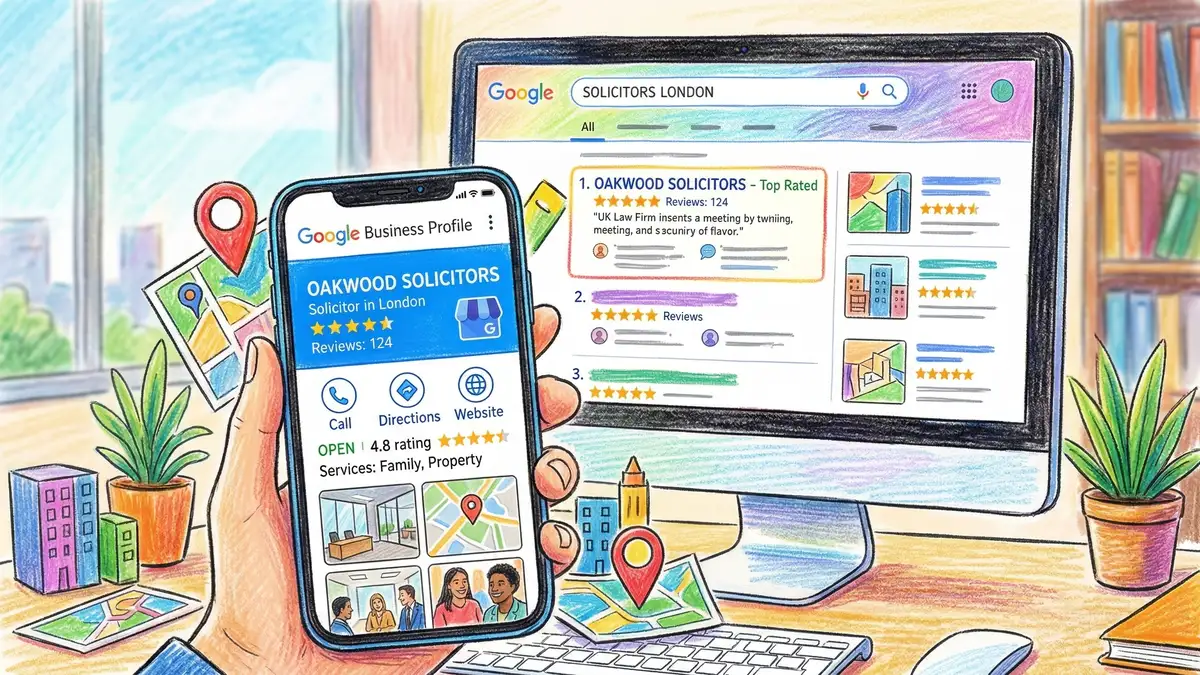
For high-street law firms, local SEO is non-negotiable. Google Local Pack results drive 19–26% of enquiries, rising to 26–31% for suburban and regional firms. Yet only 52% of UK law firms maintain active, verified Google Business Profiles—a remarkable gap given that 78% of potential clients read reviews before contacting a firm. Our local SEO guide for solicitors covers this in detail.

How Does SRA Compliance Affect Your Digital Marketing?
The SRA Code of Conduct applies to all digital marketing activities, and enforcement is increasing. SRA enforcement actions related to digital marketing breaches rose 34% year-on-year in 2024–2025, with 64 cases spanning misleading claims, testimonial violations, and inadequate fee transparency.
The key rules every law firm must follow in digital marketing include accuracy in all advertising claims (you cannot claim "specialist" status without Law Society accreditation), genuine and representative testimonials, clear fee transparency in PPC ads and landing pages, and—since October 2024—a requirement that AI-generated content must be reviewed by a qualified person before publication. Average fines for digital marketing breaches range from £2,500 to £8,500, with serious violations risking suspension.
SRA Compliance Warning
Common mistake: Using unsubstantiated superlatives in Google Ads ("best personal injury firm") or publishing AI-generated blog content without qualified human review.
The reality: The SRA fined 14 law firms in 2024–2025 for unsubstantiated claims and took action in 3 cases involving unreviewed AI content. Every claim must be factual, and every piece of published content requires a qualified person's sign-off.
Need help building an SRA-compliant digital strategy? See how Whitehat's SEO services deliver results within regulatory boundaries.
View Our SEO ServicesHow Much Should a Law Firm Spend on Digital Marketing?
Digital marketing budget how much law firms should spend on marketings vary significantly by firm size, but the benchmarks are clear. Mid-sized UK law firms (26–100 lawyers) typically invest £40,000–£150,000 annually, representing 1.5–2.8% of revenue. Solo practitioners spend £3,000–£12,000, while large firms (100+ lawyers) invest £150,000–£800,000 or more.
| Firm Size | Annual Budget | % of Revenue | Primary Channels |
|---|---|---|---|
| Solo (1–5) | £3,000–£12,000 | 0.8–1.5% | Google Business Profile, local SEO, targeted Google Ads |
| Small (6–25) | £15,000–£40,000 | 1.1–2.2% | SEO, content marketing, Google Ads, basic social |
| Mid-Sized (26–100) | £40,000–£150,000 | 1.5–2.8% | Integrated: SEO, content, LinkedIn, PPC, email, video |
| Large (100+) | £150,000–£800,000+ | 2.0–3.5% | Full-stack: brand, thought leadership, multi-practice campaigns |
Sources: Law Firm Marketing Benchmarks Report 2025, Law Society Digital Economy Survey 2025
Client Acquisition Cost by Channel
Understanding what each channel costs to acquire a paying client helps you allocate budget effectively. The table below shows typical UK acquisition costs across four major practice areas.
| Channel | Personal Injury | Employment Law | Family Law |
|---|---|---|---|
| SEO / Organic | £120–£200 | £80–£140 | £60–£110 |
| Google Ads (PPC) | £250–£600 | £180–£400 | £120–£300 |
| Email Marketing | £35–£65 | £25–£50 | £20–£40 |
| LinkedIn Ads | £200–£500 | £150–£350 | £100–£250 |
Sources: Conscious Solutions 2025, Ruler Analytics Legal Client Study 2025
How Should You Build a Digital Marketing Strategy for Your Law Firm?
The most effective approach is to start focused and expand. Rather than trying every channel simultaneously, pick two to three channels aligned with your practice area and firm size, then build systematically over three months.
Month 1: Audit and Foundation
Audit your current website (speed, mobile, technical SEO), claim and optimise your Google Business Profile, set up Google Analytics 4 and Search Console, and define your target keywords by practice area. This foundational work costs nothing but time and ensures everything built on top of it performs.
Month 2: Quick Wins and Content
Optimise existing pages (title tags, meta descriptions, headers) for your primary keywords. Publish two to three blog articles targeting questions your clients ask. If using PPC, launch a targeted campaign focused on your highest-value practice area with custom landing pages. Begin an email list with a lead magnet (free guide, checklist).
Month 3: Measure, Optimise, and Expand
Review your first month's data. Track enquiries, cost per enquiry, and conversion rates by channel. Double down on what's working: increase content frequency, expand PPC to additional practice areas, or start LinkedIn thought leadership. Set up monthly reporting dashboards so you can track trends, not daily noise.
What Digital Marketing Trends Should Law Firms Watch?
The digital marketing landscape for law firms is evolving rapidly. Three trends will shape law firm marketing over the next 12–24 months.
AI in legal marketing is accelerating fast. 34% of mid-sized UK law firms now use AI tools to draft blog content or email campaigns, but only 18% have formal review processes compliant with SRA requirements. The SRA clarified in October 2024 that AI-generated content must be reviewed by a qualified person before publication—and by March 2026, had already taken enforcement action in 3 cases involving unreviewed AI content.
Video marketing is growing from 14% to 22% adoption, with explainer videos averaging 2:35 watch duration and 8.2% engagement rates. Firms hosting two or more webinars monthly see 23–31% higher brand search volume. Short-form video (YouTube Shorts, Instagram Reels) is emerging but attribution remains difficult.
Google AI Overviews now appear for approximately 22% of legal queries in UK searches, potentially reducing click-through to organic listings by 15–31%. This makes ranking in positions 1–3 more critical than ever, as AI Overviews typically pull from top-ranking content. Firms with comprehensive, expert-attributed content will maintain visibility; thin content will lose ground. Learn more about optimising for AI search in our SEO for solicitors pillar guide.
FAQ: Frequently Asked Questions About Law Firm Digital Marketing
What is the most effective digital marketing channel for law firms?
SEO (organic search) delivers the highest long-term ROI for most UK law firms, driving 41–58% of website traffic at a client acquisition cost of £60–£200 depending on practice area. However, the most effective approach combines SEO with one or two complementary channels. For B2C practice areas (personal injury, family law), Google Ads and local SEO are essential. For B2B (commercial, employment), LinkedIn and content marketing perform best.
How much should a small law firm spend on digital marketing?
Small UK law firms (6–25 lawyers) typically invest £15,000–£40,000 annually (1.1–2.2% of revenue). For solo practitioners, a realistic starting budget is £3,000–£12,000 per year focused on Google Business Profile optimisation, local SEO, and targeted Google Ads. The key is consistency: a modest monthly investment sustained over 12 months outperforms sporadic large spends.
How long does digital marketing take to show results for a law firm?
PPC delivers immediate visibility (days to weeks). SEO and content marketing typically show meaningful results within 3–6 months, with new legal content taking 4–8 months to reach the top 10 in search results. Email marketing results depend on list size but campaigns can generate enquiries within weeks. Most law firms see clear ROI from an integrated digital strategy within 12–18 months.
What SRA rules apply to law firm digital marketing?
All digital marketing must comply with the SRA Code of Conduct. Key requirements include: all claims must be accurate and substantiated (no "best firm" without evidence); testimonials must be genuine and representative; fees must be transparently disclosed; and since October 2024, AI-generated content must be reviewed by a qualified person. The SRA has increased enforcement, taking 64 actions related to digital marketing in 2024–2025.
Should I hire an agency or do digital marketing in-house?
For most small to mid-sized firms, an agency or specialist consultant delivers better ROI because they bring established processes, tools, and cross-client learning. In-house teams work best for large firms (100+ lawyers) with sufficient budget for a dedicated role (£3,000–£6,000/month including tools). A blended model—agency for strategy and execution, in-house for day-to-day management—is increasingly popular among mid-sized firms. Read our guide on how to choose an SEO agency for evaluation criteria.
Ready to build a digital marketing strategy that delivers?
Whitehat helps UK law firms build data-driven digital marketing strategies that comply with SRA regulations and deliver measurable client enquiries. Let's discuss your firm's opportunities.
Clwyd Probert
Managing Director, Whitehat SEO
Clwyd has led Whitehat since 2011, delivering SEO and content strategy for B2B and professional services clients across the UK. A HubSpot Diamond Partner, he specialises in building sustainable organic visibility through data-driven content and technical SEO. Whitehat has helped over 200 law firms improve their online visibility and client acquisition.