
Google AI Overviews now appear on 48% of tracked search queries globally and approximately 30% of UK searches, fundamentally changing how businesses gain visibility in search results. Whitehat SEO's analysis of the 2026 citation landscape reveals that only 17–38% of pages cited in AI Overviews rank in Google's traditional top 10 — down from 76% just seven months earlier. For UK businesses, this means ranking well is no longer enough. The brands that understand how Google's AI selects its sources, structure content for extraction, and build authority across third-party platforms will capture a disproportionate share of search visibility as AI Overviews expand across more query types.
48%
Queries Trigger AIOs
58% YoY growth (BrightEdge Feb 2026)
-58%
Position-1 CTR Loss
When AI Overview appears (Ahrefs)
17–38%
Top-10 Overlap
Down from 76% pre-Gemini 3
30%
UK Search Trigger Rate
536% YoY increase (Ofcom Dec 2025)
Sources: BrightEdge February 2026, Ahrefs February 2026, Ofcom December 2025
Key Takeaway
Google AI Overviews represent the most significant change to UK search visibility since mobile-first indexing. The shift from ranking-based to citation-based visibility is already measurable: position-one organic results lose 58% of clicks when an AI Overview appears. Businesses that invest in structured, citation-optimised content now will build authority that becomes increasingly difficult to displace.
What Are Google AI Overviews and How Do They Work?
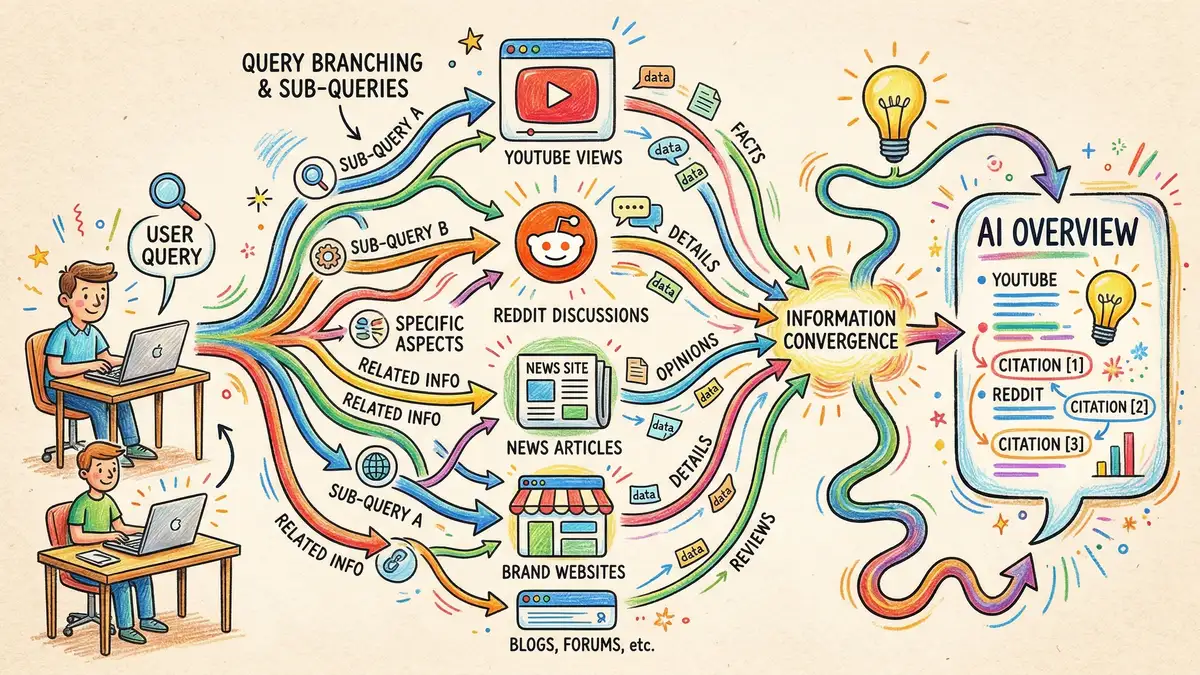
Google AI Overviews are AI-generated summaries that appear at the top of search results, synthesising information from multiple web sources into a single comprehensive answer. Powered by Google's Gemini 3 model since January 2026, AI Overviews use a process called query fan-out — breaking a single search into multiple sub-queries, retrieving the best results for each, and combining them into one response with inline citations.
The deployment scale has accelerated dramatically. BrightEdge tracking data shows AI Overviews crossed the 40% threshold in June 2025 and reached 48% by February 2026. Industry penetration varies significantly: B2B technology queries trigger AI Overviews on 82% of searches, educational queries on 83%, and healthcare on 88%. Shopping queries remain comparatively resistant at just 3.2%, reflecting Google's cautious approach to transactional searches. Question-based queries trigger AI Overviews 57.9% of the time, while single-word searches trigger them only 9.5% (Ahrefs, 146M SERPs analysed).
When an AI Overview appears, it occupies more than a standard desktop viewport in height, pushing all traditional organic results below the fold. This architectural change means organic results are invisible without deliberate scrolling — regardless of whether the AI-generated answer satisfies the user's intent. Whitehat SEO's AI search optimisation methodology addresses this shift by combining traditional ranking authority with the structured, citation-optimised content that Google's AI specifically favours.
How Google Selects Sources for AI Overviews
The January 2026 upgrade to Gemini 3 fundamentally changed how Google selects citations. Ahrefs' analysis of 863,000 keywords and 4 million AI Overview URLs found that only 38% of cited pages also appear in the organic top 10 — with 26.2% coming from positions 11–100 and a remarkable 36.7% from outside the top 100 entirely. BrightEdge reported an even lower overlap of 17% using different methodology. Both figures represent a structural collapse from the 76% overlap measured just seven months earlier.
The mechanism driving this shift is Gemini 3's more aggressive query fan-out. SE Ranking's post-upgrade analysis found the new model replaced approximately 42% of previously cited domains and delivers roughly 32% more source URLs per response. A wider source pool drawn through more intensive sub-query processing mathematically reduces dependence on traditional top-10 rankings as the primary citation signal.
What Traditional SEO Delivers
SEO wins visibility in standard search results through keyword rankings, technical health, and content depth. The ROI compounds over time as domain authority builds. 97% of AI Overview citations still come from pages ranking in the top 20 — traditional SEO remains the foundation.
What AEO Adds On Top
Answer Engine Optimisation earns your brand direct mentions inside AI-generated responses. It drives pre-qualified referral traffic from ChatGPT, Perplexity, and Google AI Overviews. Whitehat SEO's integrated SEO and AEO strategy combines both approaches.
Five factors correlate most strongly with AI Overview citation probability. Brand mentions across the web show the strongest correlation (0.664 coefficient) — substantially higher than backlinks (0.218). YouTube has become the single most-cited domain in AI Overviews, accounting for 18.2% of citations from sources outside the top 100 organic results. Content freshness matters significantly, with pages updated within 30 days cited at 3.2 times the rate of older content (Quattr, 2026). Schema markup helps indirectly: pages with attribute-rich structured data achieve a 61.7% citation rate versus 59.8% for pages with no schema and just 41.6% for generic schema (Growth Marshal, n=730, February 2026). Finally, content length shows essentially zero correlation with citation probability — 53% of all AI Overview citations go to pages under 1,000 words.
The Click-Through Rate Impact for UK Businesses
Multiple studies converge on a consistent finding: AI Overviews suppress organic clicks by approximately 55–60% for affected queries. Ahrefs' February 2026 analysis of 300,000 keywords found position-one results lose 58% of clicks when an AI Overview appears. Seer Interactive measured a 61% organic CTR drop, from 1.76% to 0.61%. SparkToro's zero-click research found that 58% of all Google searches now result in zero clicks.
The UK-specific impact has been documented in CMA submissions. Tank agency's analysis of 800 UK companies across 16 industries found average organic traffic growth dropped from 26.3% to just 3.7% after AI search rollout — a 22.6 percentage point decline. However, Chartbeat data via Reuters Institute shows Google search traffic to European publishers declined 17% compared to 38% in the US, suggesting the UK currently faces less severe impact than other markets.
Citation provides measurable protection. Seer Interactive's study of 3,119 queries found cited brands achieve 0.70% organic CTR versus 0.52% for non-cited brands, and earn 91% more paid clicks. AI-referred traffic also converts significantly higher: Contentsquare's 2026 benchmarks show AI referral conversion rates rose 55% year-on-year, and research across 12 million visits found ChatGPT-referred traffic converts at 14.2% compared to Google organic's 2.8%. Whitehat SEO tracks these citation metrics as part of every client's AI visibility measurement framework.
Six Strategies to Earn Google AI Overview Citations
1. Structure Content for AI Extraction
AI systems parse structure and extract self-contained passages rather than reading pages end-to-end. Front-load your main answer within the first 150 words — 44.2% of all AI citations come from the first 30% of content (Growth Memo, February 2026). Optimal passage length for extraction is 127–167 words, with 62% of featured content falling in this range. Each section should be independently comprehensible: restate key terms, avoid pronouns without clear antecedents, and lead every section with a direct answer before supporting detail.
2. Build Comprehensive Topic Coverage
Google's query fan-out means your page needs to answer not just the primary query but all implicit sub-questions. Pages ranking for multiple related queries are 161% more likely to appear in AI Overviews than pages ranking only for the primary term. Pages with 15 or more connected entities per 1,000 words show 4.8 times higher citation probability. Rather than optimising individual pages for individual keywords, Whitehat SEO develops interconnected topic clusters that address every dimension of a buyer's research journey.
3. Maintain Content Freshness
Content freshness has become one of the most dynamic citation factors. AI-cited content is 25.7% fresher on average than traditional organic results (Ahrefs, 17M citations analysed). The half-life of content visibility has collapsed: what used to decay over 12–18 months now declines in 3–6 months for competitive topics. Display publication and last-updated dates prominently, include dateModified in schema markup, and schedule quarterly reviews of cornerstone content.
4. Implement Attribute-Rich Schema Markup
Approximately 65% of pages cited by Google AI Mode include structured data markup. However, generic schema actually performs worse than no schema at all. Only implement Article, FAQPage, and Organization schema when you can populate every relevant field comprehensively — otherwise omit it entirely. JSON-LD is the preferred format, and Microsoft/Bing is the only major platform to officially confirm schema helps its LLMs.
5. Invest in YouTube and Video Content
YouTube is now the most-cited domain in Google AI Overviews, with citations growing 34% over six months (Ahrefs Brand Radar). Ninety-four percent of YouTube citations come from long-form videos, and videos with chapter markers show 78% higher citation likelihood. For UK businesses, creating educational video content with full transcripts, clear speaker attribution, and structured chapters is now a high-impact AI visibility tactic.
6. Build Off-Site Brand Authority
Brand mentions correlate more strongly with AI citations (0.664) than any other signal tested — and brands are 6.5 times more likely to be cited through third-party sources than their own domains. Maintain detailed profiles on G2 and Capterra, earn editorial coverage on industry authority sites, and build genuine community presence. YouTube deserves particular attention as the strongest correlating platform with AI visibility when analysing brand mentions across all platforms.
Google AI Overviews vs ChatGPT vs AI Mode: Key Differences
Understanding platform differences is essential for a comprehensive AI visibility strategy. Google operates three distinct AI-powered search surfaces — AI Overviews, AI Mode, and Gemini — each with fundamentally different citation ecosystems. Whitehat SEO's AEO methodology addresses all three within an integrated framework.
| Factor | Google AI Overviews | ChatGPT Search | Google AI Mode |
|---|---|---|---|
| Organic overlap | 38% from top 10 | 8–12% from top 10 | 14% from top 10 |
| Top social source | Reddit (44%), YouTube (21%) | Wikipedia (48%), Reddit | Wikipedia (29%), Reddit |
| Schema influence | Indirect via Knowledge Graph | No confirmed effect | 65% of cited pages have schema |
| Freshness weight | High (25.7% fresher content) | Moderate (favours 15yr+ domains) | Very high (143% more domains) |
| Zero-click rate | 58% | 31% trigger web search | 93% |
| Citation overlap | Baseline | 21% domain overlap with AIOs | 13.7% overlap with AIOs |
Sources: Ahrefs February 2026, SE Ranking 2025, BrightEdge January 2026
The UK Regulatory Landscape: CMA and DMCCA
The UK operates the most aggressive regulatory framework for AI search globally. On 10 October 2025, the CMA designated Google with Strategic Market Status under the Digital Markets, Competition and Consumers Act, covering both general search and search advertising. On 28 January 2026, the CMA proposed four conduct requirements that could fundamentally reshape how AI Overviews function in the UK.
Regulatory Warning
The CMA's proposed conduct requirements include a mandatory publisher opt-out allowing content owners to exclude their pages from AI Overviews without losing organic rankings. If implemented, this could reduce the source pool for AI citations — meaning businesses that remain opted in may see increased citation visibility. The copyright impact assessment deadline is 18 March 2026, which may trigger additional regulatory changes.
The proposed requirements cover four areas: publisher content controls for AI features, fair ranking obligations with 30-day notice before material algorithm changes, data portability for consumers, and user choice for default search engines. Category 1 measures (publisher controls and fair ranking) are slated for implementation in H1 2026 with a 90-day grace period. Non-compliance penalties reach up to 10% of global annual revenue. Whitehat SEO monitors these regulatory developments closely and adjusts client strategies through the agency's SEO and AEO services.
How to Measure Your AI Overview Visibility
Google Search Console does not currently provide dedicated AI Overview reporting. AI Mode has a separate filter (available since June 2025), but AI Overview clicks are blended into standard organic data with no way to distinguish them. GA4 similarly cannot isolate AI-referred traffic without custom configuration.
Whitehat SEO recommends four measurement approaches for UK businesses. First, use Search Console's Performance report with a regex filter for queries of 10+ words — these conversational queries are overwhelmingly AI-triggered. Second, track 15–20 target queries monthly across Google AI Overviews, ChatGPT, and Perplexity, documenting which brands appear in each response. Third, create a custom GA4 channel group isolating traffic from AI referral sources (ChatGPT, Claude, Perplexity, Gemini, Copilot). Fourth, consider dedicated tools: Semrush AI Visibility (from $139.95/month), Ahrefs Brand Radar (from $199/month), or Otterly AI (from $29/month) for budget-conscious tracking. For a comprehensive measurement approach, see Whitehat SEO's full guide to AI visibility measurement and KPIs.
Frequently Asked Questions
Do Google AI Overviews appear for all searches in the UK?
No. AI Overviews currently appear on approximately 30% of UK searches according to Ofcom's December 2025 data — a 536% year-on-year increase. They trigger most frequently for informational and educational queries, with B2B technology searches at 82%. Commercial and transactional queries remain comparatively resistant, with shopping at just 3.2%.
Can you opt out of Google AI Overviews?
Currently there is no way to opt out of AI Overviews specifically while maintaining organic visibility. Google-Extended in robots.txt controls AI model training but does not prevent AI Overview citations. The CMA's proposed conduct requirements include mandatory publisher opt-out controls expected in H1 2026. Until then, the only options are full participation or the nosnippet meta tag, which blocks all snippet visibility.
How long does it take to start appearing in AI Overviews?
Content that already ranks well organically and is restructured for AI extraction can begin appearing within weeks. New content targeting AI Overview-eligible queries typically needs two to three months to build sufficient authority. Whitehat SEO's clients typically see measurable AI visibility improvements within one quarter of implementing structured AEO optimisation.
Is AI referral traffic actually valuable?
Yes — AI-referred traffic converts at dramatically higher rates. ChatGPT-referred traffic converts at 14.2% compared to Google organic's 2.8% (Am I Cited, 12M visits). Contentsquare's 2026 benchmarks show AI referral conversion rates rose 55% year-on-year. However, AI traffic currently represents only about 1.08% of total website traffic, indicating a high-intent but still-growing channel.
Does ranking first in Google guarantee an AI Overview citation?
No. Only 17–38% of AI Overview citations come from pages ranking in the organic top 10 — down from 76% before the Gemini 3 upgrade in January 2026. Position-one pages still appear more frequently than any other single position, but the relationship between ranking and citation has weakened significantly. Comprehensive topical coverage, brand authority, and content freshness now matter as much as ranking position.
What is the difference between AI Overviews and Google AI Mode?
AI Overviews appear automatically in standard search results. AI Mode is an opt-in conversational interface with follow-up questions and multi-step reasoning. Citation overlap between the two is just 13.7% for the same query — AI Mode cites 143% more unique domains and has a 93% zero-click rate compared to AI Overviews' 58%. They require different optimisation strategies, which is why Whitehat SEO's AEO service addresses both surfaces.
Next Steps: Protecting Your Search Visibility
Google AI Overviews represent a structural change to search — not a temporary experiment. With 48% of queries triggering AI answers and the citation-ranking overlap collapsing from 76% to as low as 17%, the businesses that invest in citation-optimised content now will build authority that compounds over time. The UK's regulatory environment adds both urgency and opportunity: the CMA's proposed publisher controls could reshape the competitive landscape within months.
Whitehat SEO helps UK businesses build comprehensive AI search visibility across Google AI Overviews, ChatGPT, Perplexity, and Claude. The agency's integrated Answer Engine Optimisation methodology combines traditional search authority with the structured, citation-optimised content that AI systems specifically favour. Contact Whitehat SEO to discuss how AI Overview optimisation fits into your search strategy. AI consulting AI in marketing: 2026 research report