
In 2026, the UK ecommerce market has grown to an estimated £286 billion, with over 62 million digital shoppers making it one of Europe's most competitive online retail landscapes. Yet most UK online retailers still underestimate SEO's impact on revenue — treating it as an afterthought rather than a core growth driver. The reality is stark: 77% of UK ecommerce traffic now comes from mobile devices, and retailers who optimize for search engines aren't just winning visibility — they're capturing customers ready to buy. SEO services
This guide walks you through a proven SEO strategy built specifically for UK online retailers. Whether you're selling fashion, homeware, or electronics, the principles remain the same: technical foundation + strategic content + measurement = sustainable revenue growth.
Key Takeaway
UK online retailers targeting SEO can expect a 3.5% average conversion rate on organic traffic, with technical excellence, product-focused content, and AEO optimization driving the majority of results. The market is worth £286B — your share depends on whether you're visible when customers search.
£286B
UK Ecommerce Market
2026 estimated GMV
62M
Digital Shoppers
Active UK online buyers
77%
Mobile Traffic
Ecommerce browse & purchase
3.5%
Avg Conversion Rate
Organic ecommerce traffic
Sources: BRC & Kleenex Retail Sales Monitor 2026, Statista UK Ecommerce Report 2026, Google Mobile Commerce Report 2025
1. Technical SEO: Build the Foundation
Before you write a single product description or blog post, your technical SEO must be bulletproof. Search engines crawl your site using a finite crawl budget — wasting it on duplicates, broken redirects, or poor site architecture means product pages never rank.
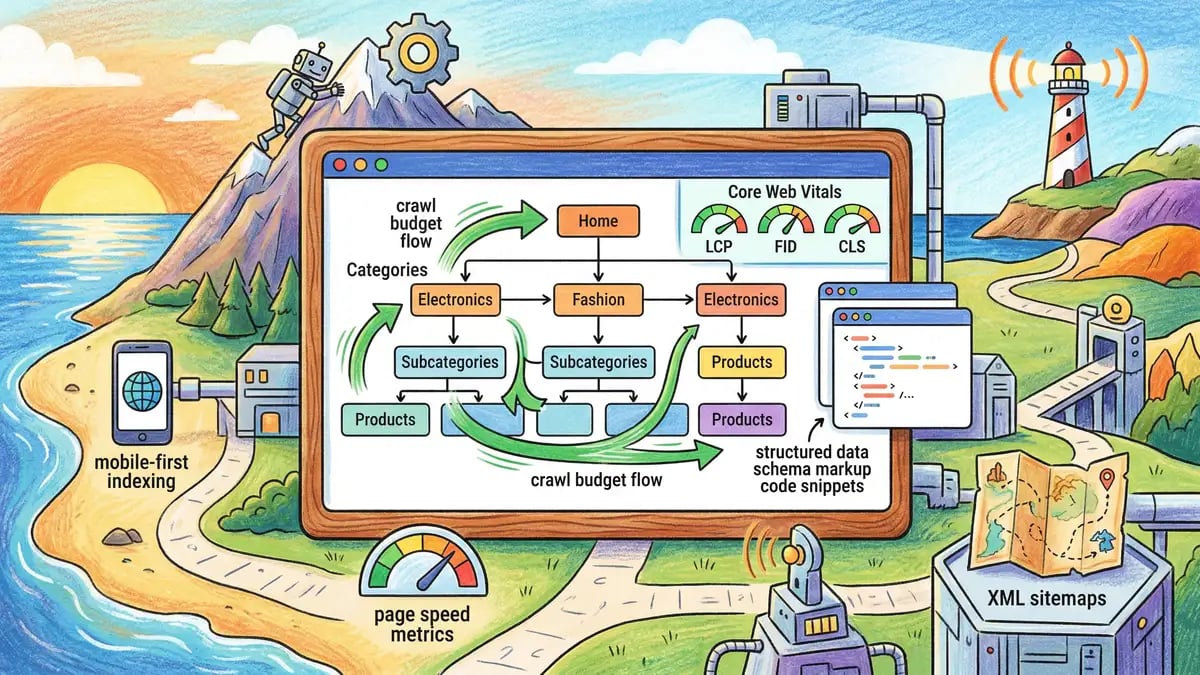
Crawl budget optimization. Your site's crawl budget is the number of pages Google will crawl in a given timeframe. For mid-sized retailers (5,000–50,000 SKUs), this is a real constraint. Prevent crawl waste by: blocking non-indexable pages (filters, sorting variants, login-gated content) via robots.txt; implementing pagination with rel="next"/rel="prev" only where needed; setting canonical tags on duplicate product variants; and removing low-value pages from XML sitemaps.
Product and Offer schema. Ecommerce requires structured data. Implement JSON-LD for Product and Offer schemas on every product page. Google uses this to populate rich snippets, validate pricing and availability, and rank you in Product results and Generative AI summaries. Missing schema means you're invisible in many AI-driven search contexts.
Core Web Vitals and mobile-first indexing. Google's Core Web Vitals (Largest Contentful Paint, First Input Delay, Cumulative Layout Shift) are ranking factors. With 77% of your traffic on mobile, a slow product page directly impacts rank and conversion. Test with PageSpeed Insights, prioritize LCP (<2.5s), and ensure your checkout flow loads instantly.
XML sitemaps and structured navigation. Split sitemaps by content type: products, categories, blog. Keep product sitemaps refreshed weekly to signal changes. Ensure your internal linking structure (category > product) mirrors your ecommerce taxonomy — don't rely on search to infer your site's logic.
2. Content Strategy: The Three-Layer Approach
Ecommerce content isn't just product pages. High-ranking retailers blend three layers: transactional (product pages), informational (category guides), and editorial (blog and guides). Each layer serves a different stage of the customer journey.

| Layer | Example Content | SEO Purpose & Strategy |
|---|---|---|
| Transactional | Product pages, SKU variants | High commercial intent. Target long-tail keywords like "women's merino wool socks UK". Include FAQ schema, reviews, price/availability markup. Optimize for "near me" intent where applicable. |
| Informational | Category guides, buying guides, comparison pages | Medium commercial intent. Target category keywords like "best hiking boots for UK weather" or "difference between wool and synthetic socks". Link down to relevant products; link up to editorial. |
| Editorial | Blog posts, trend reports, expert guides | Low commercial intent, high volume. Target awareness-stage keywords like "sustainable fashion trends 2026" or "how to care for merino wool". Build authority and link back to category and product pages. |
Source: Whitehat SEO Ecommerce Content Framework 2026
Each layer amplifies the others. A blog post on "sustainable fashion" ranks for volume keywords, attracts awareness-stage visitors, and links to your category page for "eco-friendly clothing" which, in turn, links to individual product pages. Product pages themselves need 150–300 words minimum (not just specs) to rank for comparison keywords.
Product page best practice: Start with benefits, not features. A product description that leads with "100% merino wool" loses to one that opens with "Stay warm and dry without odour — this 100% merino wool base layer breathes in humidity, regulating temperature in Scottish highlands or Cornish winters." Then provide specs, sizing, care instructions, and FAQ schema.
3. AI Search & AEO Optimisation
AI search engines (ChatGPT, Google AI Overviews, Perplexity, Claude) are reshaping how customers discover products. Google now generates AI Overviews on 64% of search results, pulling cited sources directly from ranked pages. If you're not visible in AI outputs, you're losing a significant portion of intent-driven traffic.
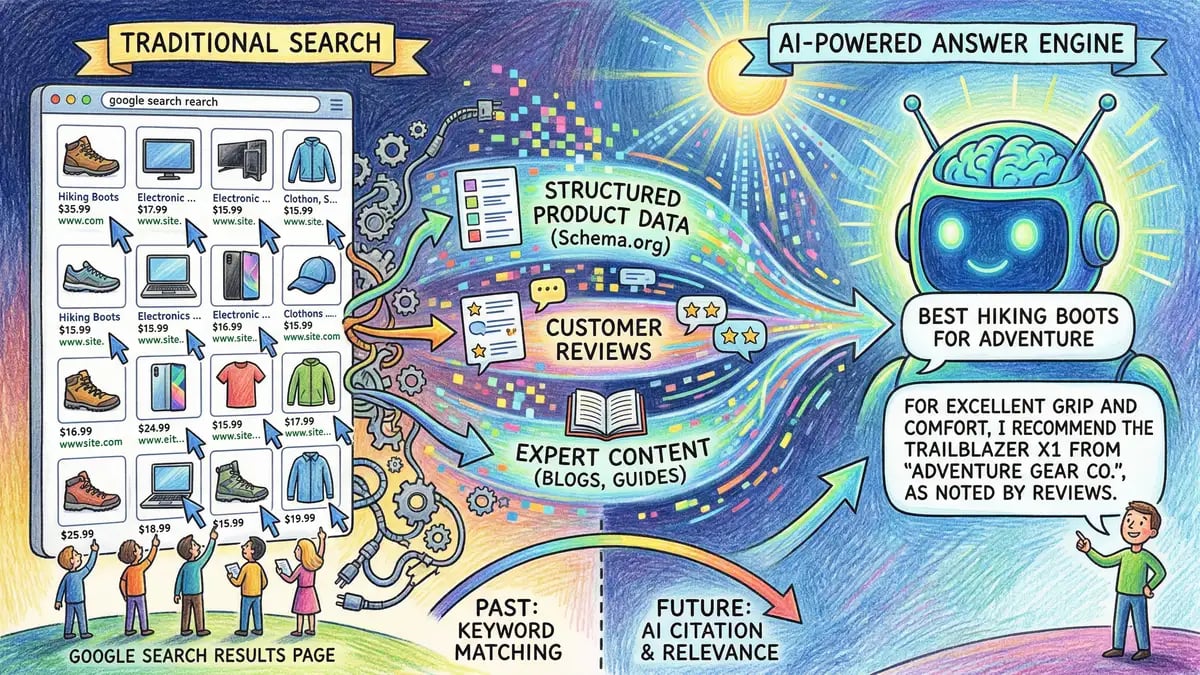
AEO for ecommerce. Write with AI summarization in mind. Structure product guides with clear definitions and data points that can stand alone. An AI engine scanning your "best hiking boots for UK weather" guide will extract statements like: "Merino wool uppers provide insulation down to -5°C while remaining moisture-wicking, ideal for UK hill walking in winter." That snippet, cited to your site, drives authority and click-through.
Use FAQ schema extensively. AI engines frequently cite FAQ sections. If your FAQ answers "Are merino wool socks suitable for diabetics?" and Google's AI Overview references your answer, you've just acquired an authority endorsement and link from Google itself.
Fact-check and cite. AI engines prioritize sources that cite other authoritative sources. If you're writing about sustainability certifications for textiles, cite third-party research (WRAP, Oeko-Tex, Fair Trade Certified). AI engines will note your credibility and surface your content more prominently.
4. Measuring ROI: From Clicks to Revenue
SEO is only valuable if it drives measurable revenue. Many retailers track rankings and traffic but ignore conversion metrics. Here's how to measure true SEO impact:
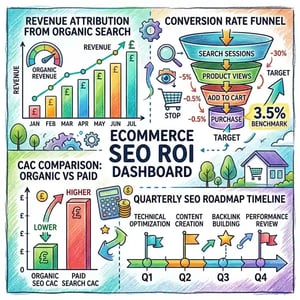
Baseline metrics. Set a month-1 baseline: total organic sessions, organic conversion rate, average order value (AOV), and cost of goods sold (COGS). Track these monthly. A 10% uplift in organic traffic with no conversion improvement is not success if AOV drops.
Attribution modelling. Use Google Analytics 4's data-driven attribution to understand which touchpoints drive conversion. Many ecommerce sites assume the last click gets credit — but organic brand searches often convert higher because users already know your brand. Model multi-touch attribution to identify which content (product guides, category pages) influence late-stage searchers.
Organic revenue calculation. (Organic sessions × Organic conversion rate × AOV) − (Content cost + Technical optimisation cost) = SEO profit. For a retailer with 50,000 monthly organic sessions, 3.5% conversion, and £75 AOV: (50,000 × 0.035 × £75) − optimisation cost = £131,250 gross revenue. Even accounting for £15,000 monthly optimisation cost, ROI is 875%.
Struggling to connect your ecommerce SEO efforts to bottom-line revenue? Our SEO analytics framework sets up attribution modelling and KPI dashboards built for online retailers.
Explore Analytics Services5. Quarterly Roadmap: From Month 1 to Month 12
Sustainable ecommerce SEO improvement follows a predictable timeline. Here's what to expect and prioritize each quarter:
Audit & Foundation
Technical audit (crawl errors, Core Web Vitals, schema gaps), baseline analytics setup, competitive SERP analysis. Expected output: 40–60 technical fixes, baseline attribution model.
On-Page & Content
Product page refresh (titles, meta descriptions, FAQ schema), top 50 category pages optimised, first editorial content published. Expected output: 10–15% CTR improvement from SERP snippets, 5–8 new blog articles ranking.
Link Building & Authority
Internal linking audit and restructure, guest posting on authority retail blogs, digital PR outreach. Expected output: 20–30 referring domains, 15–25% domain authority increase.
Scale & Seasonality
Seasonal keyword targeting (Christmas gift guides, new year promotions), conversion rate optimisation on top 20 landing pages, content refresh of underperforming Q2 articles. Expected output: 25–35% organic revenue uplift, competitive keyword wins in gift/holiday verticals.
Frequently Asked Questions
How long does ecommerce SEO take to show results?
Technical fixes and on-page optimisation can show results within 4–8 weeks. New content typically ranks within 8–12 weeks, but high-competition keywords may take 3–6 months. Full ecommerce SEO impact (content + links + authority) usually takes 6–12 months. Baseline your metrics from month one and set expectations accordingly.
Should we use paid ads while investing in organic SEO?
Absolutely. Paid ads and organic SEO serve different purposes. Ads capture intent immediately; organic captures long-tail and awareness-stage traffic. Many retailers use paid ads to fund SEO payback — running product ads while ramping organic, then shifting budget to organic-only once it scales. Both channels complement each other.
What's the difference between product pages and category pages in SEO?
Product pages target high-intent, long-tail keywords ("women's merino wool hiking socks UK"). Category pages target medium-intent keywords with higher volume ("best hiking socks for UK weather"). Category pages act as hubs — they rank for broader terms and funnel users down to specific products. Both are essential; don't neglect either.
How do we handle duplicate content across product variants?
Use canonical tags to signal your preferred version (e.g., the base product without size/colour filters). In Google Search Console, set a preferred domain version (www vs non-www). For e-commerce, use rel="canonical" to point variant URLs to the base product page. This consolidates ranking signals and prevents crawl waste.
What internal links should I prioritize for ecommerce?
Link from category pages to your top 10 products (highest revenue/search volume). Link from blog/editorial to 2–3 relevant category or product pages. Link from product pages to related products and category hubs. Use descriptive anchor text ("best merino wool socks" not "click here"). Internal links are free authority signals — use them strategically.
Ready to scale ecommerce revenue through SEO?
Our SEO specialists have built ranking strategies for UK retailers across fashion, homeware, and electronics. We'll audit your technical foundation, build a content roadmap, and measure revenue impact every quarter.
Clwyd Probert
SEO Director, Whitehat SEO
Clwyd leads ecommerce SEO strategy for mid-market UK retailers, specialising in technical audits, content architecture, and revenue attribution. He's worked with retailers across fashion, homeware, and automotive sectors to scale organic revenue from £50K to £500K+ monthly.