
Search engine optimisation has become non-negotiable for architecture practices competing for high-value residential and commercial projects. This comprehensive guide walks you through proven strategies to attract qualified leads, establish authority in your local market, and convert website visitors into paying clients.
The architecture sector in the UK is thriving. With nearly 39,000 registered architects, a sector value exceeding £5 billion, and architecture employment reaching 54,100 professionals in Q2 2025, the competitive landscape has shifted decisively online. Your SEO strategy determines whether potential clients find you—or your competitors.
Why SEO Matters for UK Architecture Practices
Key Takeaway
The vast majority of potential architecture clients begin their search online. Without a strong SEO strategy, you're missing high-value leads that directly convert into projects. Local SEO, portfolio optimisation, and thought leadership content are the three pillars of architect visibility.
1. Master Local SEO for Architecture Practices
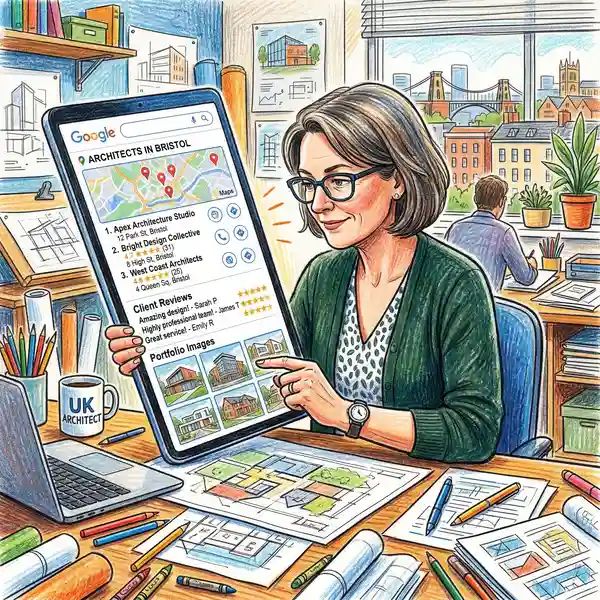
Local search is where architecture opportunities materialise. When homeowners, property developers, and commercial clients search for "architects near me" or "residential architects in [city]", they're actively looking to hire. Dominating local search results puts your practice at the top of their consideration list.
| Local SEO Tactic | Impact | Effort |
|---|---|---|
| Google Business Profile optimisation | High | Low (1-2 hours) |
| Local citations (Yell, Yelp, TripAdvisor Pro) | High | Medium (3-5 hours) |
| Location pages (for multi-office practices) | Medium | Medium (4-6 hours) |
| Review generation campaign | High | Medium (ongoing) |
| Local link building (chamber of commerce, associations) | Medium | High (8-12 hours) |
Common Local SEO Mistake
Many architects neglect their Google Business Profile or let outdated information linger (old phone numbers, missing service areas). This signals to Google that your business is inactive. Update your profile quarterly with fresh photos of completed projects and current service areas.
Google Business Profile: Your Local SEO Foundation
Your Google Business Profile is the single most important local SEO asset. It appears in Google Maps, local search results, and Knowledge Panels. Here's what to optimise:
- Business Category: Select "Architect" as your primary category and "Architectural Design Services" as secondary categories.
- Service Areas: List all postcodes and regions you serve. Be specific—don't claim to serve "all of the UK" if you're London-based.
- Photos & Videos: Upload high-quality images of completed projects, office interiors, and team members. Google prioritises profiles with 30+ photos. Rotate seasonal or new project photos monthly.
- Posts & Updates: Use Google's Posts feature weekly to announce project completions, design awards, or team news. Posts improve visibility and signal active business status.
- Reviews & Ratings: Encourage clients to leave reviews on Google. A 4.5+ star rating dramatically increases click-through rates from local search results. Respond professionally to all reviews within 48 hours.
- Q&A Section: Monitor and answer questions about your services, project timelines, and architectural styles you specialise in.
Building Local Citations for Authority
Local citations—your business name, address, and phone number (NAP) listed on external websites—signal to Google that your business is legitimate and established. Citation quality matters more than quantity. Focus on high-authority, industry-relevant directories:
- Yell.com: The UK's primary business directory. A premium listing (£90–£200 annually) includes a backlink and enhanced profile.
- The Royal Institute of British Architects (RIBA) Directory: Essential for credibility. RIBA-registered architects should ensure their listing is complete and up-to-date.
- Yelp & Trustpilot: Review sites that also serve as citations. Quality reviews on these platforms improve local visibility.
- Chamber of Commerce & Local Business Associations: Join your local chamber for a citation plus networking opportunities and potential referrals.
2. Portfolio Optimisation: Turn Your Work Into Search Visibility
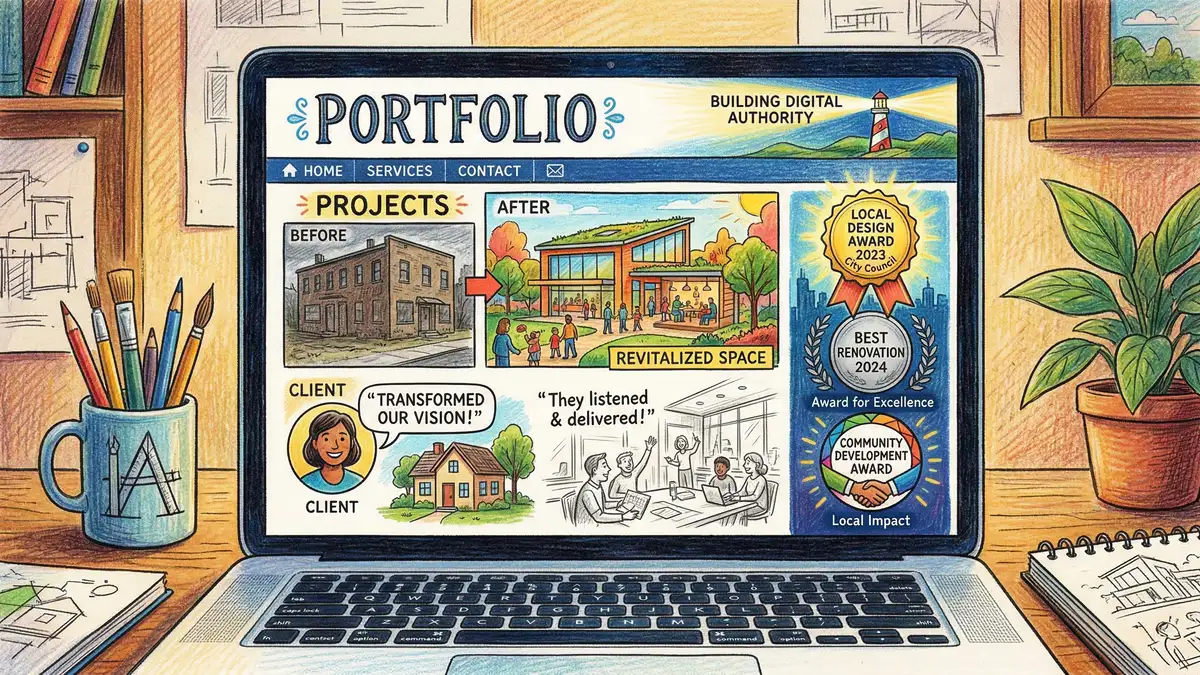
Your portfolio is your strongest SEO asset. Unlike generic content, portfolio pages target high-intent keywords and directly demonstrate your expertise to potential clients. A well-optimised portfolio can rank for "residential architects in [city]", "kitchen extension designers", or "commercial architecture firms" while showcasing completed work.
Key Takeaway
Each project page is an opportunity to rank for location and service-specific keywords. A single project page optimised for "kitchen extension architects in Bristol" can generate consistent leads for years.
Portfolio SEO Fundamentals
Every project in your portfolio should follow a consistent SEO structure:
- Project Title (H1): Include location and service type. "Victorian Terraced House Extension in Shoreditch" ranks better than "House Extension Project".
- Meta Description (160 characters): Write a compelling summary that includes your target keywords. Example: "Award-winning Victorian house extension in Shoreditch combining period charm with contemporary design. See photos and case study."
- Project Description: Write 300–500 words covering the challenge, your design solution, and the outcome. Use natural language, not keyword stuffing. Include the location (postcode or neighborhood) and architectural style.
- Image Alt Text: Every project image needs descriptive alt text including the location. "Kitchen renovation in Islington" is better than "kitchen photo".
- Project Location Data: Use schema markup (Schema.org) to mark up the project location. This helps Google understand the geographic relevance of your work.
- Client Testimonials: Add a short quote from the client. Rich content (testimonials, ratings) boosts time-on-page and signals quality.
Internal Linking Strategy for Portfolio Pages
Internal links from your portfolio to service pages create a powerful SEO structure. Example link architecture:
- Home → Services (Residential Design) → Project Page (Victorian Extension) → Related Projects (Other London Extensions)
- This hierarchy helps Google understand your content structure and distributes authority (PageRank) throughout your site.
Portfolio Freshness: The Underrated SEO Signal
Google favours recent content. A portfolio website with a project from 2015 and no updates signals stagnation. Establish a routine:
- Monthly: Add a new project to your portfolio.
- Quarterly: Update 2–3 existing project pages with new photos or refined descriptions.
- Annually: Audit all portfolio pages, remove low-performing ones, and refresh high-performers with new images or awards.
3. Establish Thought Leadership Through Strategic Content
Building authority requires consistent, high-quality content that addresses your audience's questions and pain points. This section covers the content pillars that drive sustainable SEO for architecture practices.
Content Pillars for Architecture Practices
Effective content marketing follows a pillar-cluster model. A pillar page covers a broad topic (e.g., "residential extensions"), and cluster content targets subtopics and long-tail keywords:
| Pillar Topic | Cluster Content Examples |
|---|---|
| Residential Extensions | Planning permission for extensions, kitchen extensions, loft conversions, cost calculator, Victorian extension ideas |
| Commercial Fit-Out | Office design trends, retail space optimisation, hospitality design, sustainable commercial design |
| Sustainable Design | Passive house design, solar panel integration, green roofs, building regulations Part L |
| Heritage & Conservation | Listed building renovation, conservation area design, period feature restoration |
High-Intent Content Ideas for Architects
Rank for keywords that drive qualified leads by creating content that solves real client problems:
- "How to get planning permission for a residential extension" – High-intent keyword. Clients actively seeking extension architects search this.
- "Cost of loft conversion in [City]" – Commercial intent. Homeowners with budget questions are ready to engage.
- "Best architectural styles for listed buildings" – Educational but attracts heritage-conscious clients.
- "Passive house design in the UK: Complete guide" – Attracts sustainability-focused clients and government incentive seekers.
- "Office design trends 2026" – B2B content for commercial clients planning renovations.
Key Takeaway
Content marketing for architects works best when it bridges the gap between education and sales. Help prospects understand design possibilities and building regulations, then position your expertise as the solution.

4. Technical SEO Essentials for Architecture Websites
A technically sound website provides a foundation for content and strategy to work. Poor technical health undermines even excellent content. This section covers the critical technical factors for architecture practice websites.
Core Web Vitals: Speed & User Experience
Google's Core Web Vitals are ranking factors. Architecture websites, heavy on high-resolution portfolio images, often suffer from poor performance. Optimise for:
- Largest Contentful Paint (LCP) < 2.5 seconds: Your largest visible element (usually an image or hero section) must load quickly. Compress portfolio images to under 200KB per image.
- Cumulative Layout Shift (CLS) < 0.1: Ensure elements don't shift as the page loads. Specify image dimensions and avoid pop-ups that surprise users.
- First Input Delay (FID) < 100 milliseconds: Pages must respond to user interactions quickly. Reduce JavaScript execution and optimise for mobile.
Mobile-First Indexing: A Non-Negotiable Priority
Google indexes the mobile version of your website first. If your mobile site is slow, missing content, or poorly formatted, your desktop rankings suffer. Test your site on mobile:
- Viewport meta tag present:
<meta name="viewport" content="width=device-width, initial-scale=1"> - Readable text (16px minimum font size on mobile)
- Touchable buttons (48px minimum)
- No interstitial pop-ups blocking content on mobile load
- Images responsive and properly sized for mobile
Schema Markup: Communicate Your Expertise to Google
Schema markup helps Google understand your content in context. For architecture practices, implement:
- LocalBusiness Schema: Mark up your business name, address, phone, hours, and reviews.
- Organization Schema: Define your company, logo, and contact details.
- Person Schema: Mark up architect team members (name, photo, credentials).
- Project/CreativeWork Schema: Mark up portfolio projects with completion date, images, and location.
- Review/AggregateRating Schema: Mark up client testimonials and star ratings to display rich snippets in search results.
Technical SEO Red Flag
Portfolio images uploaded directly to your site without optimisation can balloon page size to 5MB+, tanking performance. Always compress, lazy-load, and deliver images via a CDN. Consider WebP format (25–35% smaller than JPEG) for modern browsers.
5. Build Backlinks & Domain Authority
Backlinks—links from external sites to yours—are the most important ranking factor for competitive keywords. Building authority requires a multi-channel strategy focused on quality over quantity.
High-Quality Backlink Sources for Architecture Firms
Focus on backlinks from sites Google trusts. For architecture practices, the best sources are:
| Backlink Source | Authority | How to Acquire |
|---|---|---|
| RIBA Directory & Awards Sites | Excellent | Submit projects to RIBA awards; ensure directory listing is complete |
| Local Authority & Government Sites | Excellent | Speak at local planning meetings, contribute to regeneration projects |
| Industry Publications & Design Blogs | Very Good | Pitch projects to Dezeen, Archdaily, Wallpaper*, design publications |
| Local News & Community Sites | Good | Issue press releases on significant projects; offer expertise to local journalists |
| University & Educational Sites | Excellent | Guest lecture at architecture programs, contribute to alumni networks |
| Professional Associations | Good | Join and be listed on professional bodies (ARB, RIBA, IES) |
Key Takeaway
A single link from Dezeen or the RIBA Directory is worth 10+ links from low-authority websites. Prioritise award submissions, industry publications, and local authority recognition over quantity.
Earned Media & Press Coverage
Press coverage generates high-quality backlinks and brand authority. Architecture practices can earn media through:
- Award Submissions: Submit significant projects to design awards (RIBA, Architects' Journal, World Architecture News). An award win triggers press coverage and direct backlinks from award sites.
- Press Releases: Announce major projects, team hires, or thought leadership. Send to local news, architecture publications, and industry blogs.
- Expert Positioning: Offer yourself as a source for journalists writing about architecture trends, building regulations, or sustainability. This drives backlinks and brand awareness.
- Speaking Engagements: Speak at industry conferences, university events, or local forums. Conference sites and event directories link to speakers, building authority.
6. RIBA Compliance & Building Regulations: SEO Considerations
UK architects must follow the Royal Institute of British Architects (RIBA) code of conduct and Building Regulations. These constraints actually create SEO opportunities.
RIBA Advertising Standards & SEO
RIBA members must comply with strict advertising rules. Your website and content must not:
- Make unsupported claims about expertise or service quality (e.g., "best architects in London")
- Include misleading images or case studies from projects you didn't lead
- Overstate qualifications or awards
- Use aggressive sales language or high-pressure tactics
SEO Strategy: Instead of claiming superiority, demonstrate it. Feature complete case studies, client testimonials, and award certifications. Let your work speak for itself. This builds trust and often outranks competitors making vague claims.
Content Opportunities Around Building Regulations
Building Regulations are complex and frequently updated. Create content that positions you as knowledgeable:
- "Building Regulations Part L 2024: What Changed & How It Affects Your Extension" – Homeowners planning extensions urgently need this information.
- "Planning Permission vs. Building Regulations: What Your Project Needs" – Many people confuse these; educating them builds trust.
- "Accessibility Requirements for Commercial Fit-Out: A Practical Guide" – B2B clients need this; limited competition in search results.
7. Measure SEO ROI: From Rankings to Revenue
SEO investment is only worthwhile if it converts to business results. This section covers the metrics that matter for architecture practices.
Key Performance Indicators (KPIs) for Architect SEO
Track these metrics to understand SEO performance:
| Metric | Definition | Target for Architects |
|---|---|---|
| Organic Traffic | Monthly visitors from search engines (Google, Bing) | Grow 10–20% monthly |
| Keyword Rankings | Average position for target keywords | Top 10 for 50+ keywords |
| Organic Conversions | Enquiries, contact form submissions from organic search | 5–10 qualified leads monthly (varies by market) |
| Conversion Rate | % of organic visitors who contact you or request a quote | 2–5% (service sites average 1–2%) |
| Customer Acquisition Cost (CAC) | SEO investment ÷ clients acquired via SEO | <£3,000 per project-acquiring client |
| Domain Authority (DA) | Overall authority score 0–100 (third-party metric) | DA 30+ within 12 months |
Calculating SEO ROI for Architecture Practices
Use this framework to justify SEO investment:
Example: Mid-size London architecture firm
- Average project value: £75,000
- Close rate from qualified enquiry: 20% (1 in 5 enquiries becomes a project)
- Monthly organic enquiries (goal after 12 months): 8
- Monthly projects from organic (8 × 20%): 1.6 projects
- Monthly revenue from organic: 1.6 × £75,000 = £120,000
- Annual revenue from SEO: £1.44 million
- SEO investment (annual): £15,000–£30,000 (agency + internal time)
- ROI: 48–96x return on investment
Even conservative estimates show SEO delivers exceptional ROI for architecture practices. A single major project often pays for 1–3 years of SEO investment.
Key Takeaway
Track organic enquiries, not just traffic. A small increase in qualified leads from SEO can generate 7-figure revenue impact. This is why architecture firms should prioritise SEO.
Ready to Dominate Local Search?
SEO for architects isn't complex—it's systematic. Focus on local optimisation, portfolio excellence, and authority building, and you'll outrank competitors still relying on paid ads.
Let us help you build an SEO strategy that attracts high-value clients and transforms your online presence into a predictable lead-generation machine.
Discuss Your Architecture Firm's SEO
Get a personalised SEO strategy and learn how to attract high-value clients.
Schedule a ConsultationFrequently Asked Questions
How long does SEO take to show results for architecture firms?
What's the difference between local SEO and national SEO for architects?
How much does SEO cost for an architecture practice?
Can portfolio optimisation really drive leads for architecture firms?
How does RIBA compliance affect SEO strategy?
Should architects rely on Google Business Profile over referrals?
About the Author
Clwyd Probert is Managing Director at Whitehat SEO, specialising in SEO for professional services and high-value B2B practices. With 10+ years in search marketing, Clwyd works with architecture, legal, engineering, and consulting firms to transform organic search into their primary lead-generation channel. He has helped practices grow from 2-5 monthly enquiries to 15-30+ qualified leads through systematic SEO strategy.
Sources:
Royal Institute of British Architects (RIBA) - https://www.architecture.com
Google Business Profile Help - https://support.google.com/business
Dezeen Architecture & Design Magazine - https://www.dezeen.com
Web Vitals: Essential Metrics for a Healthy Site - https://web.dev/vitals/