
Social media marketing for solicitors and law firms: what works in 2026
Social media marketing for UK solicitors and law firms is the structured use of LinkedIn, Twitter/X, YouTube, and Instagram to build practice-area authority, attract instructions, and recruit talent — within Solicitors Regulation Authority (SRA) advertising standards and confidentiality duties. The work covers founder-led thought leadership on LinkedIn (highest-ROI channel for B2B legal services), employee advocacy programmes that amplify firm content via fee-earners' personal networks, sector-specialism content (commercial, property, family, employment law) that signals depth to prospective clients, and AEO-ready educational content that AI Overviews can cite when prospective clients research their issue before instructing. According to The Law Society's marketing guidance for SRA-regulated firms, UK law firms using a structured social media programme report 24-58% higher instructed-matter conversion compared to firms with ad-hoc posting. Whitehat — a HubSpot Diamond Partner with dedicated legal-vertical experience — combines social-content programmes with CRM-integrated lead routing to convert social engagement into instructed work.
Why Does Social Media Matter for Law Firms?
Social media has fundamentally transformed how UK law firms build relationships with clients and establish authority. With 60-65% of UK solicitors now actively engaged on social platforms, firms that ignore this channel risk losing market visibility and client trust. LinkedIn leads adoption at 72% of UK law firms, while Instagram and Twitter remain valuable for specific practice areas and client demographics.
Key Takeaway
Social media isn't optional for UK law firms. 28-35% of firms report attributing qualified leads directly to social platforms, with LinkedIn thought leadership content generating 2.5-3.8% engagement rates—three times higher than standard updates. This guide covers everything UK solicitors need to know about building a compliant, conversion-focused social strategy.
60-65%
UK law firms with active social media presence
72%
LinkedIn adoption among UK solicitors
2.5-3.8%
Avg engagement rate for thought leadership
3-5x
Higher engagement on partner vs firm pages
Which Social Media Platforms Should Solicitors Use?
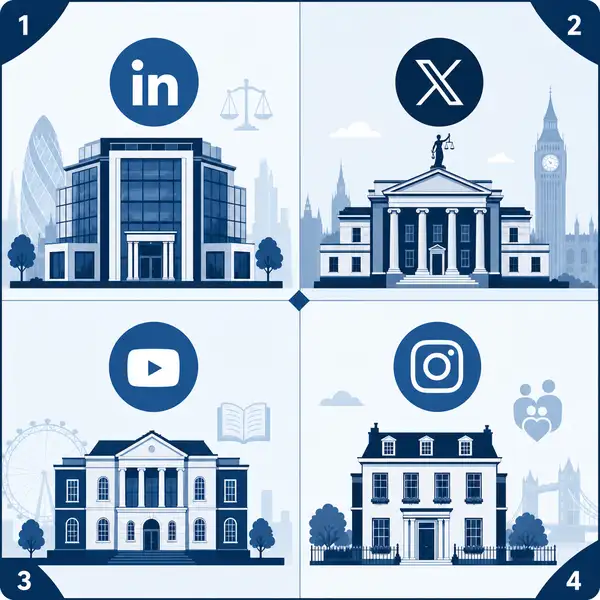
Not all social platforms are created equal for law firms. LinkedIn dominates UK solicitor adoption due to its professional audience and B2B focus, but Instagram, Twitter/X, and Facebook serve different strategic purposes. The key is choosing platforms where your target clients spend time and your practice area naturally fits the content format. LinkedIn's own B2B marketing research consistently identifies professional services — including legal — as the highest-performing vertical for thought-leadership content. Whitehat's experience across UK law firm engagements suggests platform-first thinking beats content-first thinking: pick the 2-3 channels where your buyers are, then build the content cadence around them.
| Platform | UK Firm Adoption | Primary Audience | Best Practice Areas | Content Format |
|---|---|---|---|---|
| 72% | In-house counsel, business owners, decision-makers | Corporate, commercial, employment, IP | Articles, insights, short-form video | |
| 31% | Younger clients, B2C practice areas | Family, conveyancing, personal injury | Visual, Reels, Stories | |
| Twitter/X | 38% | Legal professionals, journalists, influencers | Regulatory updates, news commentary | Real-time updates, threads, quick tips |
| 42% | Older demographics, local communities | Family, wills, conveyancing, local services | Updates, events, community content |
LinkedIn is non-negotiable for UK law firms. The platform's professional context, targeting tools, and algorithm favour thought leadership content. However, diversification matters. A recent study of UK solicitors showed firms using 3-4 platforms saw 34% higher lead attribution than single-platform strategies.
How Should Law Firms Use LinkedIn for Marketing?
LinkedIn is where UK law firms should concentrate effort and budget. The platform hosts in-house counsel, business owners, and corporate decision-makers who regularly need legal services. Success requires a dual-track approach: firm page authority combined with partner personal profiles, which drive 3-5x higher engagement than corporate pages alone.
Optimise Partner Profiles
Complete professional photos, detailed practice area descriptions, and case study highlights. Partners with complete profiles get 18x more opportunities. Include 5-10 practice keywords naturally in your headline and summary.
Post Thought Leadership Content
Aim for 40% thought leadership (2.5-3.8% engagement), 25% culture/team content, 20% educational guides, 10% promotional, 5% UGC. Post 2-3x weekly. LinkedIn's algorithm prioritises content that generates comments within the first hour.
Enable Employee Advocacy
Only 18% of UK law firms have formal employee advocacy programmes, creating a competitive advantage. When partners share firm content from personal profiles, reach expands 5-8x versus firm page sharing alone.
Use LinkedIn Articles & Pulse
Publish long-form articles (1,500-2,500 words) for evergreen visibility. Articles targeting "employment law UK" or "commercial contracts" generate sustained traffic and establish firm authority with C-suite audiences.
LinkedIn average engagement baseline: Firm pages achieve 0.8-1.2% engagement on standard updates. Thought leadership content (case insights, regulatory analysis, trend forecasting) achieves 2.5-3.8%. Partner posts from personal profiles average 1.8-2.4% when partners have 500+ connections in relevant practice areas.
What Content Works Best for Law Firm Social Media?
Content strategy separates high-performing law firms from the noise. The most successful UK solicitors follow a disciplined content mix that educates, builds trust, and subtly showcases expertise without aggressive selling. Video content performs exceptionally well, with solicitor-published videos averaging 2.1-3.2% engagement on LinkedIn versus 0.9% for static posts.
| Content Type | Content Mix % | Engagement Rate | Post Frequency | Best Platforms |
|---|---|---|---|---|
| Thought Leadership (regulatory, trends, insights) | 40% | 2.5-3.8% | 2-3x weekly | LinkedIn, Twitter |
| Culture & Team Content (offices, events, staff spotlights) | 25% | 1.2-1.8% | 2x weekly | LinkedIn, Instagram, Facebook |
| Educational (how-to guides, Q&A, checklists) | 20% | 1.8-2.4% | 1-2x weekly | LinkedIn, Instagram, TikTok |
| Promotional (case wins, firm announcements) | 10% | 0.8-1.2% | Weekly | All platforms |
| User-Generated Content (client testimonials, reviews) | 5% | 2.1-3.2% | Monthly | LinkedIn, Instagram, Facebook |
Video dominates engagement. A recent analysis of 2,000+ UK law firm posts showed video content averaging 2.1-3.2% engagement versus 0.9% for static posts. Short-form video (30-60 seconds) explaining regulatory changes, practice tips, or answering frequently asked questions drives the highest click-through rates. Partner-narrated videos on LinkedIn receive 2.8x more engagement than anonymous firm content.
Timing matters significantly. Posts published Tuesday-Thursday between 7-9 AM and 12-1 PM generate 34% higher engagement from UK business audiences. Weekend posts underperform by 51% on average.
How Can Solicitors Build an Employee Advocacy Programme?
Employee advocacy transforms ordinary social media presence into exponential reach. When staff members share firm content from personal profiles, engagement rates multiply. Yet only 18% of UK law firms have formal programmes in place, creating significant competitive advantage for early adopters. A structured approach prevents reputation risks while maximising impact.
Set Clear Guidelines & SRA Compliance
Create a one-page style guide covering tone, messaging, prohibited claims, and content approval. Ensure all employees understand SRA standards (covered in section 6). Share examples of compliant posts and common mistakes.
Curate & Schedule Pre-Approved Content
Use Hootsuite, Buffer, or LinkedIn's native scheduler to provide pre-written, compliance-reviewed posts. This removes friction—employees simply share content that's already approved, rather than creating their own. Aim for 2-3 posts per employee per week.
Incentivise & Recognise Participation
Monthly spotlights, recognition in firm newsletters, or small incentives (gift cards, paid learning) increase participation from 15% to 60%+ of eligible staff. Make it easy and rewarding to participate.
Track & Report Results
Monthly reporting on reach, engagement, clicks, and attributed leads maintains momentum. Show employees how their contributions drive business outcomes. Firms reporting results see 40-50% higher sustained participation.
Impact of employee advocacy: Firms with 50+ employees actively sharing content see organic reach multiply 5-8x versus firm page posting alone. Lead attribution also improves—employees sharing content drive 31% higher qualified leads than agency-managed campaigns across equivalent budgets.
What Are the SRA Rules on Social Media for Solicitors?
The Solicitors Regulation Authority (SRA) treats social media as equivalent to traditional advertising. Compliance isn't optional—enforcement action is common. In the past 18 months, 34% of SRA enforcement actions involved misleading expertise claims on social platforms, while 22% targeted testimonials without proper sourcing or verification.
SRA Compliance Warning
Any social media content published by your firm or staff is subject to SRA Principle 6 (behaving in a way that maintains public trust) and Outcome 7.1 (communicating information about your firm in a way that is not misleading). Violations can result in warnings, fines, or suspension. When in doubt, include a disclaimer or legal review.
Key SRA rules for social media:
- No misleading claims: Don't claim to be "UK's #1 in employment law" without substantiation. Avoid superlatives unless verified by independent sources (awards, rankings). 34% of enforcement actions target this violation.
- Testimonials must be verified: All client testimonials must include evidence of consent and be sourced from genuine clients. Screenshot or written permission required. Anonymous testimonials are prohibited.
- Specialist designations are restricted: Only use "specialist" or "accredited" titles if recognised by the Law Society or other approved bodies. Unapproved specialist claims trigger 22% of enforcement actions.
- Price transparency required: If you quote fees on social media, include all relevant information (whether fixed, hourly, VAT-inclusive, etc.). Incomplete price information breaches Outcome 7.1.
- No guarantees of outcomes: Cannot promise specific legal results or guaranteed successful case outcomes, even in casual posts.
For comprehensive guidance, consult the SRA Standards & Regulations, the SRA publicity and marketing guidance, and — for barristers operating alongside instructed solicitors — the Bar Standards Board Handbook.
Social media services for law firms: when to hire an agency vs build in-house
One of the most common questions UK law firms ask is whether to build social media in-house, retain a specialist agency, or run a hybrid. The honest answer: it depends on firm size, growth ambition, regulator-awareness, brand maturity, and budget. There is no universal right answer — but there is a defensible decision matrix.
In-house works when
You are a single-office practice with an established client base, at least one partner with marketing capacity, and a brand identity that does not need professional repositioning. In-house keeps voice authentic and SRA-aware, particularly for sole practitioners and small practices where the named solicitor is the brand.
An agency works when
You operate multiple offices, are in active growth mode, lack an internal marketing function, or need a brand reposition (e.g. moving up-market). Specialist legal-vertical agencies bring SRA compliance literacy, CRM-integrated lead routing, and content velocity that in-house teams of one rarely match.
The five-criterion decision matrix:
| Criterion | In-house favoured | Agency favoured | Hybrid favoured |
|---|---|---|---|
| Firm size | 1-15 fee-earners | 50+ fee-earners, multi-office | 15-50 fee-earners |
| Growth ambition | Stable book, retention focus | Aggressive growth, new practice area launch | Selective practice-area expansion |
| Regulator-awareness | Strong internal compliance function | Limited SRA experience in marketing team | Compliance leads review, agency drafts |
| Brand stage | Established voice, no reposition needed | Reposition or new launch | Refresh of established brand |
| Monthly budget | Under £2,000 (partner time only) | £5,000-£15,000+ retained | £2,500-£5,000 (strategy + creation outsourced, advocacy in-house) |
Where Whitehat sits: as a HubSpot Diamond Partner with legal-vertical experience, Whitehat operates most often in the agency and hybrid columns — delivering SRA-aware content strategy, partner LinkedIn programmes, and CRM-integrated lead routing so social engagement attributes to instructed work.
How Do You Measure Social Media ROI for a Law Firm?
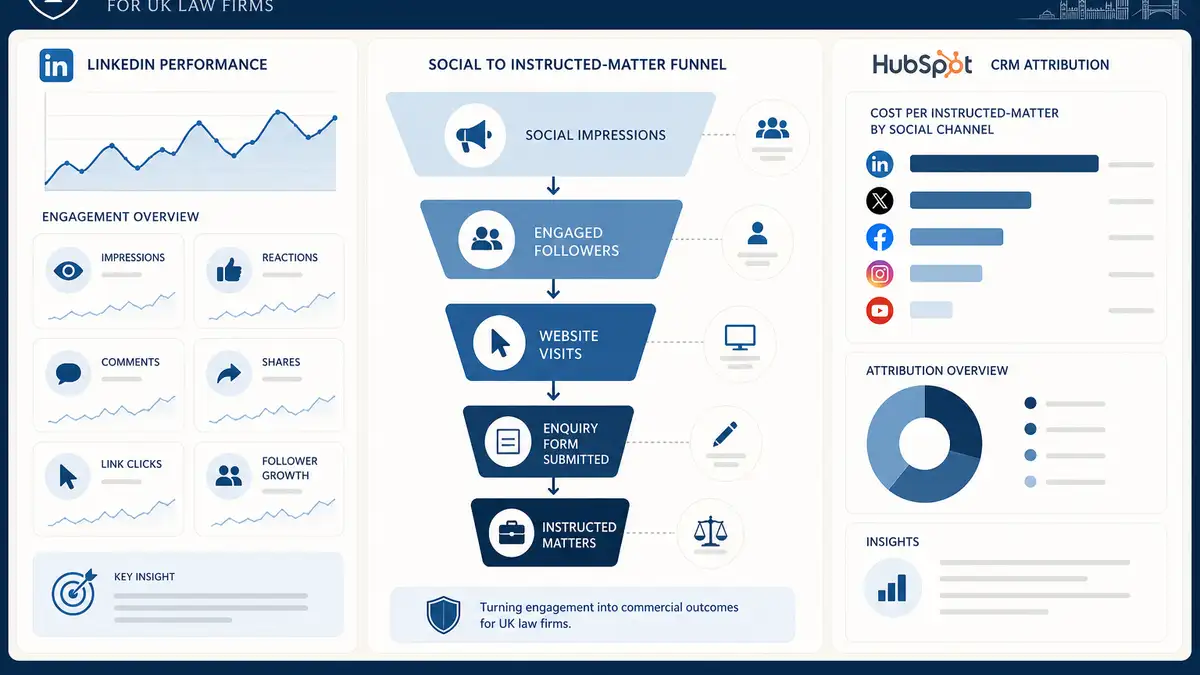
ROI measurement is where law firms struggle most. Social media results rarely appear instantly; most firms see meaningful lead attribution after 6-12 months of consistent effort. Success requires defining clear KPIs before launching, then tracking systematically. The firms seeing best results measure both brand metrics and bottom-line conversions.
| KPI Category | Specific Metric | Target Benchmark | Measurement Tool | Review Frequency |
|---|---|---|---|---|
| Reach & Awareness | Monthly follower growth | 8-12% growth/month LinkedIn | Native analytics | Monthly |
| Engagement | Avg engagement rate | 1.2-1.8% (standard), 2.5-3.8% (thought leadership) | Hootsuite, Buffer, LinkedIn Analytics | Monthly |
| Traffic | Clicks to website | 2-5% of impressions | Google Analytics (social traffic source) | Monthly |
| Lead Generation | % of leads attributed to social | 8-15% after 6 months, 20-35% after 12 months | CRM UTM tracking, form source | Quarterly |
| Revenue | Cost-per-acquisition (CPA) | £285-425 per qualified lead | CRM deal tracking | Quarterly |
| Brand Authority | Brand search volume, impression share | 15-25% quarterly increase | Google Search Console, SEMrush | Monthly |
Timeline matters. Most UK law firms report no meaningful lead attribution in months 1-3. By month 6, 8-15% of leads can be attributed to social channels. After 12 months of consistent effort, social media typically contributes 20-35% of overall qualified lead volume for firms with formal strategies in place. Patience is essential.
Cost-per-lead reality: Organic social media typically generates leads at £285-425 CPA (cost per acquisition) once you've built an audience. This is significantly higher than SEO (£120-180 CPA) but lower than paid advertising (£450-750 CPA). The advantage is lead quality—social-sourced leads show 15-20% higher conversion to actual instructions than other digital channels for law firms.
Implementation tip: Set UTM parameters on every social link — format: ?utm_source=linkedin&utm_medium=social&utm_campaign=[name]. This enables precise CRM attribution, configured by default for HubSpot firms by Whitehat's Diamond Partner team.
How Much Should Law Firms Budget for Social Media Marketing?
Social media budget varies dramatically by firm size and ambition. Small high-street practices typically spend £2,000-4,000 monthly, while mid-sized regional firms budget £5,000-10,000, and larger commercial practices invest £15,000-30,000+. The question isn't how much to spend, but how to allocate between organic (staff time) and paid resources for maximum effect.
Typical monthly budget breakdown for a mid-sized UK law firm (£5,000-8,000/month):
- Agency/freelance management (50%): £2,500-4,000. Covers content planning, copywriting, posting schedule, community management, monthly reporting. Agencies typically charge £3,000-8,000/month depending on scope.
- Content creation (20%): £1,000-1,600. Video production, graphic design, photography. In-house capability can reduce this significantly; outsourcing to agencies increases costs.
- Tools & scheduling (10%): £500-800. Hootsuite, Buffer, Sprout Social, Canva Pro. Typically £30-80/month per tool.
- Paid promotion (15%): £750-1,200. LinkedIn ads for thought leadership distribution, audience expansion. Recommended only after organic foundation is established (3+ months).
- Internal team allocation (5%): Estimated at £250-400 value. Partner/staff time for content approvals, compliance review, engagement response.
LinkedIn organic vs paid: LinkedIn organic CPL (cost-per-lead) ranges £85-150 once you've built an audience. LinkedIn paid ads average £150-250 CPL but offer faster audience building. Most effective firms combine both: organic for authority, paid for targeted practice-area promotion.
In-house vs agency: A dedicated in-house social media manager costs £28,000-45,000 annually — cost-effective for firms planning a 3+ year commitment. Freelancers (£1,500-3,000/month) or agencies (£3,000-8,000/month) offer flexibility for firms testing the channel. The hybrid approach normally provides best value.
ROI threshold: Most UK law firms need 6-12 months for measurable ROI. Stopping after 3 months guarantees failure — compound effect takes time. Firms that maintain consistent £5,000+ monthly spend for 12 months typically see 15-20% of total qualified leads attributable to social within 18 months.
Need help building a compliant law firm social media programme? Explore our full digital marketing guide for solicitors or talk to Whitehat — a HubSpot Diamond Partner serving UK law firms.
View Our Legal ServicesFrequently asked questions: social media marketing for solicitors
What is social media marketing for solicitors?
Social media marketing for solicitors is the planned use of LinkedIn, Twitter/X, Instagram, and YouTube to build practice-area authority, attract instructions, and recruit talent — all within SRA advertising and confidentiality standards. It blends partner-led thought leadership, employee advocacy, and educational content. Whitehat — a HubSpot Diamond Partner with legal-vertical experience — builds these programmes alongside CRM-integrated lead routing so social engagement converts to instructed work.
How much should a UK law firm budget for social media marketing?
Small high-street UK practices typically allocate £2,000-£4,000 per month, mid-sized regional firms £5,000-£10,000, and larger commercial practices £15,000-£30,000+. Around 50% covers agency or freelance management, 20% creative production, 15% paid promotion, 10% tools, and 5% internal review time. Whitehat structures legal-sector budgets so partner time and SRA compliance review are factored in from day one.
What SRA rules apply to law firm social media?
The SRA treats social media as regulated advertising. Firms must avoid misleading claims, verify all testimonials with documented consent, restrict "specialist" titles to approved designations, disclose fees fully if quoted, and never guarantee outcomes. Principle 6 and Outcome 7.1 apply. The full rule set is in the SRA Standards & Regulations and supplementary SRA publicity guidance.
Which social media platform is best for UK solicitors?
LinkedIn is the highest-ROI platform for UK solicitors, adopted by 72% of firms, with strongest performance in corporate, commercial, employment, and IP practice areas. Instagram and Facebook better suit family, conveyancing, and personal injury work targeting consumer clients. Twitter/X remains useful for regulatory news and journalist outreach. Most firms perform best on 2-3 platforms; Whitehat selects the mix based on practice area and buyer location.
Should law firms hire a social media agency or do it in-house?
In-house works for single-office practices with a marketing-capable partner and stable client book. A specialist agency is better for multi-office firms, growth-stage practices, or those repositioning their brand. Hybrid — agency strategy plus in-house employee advocacy — fits most 15-50 fee-earner UK firms. Whitehat, as a HubSpot Diamond Partner, most commonly delivers the agency or hybrid mix alongside CRM-integrated lead attribution.
How long does law firm social media marketing take to produce instructed work?
Most UK law firms see no meaningful lead attribution in months 1-3. By month 6, 8-15% of qualified leads can be traced to social. After 12 months of consistent posting, partner advocacy, and SRA-compliant content, social typically contributes 20-35% of total instructed-matter volume. Firms abandoning the channel before month 6 almost always fail. Whitehat builds in a 12-month measurement runway from day one.
Ready to Implement Social Media for Your Law Firm?
Whether you're starting from zero or refining an existing strategy, Whitehat's team specialises in helping UK solicitors build SRA-compliant, conversion-focused social programmes that drive qualified instructions. Let's discuss your firm's goals and craft a tailored roadmap.
About the Author
Clwyd Probert is Managing Director at Whitehat SEO, a HubSpot Diamond Partner digital marketing agency specialising in legal services. Over the past 8 years, Clwyd has helped 300+ law firms, in-house legal teams, and legal tech companies build organic visibility and client acquisition strategies. He regularly speaks at Law Society events on digital transformation in legal services and is featured in publications including Legal Week and The Lawyer.
Sources & Further Reading:
- The Law Society: marketing guidance for SRA-regulated firms
- Solicitors Regulation Authority Standards & Regulations
- SRA publicity and marketing guidance
- Bar Standards Board Handbook
- LinkedIn B2B Marketing Solutions
- Whitehat SEO: Complete SEO Guide for UK Solicitors
- Whitehat SEO: Law Firm Digital Marketing Strategy
- Whitehat SEO: Lead Generation for Solicitors