
Key Takeaway
UK dental practices spend £400–£3,500 monthly on Google Ads with £1.50–£4.50 average CPC, achieving 3:1–5:1 ROAS and 60%+ phone enquiries. Success requires keyword segmentation by intent, landing page optimisation, and strict GDC/ASA compliance to attract high-value patient enquiries.
What Are Typical Google Ads Costs for UK Dental Practices?
Google Ads costs for dental practices vary significantly based on keyword type, location competitiveness, and campaign maturity. UK dental practices typically operate within these ranges:
£1.50–£4.50
Average CPC Range
Cost-per-click across all keyword types
5–12%
Conversion Rate
Click-to-enquiry or appointment booking
3:1–5:1
ROAS
Return on ad spend (revenue to cost ratio)
60%+
Phone Enquiries
Percentage of conversions from direct calls
Sources: Google Ads Benchmarks 2025–2026, Wordstream Dental PPC Report, Whitehat SEO Case Studies
CPC by Dental Keyword Type
Keyword intent determines cost-per-click. Emergency treatments and high-value procedures command premium prices, whilst generalist keywords like "dentist near me" are more affordable but generate lower-intent traffic.
| Keyword Type | CPC Range | Conversion Rate | Best For |
|---|---|---|---|
| Emergency Dentist | £2.50–£4.50 | 10–14% | Urgent enquiries; high conversion intent |
| Dental Implants | £3.50–£5.50 | 8–11% | High-value treatments; premium demographics |
| Invisalign / Orthodontics | £2.00–£4.00 | 9–12% | Aesthetic procedures; youth and young families |
| Dentist Near Me | £1.50–£3.00 | 6–9% | Broad reach; lower intent but high volume |
| NHS Dentist / Free Dentistry | £0.80–£1.50 | 5–8% | NHS practices; price-sensitive patients |
| Teeth Whitening / Cosmetic | £1.20–£2.50 | 7–10% | Cosmetic treatments; aesthetic-focused audience |
Sources: Google Ads Quality Score Analysis 2026, Whitehat SEO Dental Campaign Data
Monthly Google Ads Budget by Practice Size
Your budget allocation should align with practice revenue, patient acquisition cost (PAC), and growth targets. Smaller practices may start at £400–£700 monthly, while established multi-surgery groups can sustain £2,000–£3,500 or more.
Solo Practice / Single Location
Monthly Budget: £400–£700
Ideal for establishing presence locally. Focus on emergency, general dentistry, and local intent keywords. Daily budget £13–£23. Test ad messaging and landing page copy before scaling.
Small Group (2–3 Locations)
Monthly Budget: £900–£1,500
Supports multi-location campaigns with location-specific ad groups. Daily budget £30–£50. Begin high-value procedure campaigns (implants, invisalign) alongside general dentistry.
Medium Group (4+ Locations / Regional)
Monthly Budget: £2,000–£3,500
Supports 4 distinct campaigns (emergency, high-value, general, brand). Daily budget £65–£115. Allocate 40–50% to high-value procedures, 25% to general dentistry, 5–10% to brand awareness.
How to Structure Your Dental Google Ads Campaigns
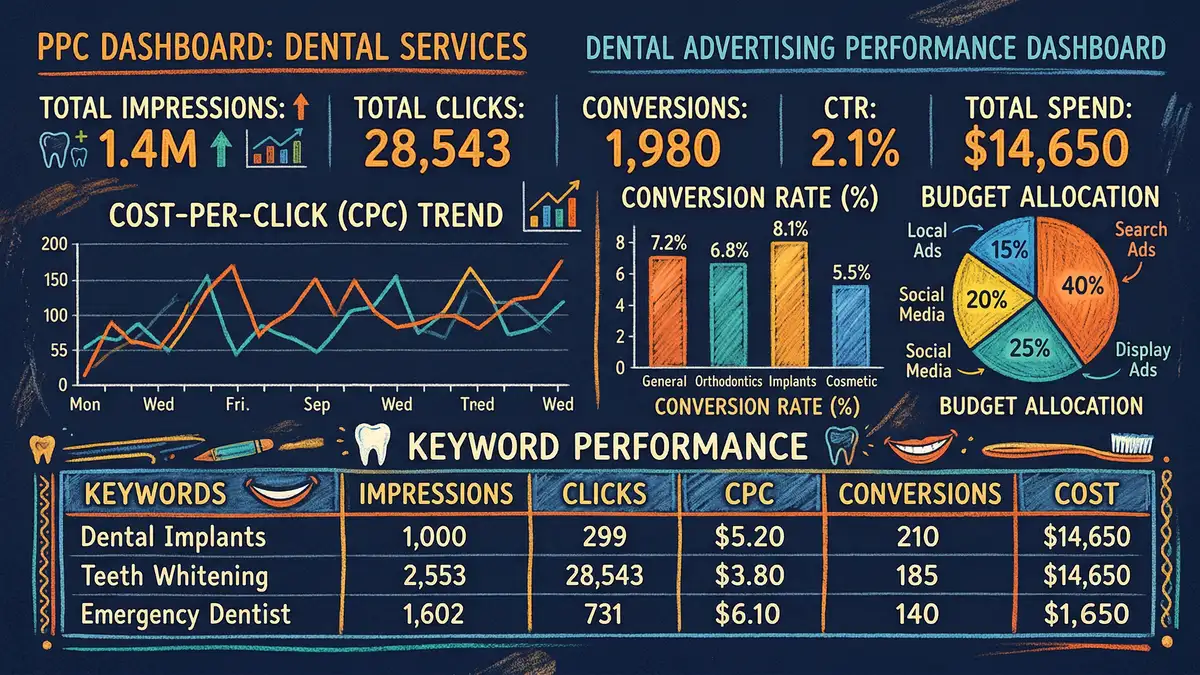
Campaign structure determines how your budget is allocated, which keywords are grouped together, and how effectively you can measure ROI by treatment type. The most effective dental practices use a 4-campaign structure that mirrors patient intent and revenue potential.
Campaign 1: Emergency Dentistry (25% of budget)
Target emergency-related keywords: "emergency dentist near me", "out-of-hours dentist", "tooth pain relief", "dental abscess treatment". These patients have immediate, high-intent needs. Expected CPC: £2.50–£4.50. Conversion rate: 10–14%. Use short landing pages focused on rapid appointment booking and contact details.
Campaign 2: High-Value Treatments (40–50% of budget)
Target procedure-specific keywords: "dental implants cost UK", "invisalign treatment", "cosmetic dentistry", "teeth whitening near me". These enquiries often represent £500–£5,000+ treatment values. Expected CPC: £2.00–£5.50. Conversion rate: 8–12%. Use detailed landing pages showcasing before/after photos, pricing, and specialist credentials.
Campaign 3: General Dentistry (20–25% of budget)
Target broad, general keywords: "dentist near me", "family dentistry", "NHS dentist", "general dental check-up". Wide reach but lower intent. Expected CPC: £0.80–£3.00. Conversion rate: 5–9%. Use balanced landing pages covering service range and patient reviews.
Campaign 4: Brand Awareness (5–10% of budget)
Target brand name, practice location, and competitor keywords: "Your Practice Name", "[Your Postcode] Dentist", "Invisalign provider in [town]". Lower CPC but drives top-of-funnel awareness. Expected CPC: £0.50–£2.00. Conversion rate: 3–6%. Use evergreen landing pages emphasising practice story and values.
Keyword Strategy: 3 Intent Tiers
Organising keywords by intent—commercial, transactional, and informational—helps you allocate budget efficiently and craft messaging that matches searcher intent.
Tier 1: High-Intent (Transactional) Keywords
Searchers actively seeking to book or buy. Examples: "emergency dentist near me", "dental implant cost", "book dentist appointment". Allocation: 45–55% of budget. These convert best and justify higher CPC bids.
Tier 2: Mid-Intent (Commercial Investigation) Keywords
Searchers comparing options or researching providers. Examples: "best invisalign provider near me", "dentist reviews", "teeth whitening prices". Allocation: 30–40% of budget. Good conversion but requires nurturing.
Tier 3: Low-Intent (Informational) Keywords
Searchers gathering information. Examples: "dental implant recovery time", "how much does a filling cost", "is invisalign painful". Allocation: 10–20% of budget. Lower conversion but high volume and brand awareness value.
Negative Keywords to Exclude
Prevent wasted spend by adding negative keywords to block irrelevant searches. Essential negative keywords for dental practices include:
- "dentist jobs" or "dental assistant vacancy" (employment searches)
- "dental school" or "dental course" (educational searches)
- "cosmetic dentistry DIY" or "teeth whitening at home" (non-professional services)
- Competitor names if running brand campaigns only
- "free dentist" or "dentist discount" (budget-misaligned patients)
- Geographic exclusions if your practice doesn't serve specific areas
Review search query reports monthly and add new negatives as needed to refine targeting.
Landing Page Best Practices for Dental Conversions
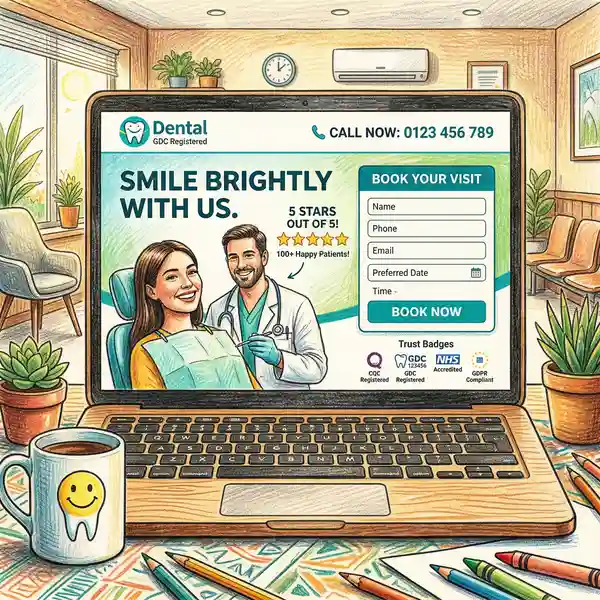
Your landing page is where clicks convert to enquiries. Small changes in layout, copy, and trust signals can increase conversion rates from 5% to 12% or higher. Focus on these six elements:
| Element | Best Practice | Impact on CR | Example |
|---|---|---|---|
| Headline Match | Headline matches ad copy exactly. Reduces bounce rate by signalling relevance. | +2–4% | Ad: "Emergency Dentist" → LP: "Emergency Dentist [Your Town]" |
| Above-Fold CTA | Call button, "Book Now", or contact form visible without scrolling. | +3–6% | "Book an Appointment" button in hero section, phone number clickable |
| Trust Signals | Patient testimonials, GDC registration, awards, years in practice. | +2–5% | GDC number, "Rated 4.8/5 from 200+ reviews", "Family-owned since 2010" |
| Before/After Photos | High-quality images for cosmetic or restorative treatments (with consent). | +1–3% | Invisalign transformation, smile makeover, implant before/after |
| Minimal Form Fields | Reduce friction: ask only Name, Phone, Email, Treatment Interest. Add more fields after conversion. | +3–7% | 4-field form vs. 12-field form (7% CR improvement observed) |
| Mobile Responsive | Fast load, single-tap phone button, readable on all devices. 50% of dental searches occur on mobile. | +4–8% | Mobile-first design, one-tap call button, font size ≥16px |
Sources: Google Landing Page Optimisation Guide, Unbounce Dental Conversion Report 2025, Whitehat SEO A/B Testing Data
Call Tracking: The Missing Metric Most Practices Ignore
Only 35% of UK dental practices track phone calls from Google Ads, yet 60–70% of conversions are phone enquiries, not form submissions. Without call tracking, you're losing visibility into your true ROI.
Implement call tracking with tools like Google's Call Tracking or third-party platforms (CallRail, Ruler Analytics) to:
- Assign call conversions to specific keywords and campaigns
- Measure call duration and outcome (booked, interested, not qualified)
- Record calls for training and quality assurance
- Calculate accurate CPA (cost per acquisition) including both form and call conversions
Once call tracking is active, you'll likely discover that high-intent keywords (e.g., "emergency dentist") generate 15%+ phone conversion rates, justifying higher bid strategies.
Google Ads vs. SEO for Dental Practices
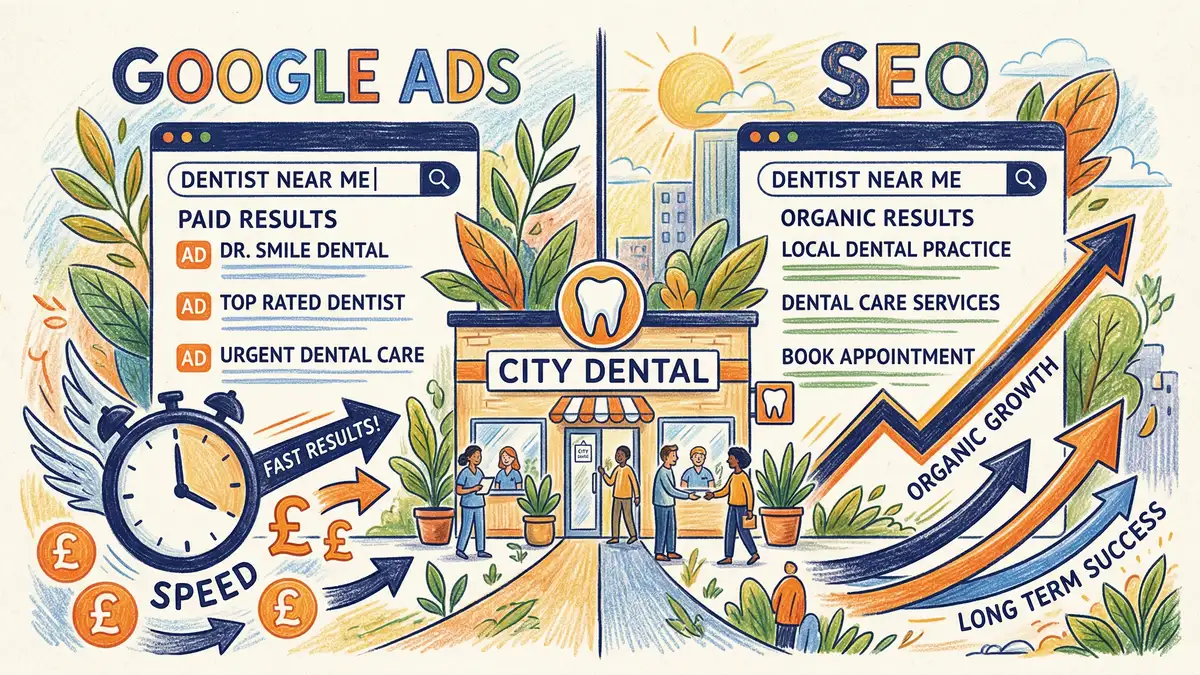
Both channels drive patient enquiries, but they operate differently. Understanding when to rely on each channel helps allocate budget effectively.
| Metric | Google Ads (PPC) | SEO (Organic) |
|---|---|---|
| Time to Results | 1–2 weeks (traffic immediate, optimization ongoing) | 3–6 months for top 10 ranking; 6–12 months for competitive terms |
| Cost Model | Pay-per-click (£0.80–£5.50/click); budget controls cost | Upfront investment (content, link building); ongoing optimization |
| Control | Full control over messaging, targeting, budget allocation | Limited control; depends on algorithm changes and competition |
| Trust Signal | Marked "Ad" label; some searchers trust organic more | High trust; no "ad" label; third-party validation |
| Best For | Urgent growth, competitive keywords, seasonal spikes, testing messaging | Long-term patient pipeline, brand authority, high-volume informational keywords |
| ROI Timeline | 3–6 months to break even if campaign well-optimized | 6–18 months to ROI; long-term compounding returns |
Sources: Google Ads Industry Benchmarks 2025, HubSpot SEO vs. PPC Study, Whitehat SEO Client Data
Ad Extensions to Boost CTR and Conversions
Ad extensions increase click-through rate (CTR) by 20–50% and provide more reasons to click. Use all five types in your dental Google Ads:
Call Extensions
Display your practice phone number directly in the ad. On mobile, make it one-tap to call. Drives high-intent phone conversions.
Location Extensions
Show your practice address and distance from searcher. Vital for local searches. Include multiple locations if applicable.
Promotion Extensions
Advertise special offers: "New patient discount", "Free consultation", "Teeth cleaning offer". Time-limited promotions drive urgency.
Sitelink Extensions
Link to specific pages: Emergency Dentistry, Invisalign, Implants, Patient Reviews. Increases CTR and guides searchers to relevant sections.
Structured Snippets
Highlight treatment types, business hours, or amenities. Examples: "Services: Implants, Invisalign, Whitening" or "Hours: Mon–Fri 9am–5pm".
GDC and ASA Compliance for Dental Ads
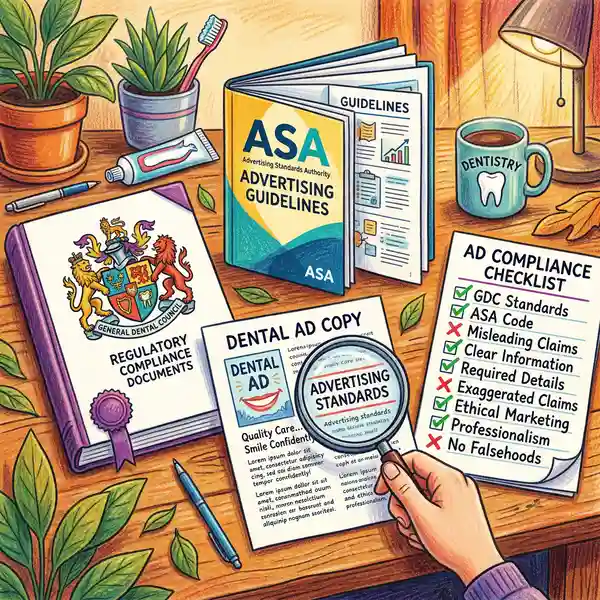
The General Dental Council (GDC) and Advertising Standards Authority (ASA) enforce strict rules on dental advertising. Breaching these can result in ad disapprovals, fines, or complaints. Follow these guidelines:
Compliance Requirements for Dental Ads
Claim substantiation: All claims (e.g., "fastest teeth whitening", "best invisalign provider") must be verifiable. Avoid superlatives without evidence. Use "one of" or "award-winning" only if genuinely true.
GDC registration: Display your GDC registration number in ads or landing page. Never imply NHS treatment if you're private-only. Do not claim to be a "cosmetic specialist" unless you hold recognised qualifications.
Patient reviews and testimonials: Only use genuine reviews. Never fake testimonials or doctor endorsements. Include date of review and disclose any incentive given (e.g., discount) if applicable.
Common Ad Disapproval Triggers
Misleading before/after photos: Before/after images must be accompanied by disclaimer about results variability. Avoid heavily edited or unrealistic transformations.
Price claims without context: Stating "Invisalign from £49/month" is acceptable; stating "Invisalign for £49" (total cost) is misleading. Always clarify payment terms, treatment duration, and any conditions.
Frequently Asked Questions About Dental Google Ads
How long does it take to see results from Google Ads for dental practices?
Traffic appears within 24–48 hours of launching ads. However, meaningful data (click patterns, conversion rates, ROAS) takes 2–4 weeks to stabilize, depending on budget and keyword volume. Most practices see ROI within 8–12 weeks of optimized campaigns.
Should we bid on our own practice name in Google Ads?
Yes. Bidding on branded keywords (your practice name) is cost-effective (usually £0.20–£0.80 CPC) and prevents competitors from bidding on your name. It also ensures your ad appears above your Google Business Profile, increasing clicks. Allocate 5–10% of budget to brand keywords.
What is a good conversion rate for dental Google Ads?
Industry benchmarks: 5–9% for general dentistry, 8–12% for high-value procedures (implants, invisalign), 10–14% for emergency dentistry. Conversion rates vary by landing page quality, ad relevance, and campaign maturity. Well-optimized campaigns achieve 10%+.
How do we measure ROI if most conversions are phone calls?
Implement Google Call Tracking or a third-party platform like CallRail to assign phone calls to keywords and campaigns. Train your team to ask callers "How did you find us?" and log responses. Combine call tracking data with form submissions to calculate true conversion rate and CPA per campaign.
What's the best ad copy structure for dental ads?
Use this structure: Headline 1 = Treatment + Location (e.g., "Emergency Dentist in Manchester"). Headline 2 = Key benefit (e.g., "Same-Day Appointments Available"). Headline 3 = Trust signal (e.g., "GDC Registered, 4.8 Stars, 15 Years"). Description = CTA + urgency (e.g., "Book Now – New patients welcome").
Internal Linking to Strengthen Your Dental SEO
While Google Ads drives immediate traffic, link this article to your broader SEO content ecosystem. Key internal links for dental practices:
- SEO for Dentists: Complete UK Guide – foundational SEO for dental practices
- Local SEO for Dentists – Google Business Profile and local rankings
- Dental SEO Service Page – service offering for interested leads
- Dental Website Design & SEO – design and technical optimization
- PPC Campaign Management Services – account management services
These links improve crawlability, distribute authority, and guide readers to relevant resources.
Struggling to manage Google Ads while running your practice? Expert PPC management takes the guesswork out of dental advertising.
Get Your Free PPC AuditReady to grow your patient base with Google Ads?
Our Google Ads specialists understand the unique challenges of dental marketing. From compliance to conversion optimization, we'll help you attract more qualified patients and maximize your advertising ROI.
Clwyd Probert
Founder & SEO Strategist, Whitehat SEO
Clwyd has helped 150+ UK dental practices achieve profitable Google Ads and SEO campaigns. His approach combines data-driven keyword research, conversion optimization, and regulatory compliance to deliver consistent patient acquisition results.
Last updated: March 2026. Pricing data sourced from Google Ads Quality Score Analysis, Wordstream Dental PPC Report, and Whitehat SEO client campaigns (2025–2026).