
AI PPC Management: How Artificial Intelligence Is Transforming Pay-Per-Click Advertising (2026)
Pay-per-click advertising has always been about precision. But manual bid management, ad copy testing, and audience targeting? Those days are rapidly becoming obsolete. Artificial intelligence is now the competitive advantage in PPC—and it's no longer optional.
UK digital ad spend reached £31.3 billion in 2025, and businesses that harness AI-driven PPC management are seeing conversion uplifts of 10-30% higher ROAS whilst reducing cost per acquisition. Whether you're managing Google Ads, Meta campaigns, or Microsoft Advertising, AI tools are automating the heavy lifting—so you can focus on strategy.
What Is AI PPC Management?
AI PPC management refers to the use of machine learning algorithms to automate and optimise every element of your pay-per-click campaigns. Rather than making manual adjustments to bids, ad copy, audiences, and budgets—which is time-consuming and prone to human error—AI systems learn from campaign data in real time and make optimisations autonomously.
Traditional PPC management relies on historical performance data and intuition. AI, by contrast, processes millions of data points simultaneously, identifying patterns across device types, geographic regions, audience segments, and time windows that human analysts would miss. The result: faster decision-making, better ROI, and less time spent on administrative tasks.
How AI Differs from Traditional Automation
Many PPC managers conflate automation with AI, but they're not the same. Basic automation (like scheduling ads or setting daily budgets) follows pre-set rules. AI, however, learns and adapts. It tests variations, evaluates outcomes, and continuously refines strategy based on what works—without human intervention.
Real-World Results: The AI Conversion Uplift
The evidence is compelling. Across industries, AI-driven PPC campaigns are delivering measurable performance gains:
Key Performance Metrics
14%
Average conversion uplift with Google AI Max for Search
2×
L'Oréal's conversion rate increase with AI optimisation
31%
Lower cost per conversion for L'Oréal
10-30%
Higher ROAS with AI-optimised campaigns
These aren't outliers. Google's AI Max for Search, which uses generative AI to optimise Performance Max campaigns, delivers an average 14% uplift in conversions at similar cost-per-action. L'Oréal's case study is even more dramatic: the luxury brand achieved a 2× higher conversion rate whilst reducing cost per conversion by 31%—proof that AI doesn't just drive volume; it drives profitable volume.
Performance Max vs. Manual Management
Performance Max campaigns, which rely entirely on AI, consistently outperform manually managed campaigns. Data shows Performance Max campaigns achieve a 5.3% conversion rate at £58 average CPA, compared to 3.9% conversion rate in manually managed search campaigns. That's a tangible difference in profitability, particularly for high-volume campaigns.
Ready to see what AI can do for your campaigns? Whitehat's AI-driven PPC specialists can audit your current strategy and identify quick wins. Get a free consultation.
Key AI Technologies Transforming PPC
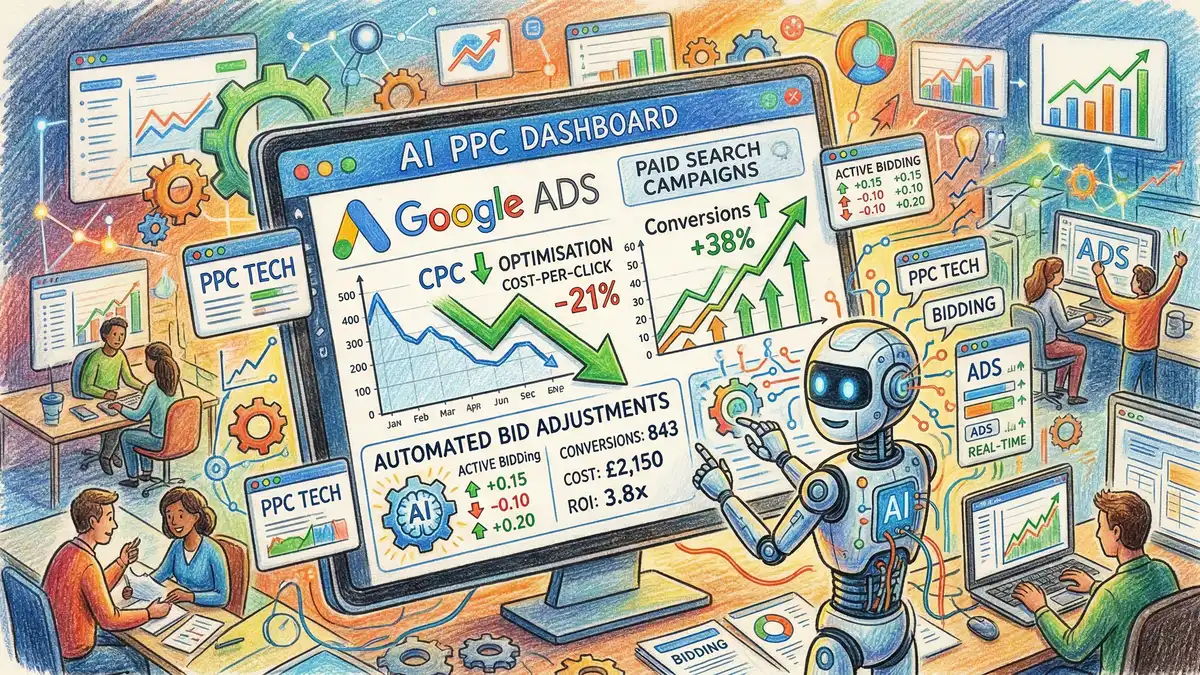
AI in PPC isn't a single tool—it's a collection of technologies working in concert. Understanding each one helps you choose the right solutions for your business.
Smart Bidding and Real-Time Optimisation
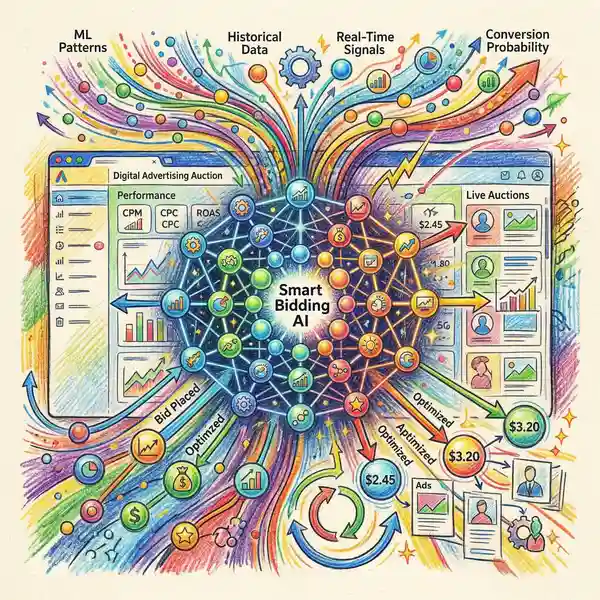
AI-powered bidding strategies (like Google's Target CPA, Target ROAS, and Maximize Conversions) adjust your bids in milliseconds based on the likelihood of conversion. Rather than setting a static bid, the algorithm evaluates thousands of signals—device, location, time of day, user intent history—and places the optimal bid for each auction. This eliminates the guesswork and manual bid adjustments that consume PPC managers' time.
Automated Ad Copy Generation and A/B Testing
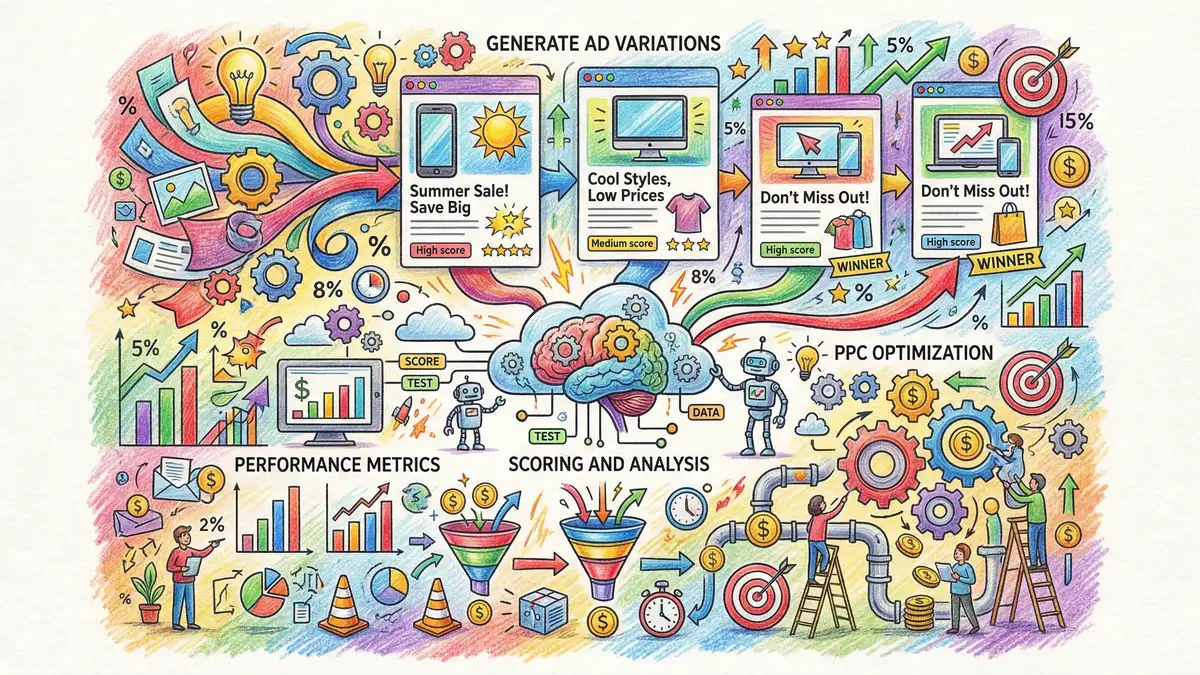
Responsive Search Ads (RSAs) use AI to test thousands of headline and description combinations automatically. Google tests 43,680 unique combinations and learns which resonate best with your audience. Meanwhile, tools like Optmyzr use machine learning to generate ad copy variations and A/B test them in your account. AI-driven ad copy testing reduces A/B test cycles by 40-60%, meaning you reach optimal performance faster.
Audience Targeting and Segmentation
AI identifies hidden audience segments and behaviours you wouldn't discover manually. Google's Similar Audiences and Meta's Lookalike Audiences use machine learning to find users with characteristics similar to your best-converting customers. Remarketing lists for search ads (RLSAs) are automatically adjusted based on predicted conversion probability, ensuring your budget goes to the most likely buyers.
Budget Allocation Across Channels
Running campaigns across Google Search, Display, Shopping, and YouTube simultaneously? AI helps. Machine learning models predict which channels will deliver the best ROI for your specific business and automatically reallocate budget in real time. Meta Advantage+ campaigns take this further, pushing toward fully autonomous campaign management across Meta's advertising ecosystem.
AI-Powered PPC Tools You Should Know About
The platform-native AI tools (Google Ads, Meta Ads Manager) are powerful, but specialist PPC software amplifies those capabilities. Here are the leading solutions:
| Tool | Key AI Features | Starting Price | Best For |
|---|---|---|---|
| Optmyzr | Smart bidding insights, AI ad copy generation, budget optimisation across accounts | Enterprise | Agencies, multi-account management |
| WordStream | AI-powered recommendations, keyword analysis, quality score optimisation | Custom | SMBs, in-house teams |
| Adzooma | Automated audit and recommendations, bid optimisation, performance insights | From £49/month | Budget-conscious teams, quick wins |
These tools sit on top of Google Ads and Meta, providing a layer of AI intelligence that identifies optimization opportunities you might miss. Most offer free trials, so testing them against your specific campaigns is risk-free.
Not sure which tool fits your workflow? The right AI tool depends on your campaign complexity, budget, and team size. Whitehat can recommend and integrate the best solution for you.
Implementing AI in Your PPC Strategy: A Practical Roadmap
Switching to AI-driven PPC doesn't happen overnight, and it shouldn't. A phased approach ensures you capture value quickly whilst maintaining control and avoiding costly mistakes.
Phase 1: Audit and Baseline (Weeks 1-2)
Before deploying AI, establish where you stand. Review your current account structure, bidding strategies, and conversion tracking. Check for data quality issues (missing conversion parameters, inconsistent UTM tags) that could confuse the AI. Tools like Adzooma provide automated audits that highlight these gaps in minutes.
Phase 2: Start with High-Volume Campaigns (Weeks 3-6)
Test AI bidding strategies on your largest, most data-rich campaigns first. If you're running Google Search, enable Target CPA or Target ROAS on a campaign with at least 50 conversions per week. AI needs data to learn; smaller campaigns will produce noisy, unreliable optimisations initially. Monitor for 2-3 weeks before expanding.
Phase 3: Expand to Ad Copy and Audience Testing (Weeks 7-12)
Once bidding is stable, enable Responsive Search Ads if you haven't already. Create 3-5 diverse headline and description combinations and let AI test them. Simultaneously, activate Similar Audiences on search campaigns and test lookalike audiences on Meta. This phase builds the multiplier effect: AI isn't just optimising bids, it's optimising messaging and targeting too.
Phase 4: Cross-Channel and Budget Optimisation (Month 4+)
Once single-channel AI is working, optimise across channels. Use conversion tracking to understand which channel (Search vs. Display vs. Shopping) delivers the best quality customers. Implement tools that automate budget reallocation or test Meta's Advantage+ campaigns for end-to-end AI management.
Compliance and Privacy: Running AI PPC in a GDPR World
AI-powered audience targeting raises important privacy questions, particularly in the UK and EU where GDPR applies. Here's what you need to know:
First-Party Data is Your Foundation
GDPR compliance starts with consent. AI targeting based on first-party data (users who've actively engaged with your brand, subscribers, purchasers) is generally lower-risk than third-party data targeting. Ensure your privacy policy clearly discloses how you use customer data for ad targeting, and obtain explicit consent where required.
Google's Privacy-Focused Solutions
Google is phasing out third-party cookies and replacing them with Privacy Sandbox technologies. AI Max for Search and Performance Max campaigns work with both old and new systems, but Google recommends prioritising first-party data and customer match audiences. Make sure your Google Analytics 4 (GA4) implementation is solid; AI relies on clean, accurate conversion data.
Transparency and Explainability
AI systems are sometimes viewed as "black boxes"—you feed in data and get optimisations without understanding why. For compliance and trust, document your AI implementation: which tools you use, how they process data, and how users can opt out. Tools like Optmyzr and Adzooma provide transparency reports showing what optimisations were made and why.
Common Mistakes When Implementing AI PPC
Enthusiasm for AI can lead to costly mistakes. Watch out for these pitfalls:
Insufficient Conversion Data
AI learns from conversions. If you enable Target CPA or Target ROAS without enough conversion volume (at least 30-50 per week), the algorithm is essentially guessing. Start with campaigns that have proven conversion history, not new campaigns or low-volume experiments.
Poor Conversion Tracking
AI is only as good as your data. If your conversion tracking is delayed, inaccurate, or inconsistent, the AI will make poor optimisation decisions. Audit your Google Tag Manager (GTM) setup, test conversion pixels, and ensure conversion values are consistent. This is unglamorous work, but it's foundation-critical.
Ignoring Performance Volatility
AI campaigns often have more volatile performance in the first 2-4 weeks as the algorithm explores and learns. Many managers panic and switch back to manual bidding. Resist this urge. Allow the AI learning period to complete (Google typically needs 2-3 weeks for stable performance), and measure success over 30-day windows, not daily.
Over-Reliance on Automation
AI automates execution, but strategy is still human. You still need to define target CPA, set budgets, choose audiences, and interpret results. "Set it and forget it" will eventually lead to wasted spend. Schedule monthly reviews to ensure campaigns stay aligned with business goals.
Frequently Asked Questions
Is AI PPC management suitable for small businesses?
Absolutely. In fact, small businesses benefit most from AI because they lack large in-house PPC teams. Tools like Adzooma (starting at £49/month) bring enterprise-grade AI optimisation within reach of SMBs. The key is having enough conversion volume to feed the algorithm—typically 20+ conversions per month as a minimum.
Will AI completely replace PPC managers?
No. AI handles execution brilliantly, but strategy, business context, and competitive positioning still require human judgment. Future PPC managers will spend less time on bid adjustments and more time on strategy: audience definition, offer optimisation, landing page testing, and interpreting insights. It's a shift in focus, not a replacement.
How long does it take to see results from AI PPC?
AI typically needs 1-2 weeks to stabilise and 3-4 weeks to demonstrate clear improvement. Some improvements (like cost per click changes) appear within days, whilst others (like conversion rate improvements) take longer. Set a 30-day baseline comparison to avoid judging performance too early.
Can I use AI across Google, Meta, and Microsoft simultaneously?
Yes, but with caveats. Each platform has native AI tools (Google Ads, Meta Ads Manager, Microsoft Advertising) that work within their ecosystems. Cross-platform tools like Optmyzr can optimise across accounts, but unified budget allocation requires careful setup. Start with single-platform AI, then expand once you're comfortable.
What data does AI PPC need to work effectively?
Clean conversion data is paramount: accurate tracking, consistent conversion definitions, and regular GTM audits. Beyond that, first-party audience data (customer lists, website visitors, engagement history) helps AI make smarter targeting decisions. Third-party data works too, but first-party is increasingly reliable in a GDPR-conscious world.
How do I measure AI PPC success?
Look beyond individual metrics. Instead of focusing on CPC or CTR, track the full funnel: conversion rate, cost per conversion, ROAS, and customer lifetime value. Compare AI-managed campaigns against a manual control group (if you have multi-campaign accounts). Use these metrics over 30-60 day windows, not weekly volatility.
Ready to Transform Your PPC with AI?
AI PPC isn't the future—it's now. The brands capturing 10-30% higher ROAS aren't waiting; they're implementing. Whether you need a full audit, tool recommendations, or hands-on campaign management, Whitehat can help.
We combine AI-powered tools with strategic expertise to deliver real ROI improvements.
Get Your AI PPC StrategyConclusion: The Competitive Edge is AI
AI PPC management is no longer a nice-to-have—it's a competitive necessity. Campaigns powered by machine learning are delivering 10-30% higher ROAS, reducing cost per acquisition, and freeing PPC managers to focus on strategy rather than admin. The technology is mature, affordable, and proven.
Start small: audit your conversion data, pilot AI bidding on your highest-volume campaigns, and expand methodically. Within 30-60 days, you'll see measurable improvements. And unlike other marketing trends, the gains from AI PPC are sustained and compounding—as the algorithm learns, performance typically improves further.
The question isn't whether to adopt AI PPC—it's whether you can afford not to. With £31.3 billion in UK digital ad spend, every percentage improvement in ROAS matters. AI delivers exactly that.
Related Reading
Sources: Google Ads case studies (2025), L'Oréal AI campaign performance analysis, Meta Advantage+ documentation, DataForSEO PPC benchmarks, UK Digital Advertising Association (2025).