
The artificial intelligence revolution in marketing has moved beyond experimental territory to operational necessity. In 2026, UK businesses face a critical inflection point: those integrating AI strategically into their marketing operations are capturing significant competitive advantages in productivity, revenue growth, and customer engagement. Those hesitating risk falling further behind.
We've seen the evidence unfold across 2025 and into 2026—organisations using AI strategically are generating 152% more revenue than non-adopters, growing twice as fast, and achieving measurable returns on their investment. This guide examines the current state of AI adoption in UK marketing, explores practical applications across every major channel, and provides evidence-based guidance for implementing AI-driven strategies that deliver measurable ROI.
What Is AI Marketing?
AI marketing encompasses the application of artificial intelligence technologies—primarily machine learning, natural language processing, and predictive analytics—to enhance marketing strategy and execution across all channels. Rather than replacing marketers, effective AI marketing amplifies human expertise, automating routine tasks and revealing insights that would be impossible to uncover through manual analysis.
The scope of AI in marketing spans three primary categories:
Generative AI creates new content—copy, images, videos, code—from prompts and training data. Tools like ChatGPT and DALL-E have made content generation accessible to marketing teams without specialist copywriting or design skills.
Predictive AI forecasts future outcomes by learning patterns from historical data. Lead scoring, churn prediction, and optimal send-time identification all rely on predictive models identifying which prospects are most likely to convert.
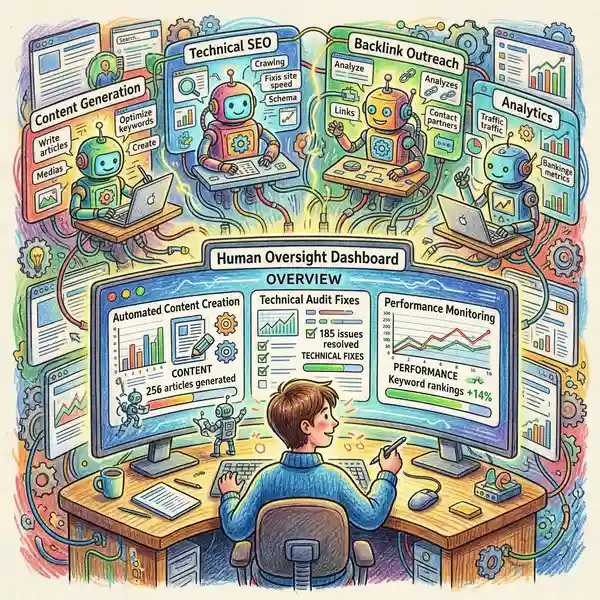
Autonomous AI (Agents) operate independently to accomplish defined objectives with minimal human intervention. An AI agent might autonomously route inbound leads to optimal campaign sequences or generate performance summaries from raw analytics data.
The State of AI in UK Marketing (2026)
Adoption of AI across UK business functions has reached a critical threshold. Currently, 39% of UK businesses are actively using AI in some capacity, with another 31% seriously considering adoption—bringing total engagement to nearly 70% of the business community. However, this aggregate figure masks important sectoral and organisational differences.
UK AI Marketing Adoption Snapshot (2026)
44%
UK businesses using AI for content creation & marketing
39%
Actively using AI across at least one business function
70%
Total business engagement with AI (active + considering)
46%
Analytics and reporting adoption (leading marketing function)
The adoption rate in marketing-specific functions—44% for content creation and marketing, 46% for analytics—demonstrates that businesses recognise AI's natural fit with data-intensive, content-heavy marketing processes. These functions represent areas where AI delivers measurable speed and scale benefits without requiring fundamental changes to business logic.
Organisational size significantly influences adoption patterns. Among UK companies, sole traders show minimal full AI adoption at 9%, with 42% having no plans for adoption. Companies with 50-99 employees, however, show 37% fully embracing AI with only 3% having no adoption plans. This size gradient reflects both capital investment requirements and organisational complexity—mid-market and enterprise organisations benefit from dedicated technology teams and established change management processes.
Key Insight: The Global AI Marketing Opportunity
The global AI marketing market reached $47.32 billion in 2025 and is projected to grow to $107.5 billion by 2028 at a compound annual growth rate of 36.6%. This explosive growth reflects genuine business value demonstration, not merely technology hype. For UK marketers, this trajectory underscores that AI adoption is becoming not optional but increasingly expected by competitors and customers alike.

How AI Is Transforming Each Marketing Channel
AI is reshaping how marketers approach each channel. Rather than replacing human expertise, these technologies amplify what marketing teams can accomplish, freeing time for strategy and creativity.
Content Creation & SEO Optimisation
Content generation represents the most visible AI application in marketing, with 44% of UK businesses actively using AI for content creation. However, the critical success factor isn't simply generating more content—it's maintaining brand voice authenticity whilst improving productivity.
The challenge is real: human-created content receives 5.44x more traffic than AI-generated content. This gap reflects consumer preference for authentic human voice and perspective. The most successful marketing organisations treat AI as an amplifier of distinctive brand voice rather than a replacement for strategic creative direction.
For SEO professionals specifically, AI tools save an average of 12.5 hours per week through automated keyword identification, content structure suggestions, market trend recognition, competitor analysis, and ranking evaluation. This time saving allows teams to redirect human effort toward content positioning and competitive differentiation.
Read our complete guide: AI Content Creation for Marketing
Email Marketing & Send-Time Optimisation
One of the most compelling email AI applications is personalised send-time optimisation, where models identify the precise moment each subscriber is most likely to engage. During beta testing, campaigns using AI-powered personalised send time achieved 35% increases in click rates, with case studies showing over 10% improvements in order rates.
Rather than applying a single "best time to send" across all recipients, the system calculates optimal sending windows for each individual. The system automatically creates control groups to measure performance lift, enabling teams to track incremental impact directly in campaign reporting.
Learn more: AI Email Marketing Strategies
Social Media Management & Performance Prediction
Social media AI tools address the challenges of constant algorithmic change and difficulty predicting content performance. Posts refined with AI text analysis demonstrate strong positive engagement impact, whilst AI timing optimisation achieves significant improvements in communication effectiveness.
Intelligent scheduling adapts based on audience behaviour patterns rather than generic "best time to post" guidance. Emerging capabilities in pre-publish performance prediction allow teams to estimate likely engagement before campaign launch—identifying underperforming concepts before they consume resources.
Explore further: AI Marketing Automation
Lead Generation & Sales Alignment
AI-powered predictive lead scoring dynamically analyses real-time data and historical trends to forecast each lead's likelihood to convert. This represents a meaningful advance over traditional static lead scoring based on demographics, capturing behavioural signals that indicate genuine interest.
Companies deploying conversational AI report up to 30% increases in lead capture rates and faster sales cycles. Intelligent prospect identification uses machine learning to process massive volumes of social signals, website interactions, and purchase history to uncover patterns identifying promising leads.
In-depth resource: AI Lead Generation Strategies
Analytics, Reporting & Market Research
Analytics adoption leads all marketing functions at 46% of UK businesses, reflecting clear value in automated insights and predictive analytics. Multi-touch attribution models distribute conversion credit across entire customer journeys rather than crediting only first-touch or last-touch interactions, helping marketers understand true contribution of each channel.
Predictive analytics tools analyse vast datasets to forecast lead quality and buying intent signals, enabling smarter prioritisation within existing lead databases. Market research is accelerated as AI systems process competitor websites, customer reviews, and industry reports to identify trends and opportunities that would require weeks of manual research.
Discover more: AI Analytics & Reporting and AI Market Research
Copywriting & Personalisation
AI copywriting tools accelerate creation of email subject lines, ad copy, landing page headlines, and product descriptions whilst maintaining brand voice. These tools understand that different audiences respond to different messaging angles—what drives conversions for first-time buyers differs significantly from messaging that resonates with repeat customers.
Read our guide: AI Copywriting for Marketing

AI Marketing Tools: What You Need
The AI marketing technology landscape divides into comprehensive platforms integrating AI into existing features and specialised point solutions focused on specific functions. Rather than recommending specific tools, we focus on categories and evaluation criteria. For detailed tool analysis, see our dedicated guide.
| Tool Category | Key Functions | Examples |
|---|---|---|
| Comprehensive Platforms | Email optimisation, lead scoring, content suggestions, analytics, personalisation | HubSpot, Salesforce Marketing Cloud, Marketo |
| Content Generation | Text generation, brand voice training, multi-format creation | Jasper, Copy.ai, Claude (Anthropic) |
| Image & Video | AI image generation, video synthesis with avatars, commercial licensing | Midjourney (from £10/month), DALL-E, InVideo (from £30/month) |
| Workflow Orchestration | Cross-platform automation, AI agents, workflow design | Zapier (8,000+ app integrations), Make |
| Analytics & Attribution | Multi-touch attribution, predictive lead scoring, journey analysis | Matomo, 6sense, Leadspace, InsideSales |
Comprehensive platform integration reduces implementation complexity—teams already operating within HubSpot or Salesforce can adopt AI features through upgraded modules. However, they may sacrifice specialised capability depth compared to purpose-built tools.
For detailed evaluation of AI marketing tools: AI Marketing Tools Guide
Building Your AI Marketing Strategy
Strategic AI adoption requires moving beyond tool selection to systematic organisational change. Organisations successfully scaling AI share common characteristics: they pursue transformational change rather than incremental efficiency gains, redesign workflows to accommodate AI capabilities, and invest significantly in workforce enablement.
Step 1: Clarify Strategy
Define which business goals AI adoption should support—efficiency, revenue growth, customer experience, or competitive positioning. Map AI applications against these priorities to ensure adoption connects to measurable outcomes.
Step 2: Assess Data Readiness
Audit data architecture to identify fragmentation, assess quality issues, and evaluate governance. Many organisations discover that data preparation is the biggest constraint—requiring investment before AI deployment.
Step 3: Evaluate Workforce Capability
Different roles require different AI capabilities. CMOs need strategic understanding; demand generation managers need lead scoring knowledge; content teams need prompt engineering skills. Design role-specific training paths rather than generic programmes.
Step 4: Establish Governance
Create frameworks defining which decisions require human approval, establishing spending limits, implementing monitoring dashboards, and maintaining authority to intervene when systems drift from business logic.
Step 5: Plan Measurement
Define primary business metrics you intend AI to improve. Track baseline metrics before implementation, then measure impact post-deployment. Include risk metrics like hallucination rates and brand consistency alongside opportunity metrics.
Step 6: Start Small, Scale Fast
Begin with a pilot project in a lower-risk area—perhaps email send-time optimisation or content outline generation. Document results, build organisational confidence, then expand to additional applications based on proven success.
The Productivity Impact: What You Can Expect
Organisations implementing strategic AI across marketing operations report measurable outcomes within 60-90 days: 30% reduction in routine task times, 15% increase in average order values, 25% acceleration in process execution. When combined with workflow redesign, organisations achieve 44% higher productivity gains and 41% revenue increases. These aren't isolated wins—they compound across dozens of marketing activities.

Challenges, Risks and How to Navigate Them
Common Implementation Failure Patterns
Organisations deploying AI as an efficiency lever rather than strategic transformation opportunity can achieve short-term cost reduction but risk losing marketing capability and brand differentiation. Instead, organisations viewing AI as a growth engine unlock more than double the marketing-driven profitability. This requires reimagining workflows, not just automating existing ones.
Hallucination and Factual Accuracy
AI models sometimes generate plausible but factually incorrect information—a phenomenon called hallucination. When models hallucinate, they do so confidently, without recognising the error. In marketing contexts, fabricated statistics in white papers damage credibility and invite regulatory scrutiny; hallucinated pricing terms create legal obligations the organisation cannot fulfil.
Mitigation approach: Treat AI-generated content like a prolific junior copywriter requiring human oversight. Critical outputs including factual claims, rates, fees, and legal qualifiers require human review and verification before deployment. For high-stakes claims, implement mandatory human verification with documented fact-checking. For lower-stakes content, sampling verification provides risk management with reasonable operational efficiency trade-off.
Data Quality and Bias
Machine learning models trained on biased data sources inherit and amplify biases present in training data. Models trained on historical customer data might learn to predict purchase likelihood while simultaneously perpetuating discrimination by demographic characteristics. This risk is particularly acute for organisations deploying AI in hiring-related targeting or other decisions with legal implications.
Responsible governance approach: Include bias assessment processes identifying potential discriminatory impacts, particularly for AI systems making decisions with legal or significant effects. Test AI systems for disparate impact across demographic groups and document findings. Implement corrective actions based on test results, providing evidence of compliance with legal standards and ethical principles.
Regulatory Compliance and AI Washing
Regulatory bodies are scrutinising organisations making AI-related claims without substantiation. The SEC penalised investment advisers $400,000 for making unsupported AI claims in marketing materials. The FTC's Operation AI Comply sweeps against deceptive AI claims, particularly "AI-powered" assertions lacking clear definition or evidence.
Compliance playbook: Build claim inventories cataloguing every performance assertion including AI-related claims, tagged with required substantiation. Create negative claim libraries listing prohibited phrases tied to compliance risk. Ensure LLM outputs gate through human-in-the-loop review for factual claims, with clear escalation paths for substantiation and approval.
Insufficient Data Preparation
A common failure pattern is rushing to AI deployment without first addressing data governance, quality, and hygiene. AI amplifies data quality—models trained on incomplete, biased, or stale inputs produce flawed outputs that erode trust. The smart implementation approach inverts this priority, investing significantly in data accuracy and standardisation before scaling AI applications.
The Future of AI in Marketing
Agentic AI and Autonomous Marketing Systems
The evolution from generative AI to agentic AI represents the next frontier. AI agents are specialised software systems that complete specific tasks autonomously with minimal human intervention. Rather than replacing entire campaigns, agents handle precisely defined work components—checking their own outputs for accuracy and connecting to external systems for real-time data.
One B2B SaaS firm implementing agentic campaign routing achieved 25% increases in lead conversion after enabling autonomous routing of inbound prospects to optimal campaign sequences based on behavioural and firmographic signals. The agent's judgment about which campaign sequence serves each prospect replaces manual lead assignment—a process that scales poorly as volume increases.
Answer Engine Optimisation (AEO) and AI Search Evolution
The search landscape is fundamentally transforming as generative AI integrated into search interfaces changes how users discover information. Answer Engine Optimisation (AEO) has become critical because one in ten US internet users now turns to generative AI first for search, with 400 million weekly ChatGPT users and AI Overviews appearing in 16% of all Google desktop searches.
The implication for marketers: Google AI Overviews fundamentally change search result pages by summarising information from various sources. Click-through rate studies show 34.5% lower clicks on position 1 results when an AI Overview is displayed. This reduction in organic search click volume requires compensatory strategies across paid search, social media, and direct brand development.
Brands addressing the AI search transition are optimising content specifically for AI citation. Technical readiness for AI crawlers, understanding "fan-out queries" where AI expands single questions into dozens of sub-searches, and snippet optimisation for AI answer extraction represent new optimisation targets.
Technology Stack Consolidation
A profound shift in marketing technology strategy is underway. Organisations consolidating martech stacks achieve 50-77% cost reductions and 2,101% ROI improvements through strategic consolidation, whilst 44% of marketing SaaS licenses remain underutilised or completely unused.
This consolidation trend reflects recognition that context-switching between tools creates hidden costs exceeding savings from specialised features. Organisations achieving 15-25% performance improvements consolidate stacks rather than fragmenting across multiple vendors—integrated execution matters more than maximum feature specialisation.
The Business Case for AI Marketing
152%
Higher revenue for AI-using organisations vs non-adopters
12.2%
Annual growth rate for AI-using organisations
93%
Report strong ROI on AI investments
£321k
Average AI solution investment (delivering measurable results)
Frequently Asked Questions
Ready to Transform Your Marketing with AI?
We help UK businesses integrate AI into their marketing operations—from strategy to implementation. Book a free consultation to explore what's possible for your organisation.
Book Your Free AI Marketing ConsultationOr explore our AI SEO services →
Explore the AI Marketing Guide Series
AI Marketing Tools
Comprehensive guide to platforms, tools, and evaluation criteria for AI marketing technology.
AI Lead Generation
Predictive scoring, conversational AI, and intelligent qualification for faster pipeline growth.
AI Content Creation
Generative AI for blogs, emails, social media, and ads—whilst maintaining authentic brand voice.
AI Market Research
Accelerate competitive analysis, trend identification, and customer insight discovery.
AI Analytics & Reporting
Multi-touch attribution, predictive insights, and automated performance summarisation.
AI Copywriting
Email subject lines, ad copy, landing page headlines, and product descriptions powered by AI.
AI Marketing Automation
Workflow orchestration, customer journeys, and intelligent campaign routing with autonomous agents.
AI Email Marketing
Send-time optimisation, subject line testing, content personalisation, and win-back automation.
Clwyd Probert
Managing Director, Whitehat SEO
Clwyd leads Whitehat's AI-native marketing practice, helping UK businesses integrate artificial intelligence into their SEO and content strategies. With over 15 years in digital marketing, he specialises in bridging the gap between emerging AI capabilities and practical business outcomes. He has overseen AI implementations delivering measurable revenue impact for organisations across e-commerce, B2B SaaS, and professional services sectors.
Research sources include: IDC Future of Compute 2025, McKinsey AI Index 2025, Gartner Marketing AI Adoption Survey, Office for Artificial Intelligence UK AI Growth Lab announcement, UK Information Commissioner's Office AI and Biometrics Strategy, DataForSEO AI Marketing Analysis, HubSpot Marketing Hub AI Features Study, and Whitehat SEO proprietary AI implementation case studies. Data accurate as of March 2026.