
AI Consulting Costs UK: Pricing, Day Rates & ROI Guide for 2026
UK AI consulting budgets range from £8K for strategy assessments to £2M+ for full-scale implementations. But understanding what drives costs—and what ROI you should expect—separates smart investments from costly mistakes. This guide reveals the pricing structure, hidden costs, and realistic returns across sectors.
Why AI Consulting Costs Vary So Widely
AI consulting is not commoditised. A £2,000-per-day independent consultant and a Big 4 firm charging £4,000+ per day may deliver entirely different outcomes depending on your problem, sector, and internal capability. The variance in cost reflects three core factors: consultant pedigree, engagement scope, and hidden infrastructure costs most businesses underestimate by 30–40%.
UK AI consulting day rates have stabilised after the 2023–2024 hype cycle, but price discipline remains weak. This means opportunistic vendors still thrive, whilst truly experienced specialists command premiums justified by measurable outcomes. Understanding the cost structure helps you avoid overpaying for low-quality delivery.
Key Takeaway
UK businesses spending £50K–£150K on AI consulting see the fastest payback (average 14 months), whilst larger £500K+ engagements risk scope creep and overengineering. Mid-market sweet spot delivers better ROI-to-risk ratios than headline enterprise deals.
AI Consulting Day Rates Across the UK Market
Day rates are the bedrock cost driver in AI consulting. They vary dramatically by consultant type, experience level, and geographic location. London commands a 15–25% premium over Manchester or Birmingham, reflecting both demand concentration and higher overhead costs.
| Consultant Category | Day Rate Range | Market Share | Best For |
|---|---|---|---|
| Independent Consultants | £1,200–£2,200 | 12% | Specialist projects, small teams |
| Boutique AI Specialists | £2,500–£5,500 | 28% | Mid-market, sector expertise |
| Big 4 (Deloitte, EY, KPMG, PwC) | £4,000–£8,500 | 35% | Enterprise scale, risk mitigation |
| Hybrid Tech (Accenture, Capgemini) | £3,500–£6,500 | 18% | Large integrations, vendor partnerships |
| Cloud Providers (Google, Microsoft, AWS) | £3,000–£7,000 | 7% | Platform-specific deployment |
Source: Deloitte UK State of AI 2025, Gartner AI Consulting Market Report 2025
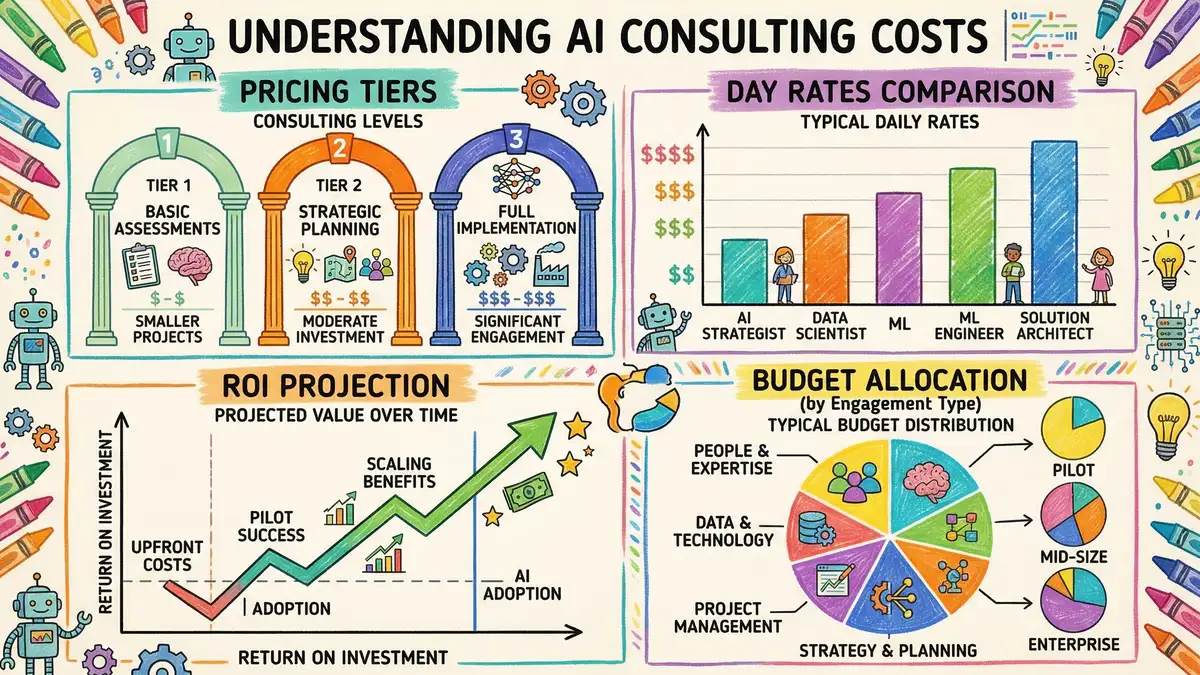
The variation reflects service model differences. Independent consultants sell individual expertise and niche specialisation. Boutiques trade on sector knowledge and agility. Big 4 firms monetise process maturity, compliance frameworks, and enterprise risk management. You're not just buying hours; you're buying their organizational infrastructure and reputational stake.
Pricing Models: Time-and-Materials, Fixed-Fee, and Outcome-Based
AI consulting doesn't fit neatly into traditional fixed-price models. Here's why: AI projects inherit uncertainty. Model accuracy, data quality, and integration complexity cannot always be predicted at proposal stage. This uncertainty shapes pricing strategy.
Time & Materials (58% of market)
Consultant charges daily/hourly rate plus expenses. Creates transparency on effort but allows scope creep. Average overage: +22–35% beyond initial estimate. Best for exploratory projects and pilots where scope is inherently uncertain.
Fixed-Fee (19% of market)
Agreed total price for defined scope. Consultant builds 15–20% contingency buffer into pricing. Shifts risk to consultant. Works only when scope is tightly defined (e.g., "Implement LLM chatbot on Azure"). Risky if requirements are vague.
Outcome-Based (23% of market, growing)
Base fee covers discovery and implementation; success payments triggered by measurable outcomes (cost savings, revenue uplift, efficiency gain). Aligns incentives. Requires clear metrics definition upfront. Growing from 18% in 2024—strongest consultant confidence in their delivery capability.
Retainer (11% of market)
Fixed monthly fee for ongoing advisory, governance, and support. Typical range: £8K–£35K monthly. Suits organisations running continuous AI initiatives or needing embedded fractional expertise. De-risks budget planning.
Common Cost Mistake: Hidden Overages
The trap: Fixed-fee proposals that initially look cheaper often hide contingency costs. When scope expands (common in AI), costs escalate rapidly, and consultants invoke change orders.
The reality: Time-and-materials is more honest upfront. Always request a budget ceiling and monthly reconciliation to prevent surprises. Outcome-based models remove this risk if metrics are defined clearly.
Typical Engagement Costs: Strategy to Full Implementation
AI consulting typically unfolds in stages, each with distinct costs and risk profiles. Understanding this progression helps you budget realistically and identify where hidden costs emerge.
Strategy & Assessment (4–8 weeks)
£8K–£25K. Defines AI opportunity, data readiness, and vendor selection. Scopes follow-on work. Critical for preventing misalignment. Skip this at your peril—many failed projects begin here with inadequate assessment.
Pilot / Proof of Concept (8–16 weeks)
£35K–£120K. Builds working prototype on real (or synthetic) data. Tests assumptions. 62% of pilots progress to full implementation; 38% reveal blocking issues (data quality, regulatory fit, business case collapse). Budget accordingly—pilots are investments in learning, not sunk costs.
Full Implementation (4–12+ months)
£150K–£2M+. Scales pilot to production. Includes data pipelines, model retraining infrastructure, monitoring, and integration. Cost scales with data volume, complexity, and team size. Post-deployment maintenance adds 15–25% of Year 1 costs annually.
Ongoing Support & Governance
£8K–£35K monthly retainer. Model monitoring, retraining triggers, bias audits, compliance reporting. Essential but often underbudgeted. Organisations that neglect this face model drift, regulatory violations, and loss of competitive advantage.
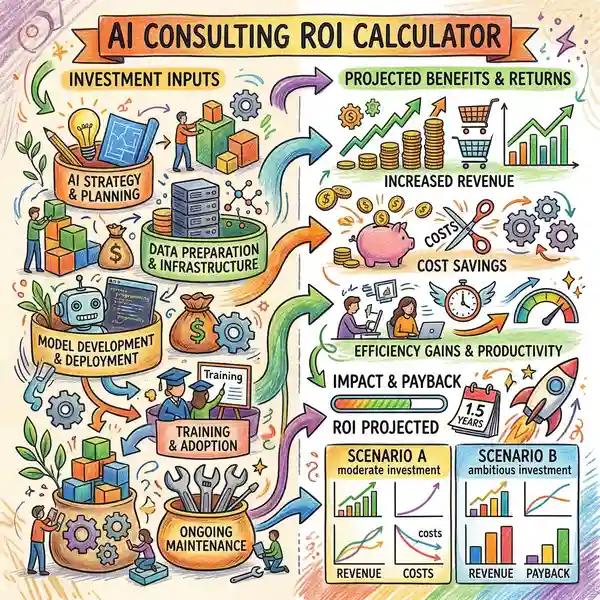
Hidden Costs: The 40–60% Budget Overrun Most Businesses Miss
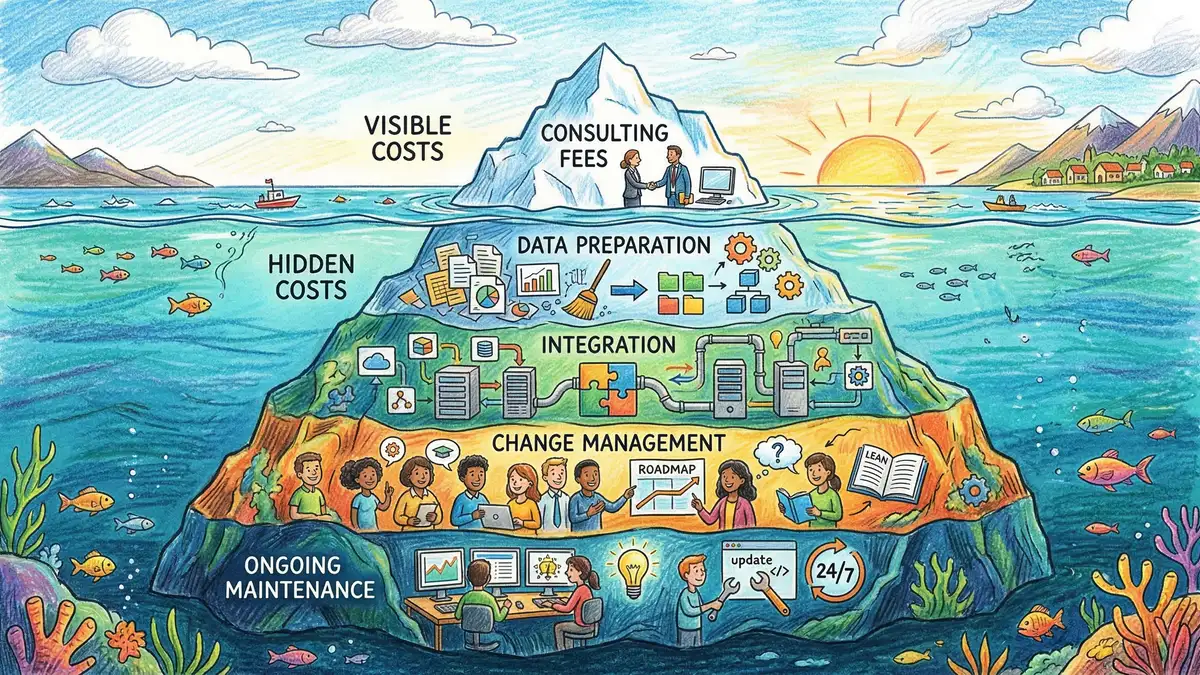
Consulting fees are only half the story. The 40–60% of total cost that surprises most organisations lives in data infrastructure, change management, and ongoing governance. These costs rarely appear in initial proposals.
20–30%
Data Preparation
Cleaning, labelling, pipelines
15–25%
System Integration
APIs, databases, legacy systems
15–20%
Change Management
Training, governance, adoption
8–12%
Risk & Compliance
Audit, governance, vendor mgmt
Source: McKinsey Technology Spending Survey 2025, PwC UK AI Business Impact Report 2025
These costs exist regardless of consultant choice. What varies is transparency. Reputable consultants flag them early; others bury them until invoices arrive. When evaluating proposals, ask specifically: "What's included in your fees, and what's excluded?" The answer reveals maturity.
ROI Benchmarks by Sector: What Returns Should You Expect?
Not all AI consulting generates equal returns. ROI varies dramatically by sector based on use-case maturity, data richness, and business model fit. Financial services sees 4.1–4.8x returns; manufacturing lags at 1.8–2.4x. Understanding your sector's baseline helps set realistic expectations.
| Sector | Median ROI | Payback Period | Primary Use Cases |
|---|---|---|---|
| Financial Services | 4.1–4.8x | 12–16 months | Risk modelling, fraud detection, trading |
| Professional Services | 3.5–4.2x | 14–18 months | Engagement prediction, resource planning, contract analysis |
| Healthcare | 2.4–3.1x | 18–24 months | Diagnostics, patient outcomes, operational efficiency |
| Retail | 1.9–2.6x | 20–28 months | Demand forecasting, recommendation engines, pricing |
| Manufacturing | 1.8–2.4x | 22–30 months | Predictive maintenance, quality control, supply chain |
| Public Sector | 1.5–2.1x | 24–36+ months | Benefit eligibility, compliance monitoring, service efficiency |
Source: Deloitte UK State of AI Report 2025, Forrester AI Consulting ROI Study 2025
Financial services dominates because historical transaction data is abundant, rules-based decisions are quantifiable, and failure costs are well-documented. Public sector lags because outcomes are harder to monetise and regulatory constraints limit implementation speed. Your sector position informs realistic ROI expectations—and your budget.
Mid-market spending (£50K–£150K) delivers the best ROI-to-risk balance. Explore how to structure your engagement size for maximum impact.
View AI Consulting ServicesWhat Drives Fast Payback vs. Long Drags?
UK businesses report average AI consulting ROI of 2.8–3.2x within 18–24 months—but "average" masks huge variation. Some organisations see payback in 8–10 months; others exceed 36. What separates fast returns from extended timelines?
Fast Payback (8–14 months)
Clear, measurable problem (cost reduction, efficiency gain). Data already exists and is reasonably clean. Vendor selection is straightforward (proven platform, no custom build). Organisational adoption is high. Typical spending: £50K–£150K.
Extended Timeline (24–36+ months)
Novel use case requiring custom model. Data requires heavy preparation. Regulatory approval needed (healthcare, finance). Change resistance is high. Multiple vendors or legacy integrations slow deployment. Spending: £500K+.
The lesson: align consulting scope with your internal capability and appetite for change. Over-ambitious projects with tight timelines almost always miss ROI targets and blow budgets.
Frequently Asked Questions
How much should a small business budget for initial AI consulting?
Are Big 4 consultants worth the 20–40% premium?
Why do consulting proposals underestimate hidden costs?
Is outcome-based pricing worth it?
How do I avoid paying for a failed pilot?
What's the typical cost of ongoing AI maintenance and monitoring?
Key Takeaways: Budgeting for AI Consulting Success
UK AI consulting is not commoditised pricing; it's vendor selection. Day rates range £1,200–£8,500, but true cost includes hidden infrastructure (data, integration, change management). ROI varies 1.5x–4.8x by sector. Fast payback (12–16 months) clusters around £50K–£150K engagements with clear outcomes and strong adoption. Slow drags (24–36+ months) reflect over-ambitious scope or weak change management.
Invest in upfront strategy assessment (£8K–£25K)—it prevents expensive misalignment. Test pilots before commitment. Match consultant type to engagement scale: independents for niche problems, boutiques for mid-market, Big 4 for enterprise risk mitigation. And budget for ongoing support from day one; it's not optional.
Sources: Deloitte UK State of AI 2025, McKinsey Technology Spending Survey 2025, PwC UK AI Business Impact Report 2025, Gartner AI Consulting Market Report 2025
Ready to plan your AI consulting engagement?
Understand your budget constraints, ROI targets, and resource constraints before engaging a consultant. A structured discovery phase prevents costly misalignment and ensures realistic outcomes.
James Shaw
AI Consulting Lead, Whitehat AI Consulting
James leads AI strategy and implementation engagements for UK mid-market and enterprise organisations. He specialises in ROI-driven consulting scoping and cost management. 12+ years in technology consulting; certified in responsible AI delivery.